How Many Hashtags Should You Use on Instagram?

- How Many Hashtags Can I Use on Instagram?
- How Many Hashtags Should You Use on Instagram?
- Do More Hashtags Equal More Reach?
- When it Comes to Engagement, the Ideal Number of Hashtags on Instagram Is Between 4 and 5
- The Optimal Hashtag Mix for Maximum Performance
- The Value of a Hashtag Generator
- Conclusion: How Many Hashtags You Should Use on Instagram
Hashtags are a central tool for building organic reach on Instagram. With the right hashtags, you can reach new audiences, make your content easier to discover, and strengthen your brand presence. No wonder many users wonder how many hashtags to use on Instagram. The question sounds simple, but numerous studies provide contradictory answers.
In this article, we bring clarity. We analyzed 1.6 million posts to determine the optimal number of hashtags on Instagram. We will show you how hashtags affect interactions and reach – and how to strategically choose the best hashtags for your content.
How Many Hashtags Can I Use on Instagram?
Let’s start with a basic but crucial question. Is there a maximum number of hashtags on Instagram? The answer might surprise some: yes, there is. As of 2026, you can use a maximum of 5 hashtags per Instagram post.
But just knowing how many hashtags are allowed on Instagram doesn’t answer the more important question: How many should you actually use?
How Many Hashtags Should You Use on Instagram?
Recommendations on how many hashtags to use on Instagram have changed significantly in recent years. While using as many hashtags as possible was once considered best practice, many social media managers now rely on much smaller sets of 3–5 hashtags per post. This can be explained by several factors:
- Adam Mosseri, CEO of Instagram, has repeatedly emphasized publicly in the past that hashtags no longer have any impact on the reach of posts. Additionally, Instagram eliminated the option to follow hashtags at the end of 2024, further signaling the decline in their importance as a discovery mechanism.
- At the same time, the way the platform’s algorithm works has evolved significantly. Instagram now evaluates content primarily based on its actual context—that is, using caption keywords, visual cues, on-screen text, and user interactions. Long lists of hashtags no longer provide any additional value.
- This shift can also be seen in specific platform changes. As of early 2026, Instagram has decreased the maximum number of hashtags per post from 30 all the way down to just 5. Again, this shows that quality and relevance are prioritized over sheer volume.
Instead of relying on data, many social media managers blindly follow vague recommendations or simply go with their gut. Ultimately, however, what matters most to brands, creators, and social media managers are measurable results. To deliver a data-based answer to the question of how many hashtags you should really use on Instagram, we have analyzed 1.6 million posts.
How Many Hashtags Do Instagram Users Actually Use?
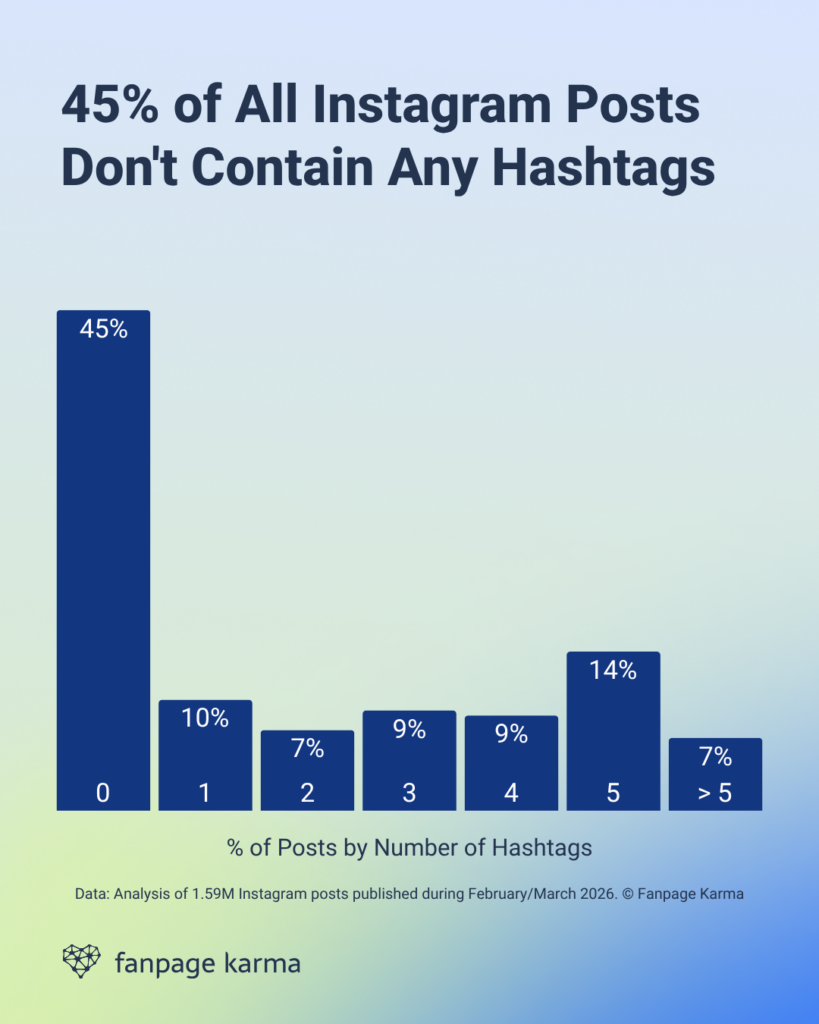
At the beginning of our analysis, we looked at the average number of hashtags used per Instagram post. The result: Nearly half of the posts analyzed contain no hashtags at all.
The chart on the right clearly shows how most Instagram users employ hashtags in 2026:
- 45% of all posts do not use any hashtags.
- 14% use the maximum number of 5 hashtags per post.
- 7% exceed the aforementioned limit and continue to use more than 5 hashtags.
These figures clearly show that the majority of brands and content creators are not currently tapping into the potential of hashtags.
In 2026, using the allowed maximum number of hashtags on Instagram is clearly a minority strategy.
While this distribution paints a realistic picture of current hashtag usage, it doesn’t yet reveal how successful these strategies really are.
Do More Hashtags Equal More Reach?
To evaluate the effectiveness of using hashtags, we examined how many people the average post reaches relative to the follower count. When it comes to achieving the highest reach, our analysis clearly shows that the best number of hashtags for Instagram posts lies between 4 and 5 hashtags.
Key insights:
- Posts with 5 hashtags achieve the greatest reach (+2% compared to posts without any hashtags), closely followed by posts with 4 hashtags.
- Posts with 1–3 hashtags perform slightly worse than posts without hashtags.
- Those using more than 5 hashtags tend to lose reach (-3%).
Posts that don’t use hashtags slightly outperform posts with 1–3 hashtags, suggesting that a small, poorly thought-out set of hashtags does not help the algorithm identify the intent of the post and may even result in lower reach than not using any hashtags at all.
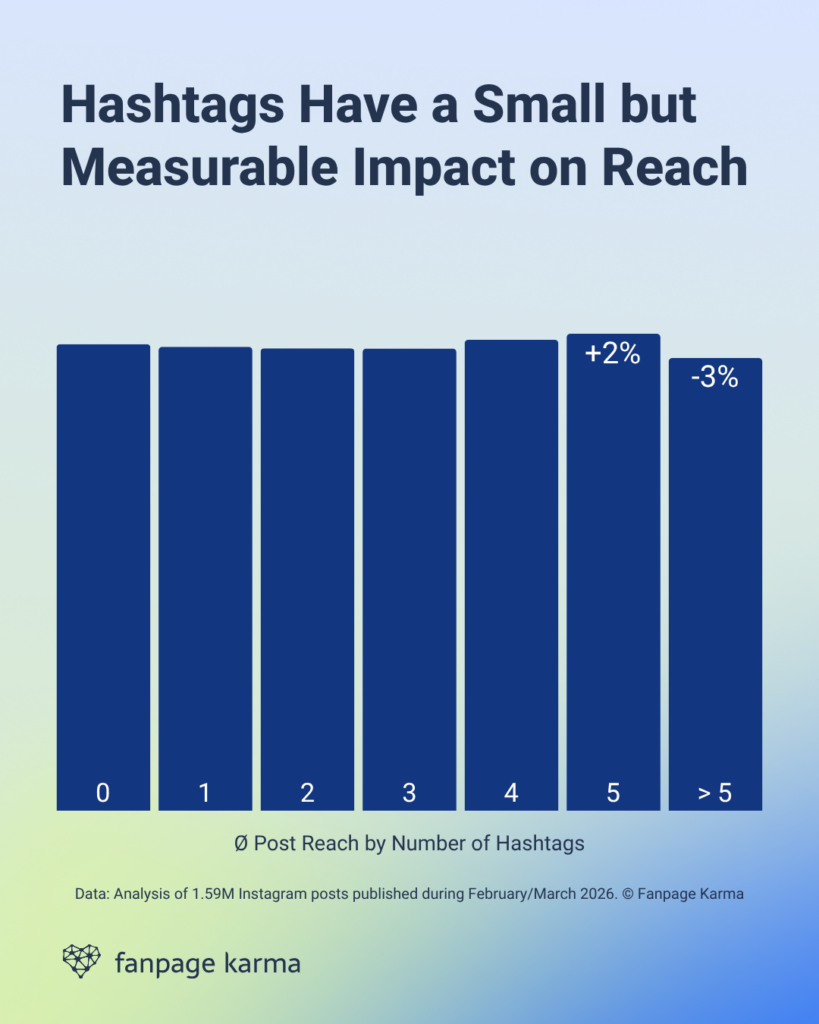
At the same time, however, the analysis also shows the optimal number of hashtags for Instagram. The sweet spot is not using no hashtags at all, but rather the targeted use of 4–5 hashtags. In this range, a modest yet measurable positive effect on reach can be observed. Conversely, the following also applies: more is not automatically better. Those who exceed the recommended maximum number of hashtags on Instagram and use more than 5 hashtags actually have to expect a decline in reach.
When it Comes to Engagement, the Ideal Number of Hashtags on Instagram Is Between 4 and 5
So even in 2026, using the maximum number of hashtags still correlates with reaching a larger audience. However for most users, visibility is not the only relevant metric. That’s why we examined in a third chart how the number of hashtags affects the average post engagement (likes & comments per follower).
Key findings:
- Posts without any hashtags receive just as much engagement as posts with one hashtag.
- Posts with 4–5 hashtags achieve the highest level of interaction (+1% and +3%, respectively, compared to 0–1 hashtags).
- Both 2–3 hashtags and more than 5 lead to a lower average engagement rate.
Engagement follows a similar pattern to reach. Posts without any hashtags perform better than posts with few hashtags (2–3). This suggests that a small, vague selection of hashtags does not provide the algorithm with a clear signal and thus actually performs worse than omitting them entirely.
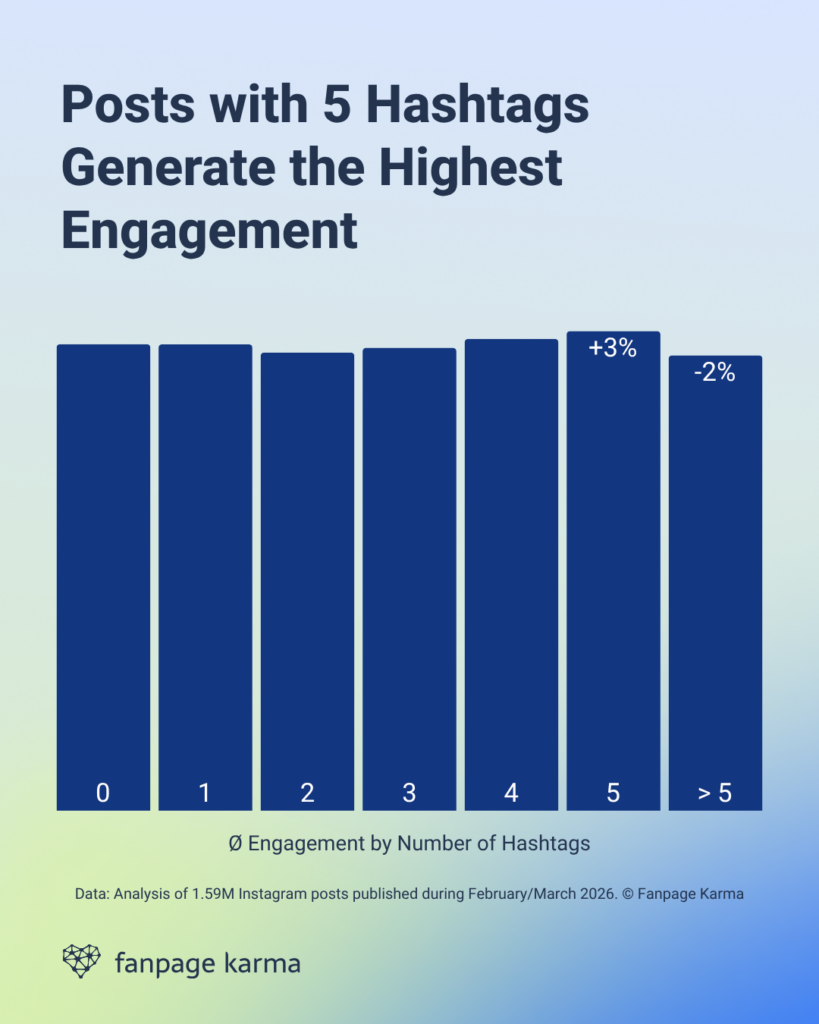
At the same time, it becomes clear that the best number of hashtags for Instagram with the greatest leverage for engagement lies in the targeted use of 4–5 hashtags. In this range, posts achieve the highest interaction rates per follower. Conversely, using both too few and too many hashtags has a negative effect. While 2–3 hashtags often do not allow posts to be clearly categorized thematically, exceeding the recommended limit of 5 hashtags seems to dilute the signal rather than strengthen it.
Nevertheless, there is a clear tendency when it comes to the best number of hashtags for Instagram. Those who use the maximum amount of allowed hashtags in a targeted and professional manner tend to have better chances of generating engagement. A well-thought-out hashtag strategy remains a key success factor for brands and social media managers.
The Optimal Hashtag Mix for Maximum Performance
Now that it’s clear that 4–5 hashtags deliver the best results, the crucial follow-up question arises. Which hashtags should you choose if you only have a few slots available? Our analysis indicates that it’s not just the number of hashtags that determines a post’s performance, but the composition of hashtag sets. More specifically, the combination of hashtags with varying reach and specificity.
A common mistake is to use five very similar or equally large hashtags. Such sets provide hardly any additional signals to the algorithm and the content does not become any easier to categorize. A balanced hashtag mix is significantly more effective:
- 2–3 large, high-reach hashtags
- 1–2 medium-sized hashtags
- 1 niche, highly specific hashtag
Large hashtags can provide additional visibility but are too vague when used on their own. Only the combination with more specific hashtags provides a precise signal for the algorithm, increasing the chance of reaching exactly the right target audience.
The data also confirms this pattern: combinations of medium and large hashtags perform best, while one-sided sets—such as those consisting predominantly of small or highly overlapping tags—perform significantly worse.
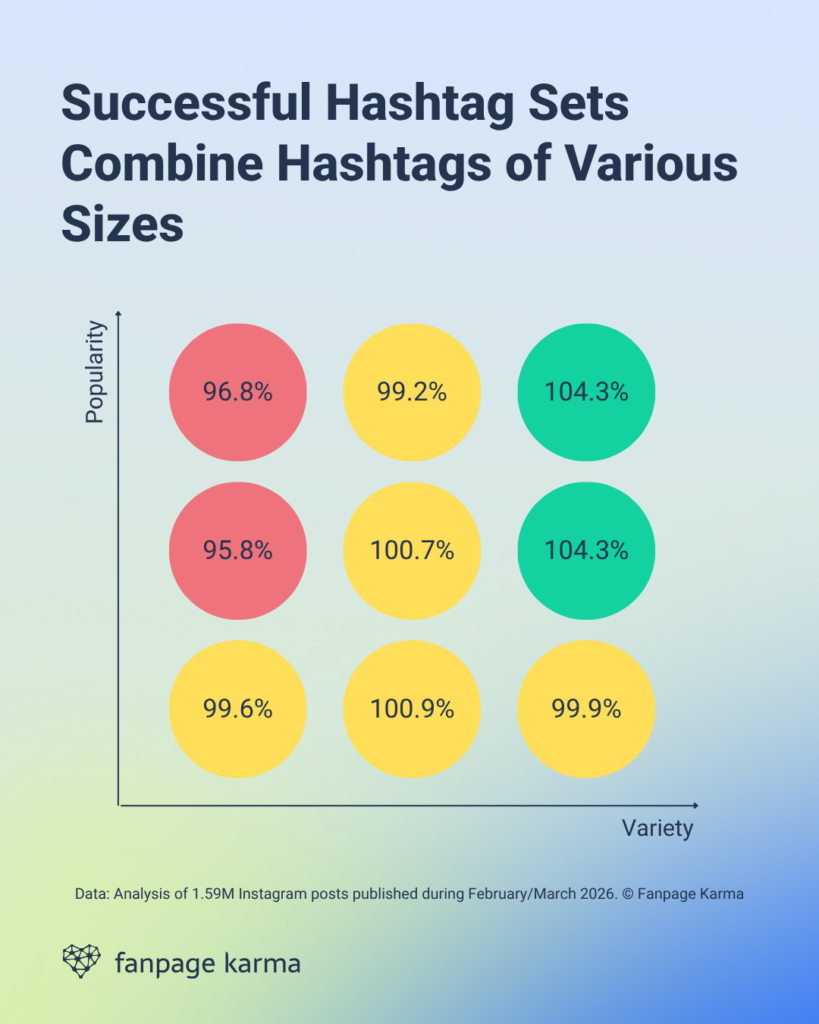
From this, we can derive a simple rule. It is not similarity but complementarity that drives performance. Effective hashtag sets enhance the categorization of your content rather than reiterating it.
Example of a strong hashtag set (Social Media Marketing):
- #onlinemarketing (large)
- #socialmedia (large)
- #contentstrategy (medium)
- #instagramtips (medium)
- #contentworkflow (niche)
Keep in mind that the influence of hashtags is measurable but limited. Content quality, format, topic, and target audience continue to be the most important leverage points. Hashtags are not a substitute for good content, but they remain a relevant optimization tool for unlocking the full potential of your posts.
The Value of a Hashtag Generator
Our analysis indicates that using the best number of hashtags for Instagram will continue to have a measurable impact on reach and engagement in 2026, though not in the sense that “more is better,” but rather through targeted and strategic selection.
But how do you know which hashtags are valuable additions to your caption? Irrelevant hashtags won’t connect you to your target audience. This is where Fanpage Karma’s Hashtag Composer comes in. Powered by AI, it provides you with carefully selected hashtags that are thematically relevant to your content while also displaying their potential reach. Even better yet, the tool is completely free and easy to use.
Keep in mind that there are also useful methods you can use to research the best hashtags to use in your industry. This can also give you great insights not only into the highest performing hashtags for specific topics, but also what hashtags other profiles are using successfully.
Conclusion: How Many Hashtags You Should Use on Instagram
Above all, our data-driven analysis clearly shows that hashtags will continue to be relevant on Instagram in 2026. However, their impact is not determined by quantity but rather by curating strategic hashtag sets. According to the study, posts with 4–5 carefully selected hashtags yield the best results. On average, these posts perform best in terms of both reach and engagement.
This finding challenges the widespread belief that hashtags no longer have a real impact on Instagram. The data clearly shows: When used correctly, hashtags remain a powerful tool for increasing both your reach and your engagement. Of course, quantity isn’t everything – what matters most is that hashtags are relevant, targeted, and thematically appropriate. Using the right hashtag composer can help you find meaningful hashtags with a high potential reach.
What this means for you:
- Don’t blindly max out the hashtag limit, but consciously experiment with carefully curated hashtag sets.
- Focus on 2–3 popular, 1–2 medium-sized, and 1 specific niche hashtag to best describe your content.
- Regularly track and evaluate your performance data.
While hashtags alone won’t make up for low-quality posts, they can still contribute to better performance when used in conjunction with high-quality content, strong brand positioning, and sound analytics. For social media managers, this translates to one straightforward recommendation. Rethink and professionalize your hashtag strategies. Rather than using only a few or no hashtags at all, consider using hashtags strategically and select a mix of popular, trending, and niche hashtags. For the most accurate results, you should always validate these findings in your own A/B tests, tailored to your target audience, industry, and content strategy.
To determine which content is producing results, consider using a social media tool with powerful analytical insights, designed to monitor your progress and boost your performance. Fanpage Karma offers a free 14-day trial of its all-in-one social media tool that offers benchmarking, research, publishing, and community management features.
Fanpage Karma also offers a free weekly webinar that can help you see how a social media tool can improve the performance of your profiles.