Reel, carousel, or image post: Which format delivers the most reach at each account size?

- How to compare format performance
- Reels set the pace for reach
- Image posts lose ground as accounts grow, while carousels remain more stable
- Where the reach actually comes from
- The picture changes for interactions
- What the results mean for each account size
- From data point to a better content plan
- What the ranking does not tell you
- Conclusion: Reels win on reach, but not on every goal
Reel, carousel, or image post? In a content calendar, it can feel like a quick format choice. Yet it can make a significant difference to performance. A format that generates reach for a small Instagram account may play a very different role for an account with millions of followers. And high reach does not necessarily mean that people will interact with the post.
This analysis compares Reels, carousels, and image posts by account size and target metric. It examines how total reach, follower and non-follower reach, and interactions change as accounts grow. The results show why a one-size-fits-all format recommendation falls short in content planning and which data social media teams actually need when choosing formats.
How to compare format performance
Absolute reach naturally favors larger accounts. That is why our analysis focuses on median reach per follower and post. This metric relates the reach generated by Reels, carousels, and image posts to account size. It allows accounts of very different sizes to be compared even when their absolute reach figures are far apart. A value of 4.9% is not an absolute number of people. It represents the share of followers reached on average per post. The analysis covers seven account size bands, from fewer than 10,000 followers to more than 1 million. We analyzed more than 3 million Reels, carousels, and image posts published on Instagram between January and April 2026.
Reels set the pace for reach
Even for small accounts, Reels lead by a clear margin
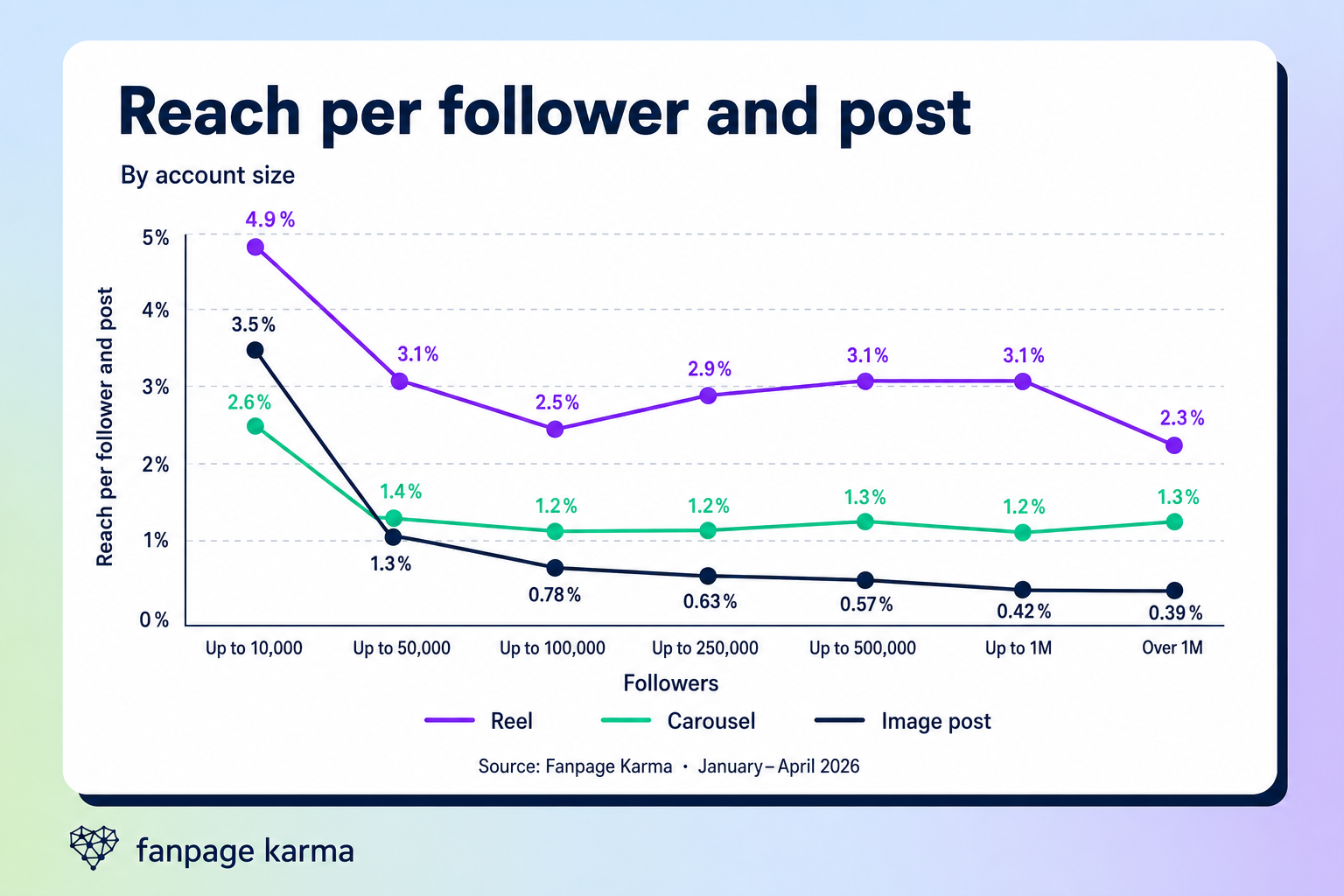
For accounts with fewer than 10,000 followers, Reels achieve a median reach of 4.9% per follower and post. Image posts follow at 3.5%, with carousels at 2.6%. Reels therefore lead the other two feed formats even in the smallest segment. However, the gap between Reels and image posts is narrower here than in many larger account size bands. That matters for small accounts because image posts tell a different story when interactions enter the picture.
The advantage holds for large accounts, too
Across the size bands from fewer than 50,000 followers to 1 million followers, Reel reach stays between 2.5% and 3.1%. Despite the vast differences in follower counts, that figure remains relatively stable. Only once accounts exceed 1 million followers does median reach per Reel drop to 2.3%. Even then, the ranking does not change: carousels reach 1.3% of followers, while image posts reach just 0.39%. A lower figure does not automatically mean that a format loses its leading position.
Image posts lose ground as accounts grow, while carousels remain more stable
The decline is much steeper for image posts. Their reach per follower and post falls from 3.5% to 0.39% across the account size bands. The larger the account, the more pressure image posts face in terms of normalized reach. Reels hold their ground far better through most of the comparison, although their reach also declines for accounts with more than 1 million followers.
Once accounts have more than 10,000 followers, carousels show a more stable pattern, ranging between 1.2% and 1.4%. Except among accounts with fewer than 10,000 followers, they generate more reach per follower and post than image posts. The next question is whether these formats mainly reach existing followers or people outside the account’s current community.
Where the reach actually comes from
Reels open the door to new audiences
Reels lead for non-follower reach regardless of account size. The advantage is especially clear among small accounts with fewer than 10,000 followers. There, Reels reach nearly three times as many non-followers as carousels.
The trend continues across every size band. Even for accounts with more than 1 million followers, Reels still reach roughly twice as many non-followers as carousels.
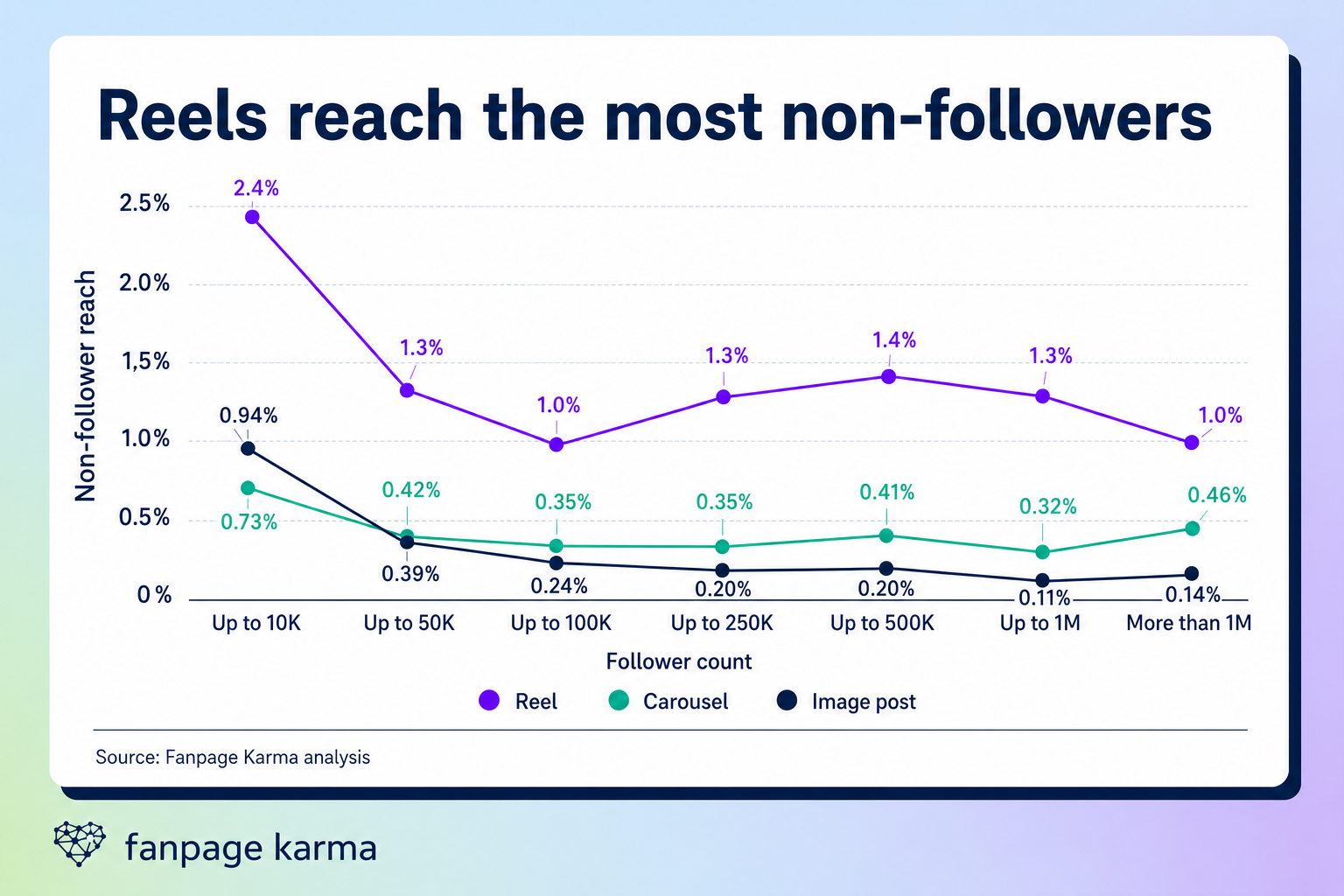
This makes Reels the strongest format for building visibility beyond an existing community at any account size. That does not mean every individual Reel will automatically reach new people.
Reels also tend to reach more of the existing community
In this analysis, Reels are not just a discovery format for non-followers. Among small accounts with up to 10,000 followers, image posts hold a narrow lead for reach within the existing community. They reach 2.1% of existing followers, compared with 2.0% for Reels. In every other size band, Reels achieve the highest reach per follower and post among the formats compared. In almost every segment, they combine visibility beyond the follower base with strong reach inside the existing community.
The picture changes for interactions
Small accounts should not write off image posts
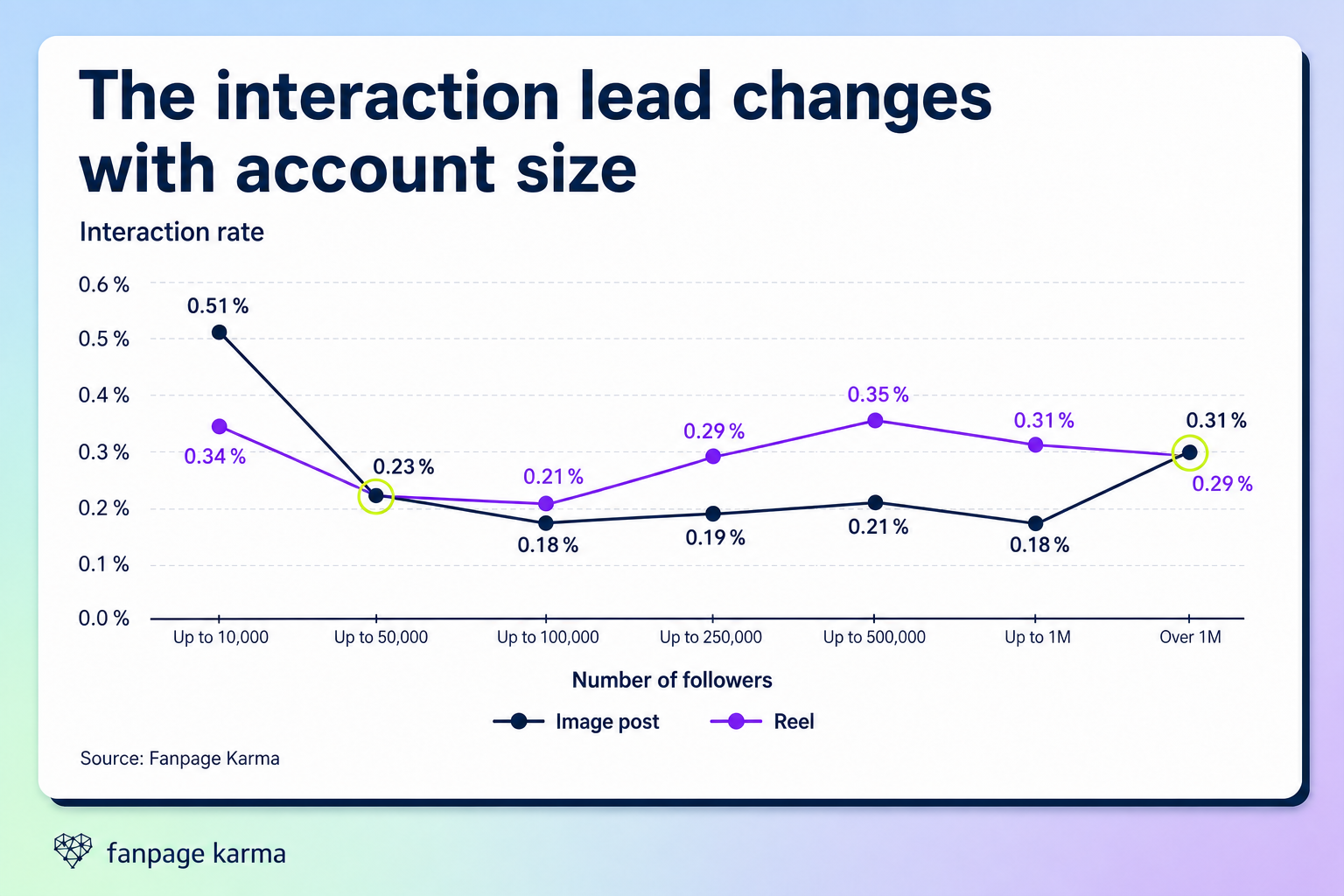
The format with the highest reach does not automatically generate the most interactions. Among accounts with fewer than 10,000 followers, image posts deliver an interaction rate of 0.51%. Reels come in at 0.34%. In the size band up to 50,000 followers, the two formats tie at 0.23%. An account that relies exclusively on Reels could therefore scale back a format that still generates valuable responses from its community.
The winner changes with account size
From the size band up to 100,000 followers through the band up to 1 million, Reels generate more interactions per follower than image posts. For very large accounts with more than 1 million followers, the result flips again, although only slightly. Image posts achieve an interaction rate of 0.31%, compared with 0.29% for Reels. This small gap does not prove that image posts are generally superior for large accounts. Instead, it shows why account size and the target metric need to be considered together.
What the results mean for each account size
When planning a content calendar, knowing which format leads overall is not enough. What matters is the job each post needs to do and the size band the account falls into. The findings point to four practical guidelines:
- Up to 10,000 followers: Use Reels for reach and visibility among new audiences, but do not scale back image posts too quickly. They lead on interactions and hold a narrow advantage for follower reach.
- Up to 50,000 followers: Reels continue to lead on reach, while image posts tie with them on interactions. This is also the first size band in which carousels overtake image posts for normalized reach.
- From the band up to 100,000 followers through the band up to 1 million: Reels combine their reach advantage with more interactions than image posts. Carousels remain an additional option for generating reach.
- More than 1 million followers: Reels are the strongest choice for overall and non-follower reach. Image posts hold a narrow lead on interactions, while carousels clearly outperform image posts on reach.

From data point to a better content plan
The results do not support a fixed quota for each format. A decision framework that connects the goal, account size, and first-party performance data is more useful. These five steps bring structure to the planning process:
- Define the goal: Decide whether the post should generate reach, visibility among non-followers, or interactions.
- Identify the account size: Use results from the relevant size band instead of comparing small and large accounts directly.
- Choose the format: Prioritize Reels for reach, consider image posts for interactions depending on the segment, and use carousels as an additional reach format.
- Review your own performance: Evaluate formats over the same period using the same metric.
- Adjust the format mix: Revisit the strategy regularly without turning one strong or weak post into a general rule.
A social media analytics tool such as Fanpage Karma can bring this analysis together by account, period, format, and metric. It is still essential to evaluate separately total reach, follower and non-follower reach, and interaction rate. One format may build visibility among new audiences, while another generates stronger responses from the existing community. Both roles belong in the content plan as long as they support the communication goal.
What the ranking does not tell you
The data describes patterns across grouped accounts. It does not prove that format alone caused the observed performance. A top result for Reels also does not mean that every Reel will outperform every image post or carousel. The analysis therefore provides guidance by account size, but it cannot replace a review of your own account’s results.
Conclusion: Reels win on reach, but not on every goal
Reels achieve the highest reach per follower and post in every account size band. Image posts lose significant normalized reach as accounts grow, while carousels remain more stable from the second size band onward. For interactions, however, the lead depends on the segment. Reels can serve as the foundation of a reach strategy, but they should not be the only format in the content plan. Before planning, define the goal, place the account in the relevant size band, and review performance by format. That way, the decision is driven not by a generic recommendation, but by the metric that matters for your account.
Only your own account data can show which formats truly generate reach and interactions. With a social media analytics tool such as Fanpage Karma, you can evaluate Reels, carousels, and image posts by period and metric, then review your format mix with greater precision. Try Fanpage Karma free for 14 days and discover which content works best for your goals.