Relic or Must-Have: Do Hashtags Still Work on Instagram?

Hashtags have been a staple on Instagram for a long time. If you wanted reach, you most certainly used them. But things have changed a lot in recent years. Algorithms are more influential than ever in determining your feed, search behavior is increasingly keyword-driven, and some official statements question the usefulness of hashtags. So the question is, do hashtags still work on Instagram in 2026? A closer look reveals that the truth lies somewhere in between declining technical relevance and continuing strategic importance.
The End of an Era: Are Hashtags Still a Thing on Instagram?
Since the middle of last year, Instagram CEO Adam Mosseri has repeatedly emphasized that hashtags no longer have a direct impact on the reach of posts. In addition, the ability to follow hashtags was removed in December 2024. Most recently, Instagram also reduced the number of allowed hashtags per post from 30 to 5. This clearly signals that hashtags no longer play a central role in content distribution on Instagram.
At the same time, the logic of the feed has also changed fundamentally. Around 50% of the content displayed now consists of suggested posts recommended to users by the algorithm. This shows that the way the algorithm works is constantly evolving. Today, content is primarily evaluated based on its contextual content, that is, using keywords in the content and caption, visual cues, on-screen text, and user interactions. Long lists of hashtags provide little to no additional value in this context.
The way users search on Instagram has also changed. While it used to be common practice to type in specific hashtags to find relevant content, the platform now functions more like a classic search engine. Similar to Google, users enter keywords and expect precise results. Social SEO on Instagram is therefore becoming increasingly important, while the function of hashtags as search filters is declining. So should you still use hashtags on Instagram?
Data Reveals That Hashtags Are Still Relevant
Do Instagram hashtags still work in terms of reach and engagement? Our latest analysis of 1.6 million Instagram posts proves that hashtags still play a role. We analyzed how the number of hashtags used affects reach and engagement. The short version: Yes! In fact, hashtags will still deliver results on Instagram in 2026—albeit to a limited extent.
The data shows that the use of hashtags continues to correlate with better performance. The impact on reach is small but clearly measurable.
Key findings:
- Posts with 5 hashtags achieve the highest reach, closely followed by posts with 4 hashtags.
- 1–3 hashtags perform slightly worse than no hashtags.
- Those who use more than the 5 allowed hashtags tend to experience a loss in reach.
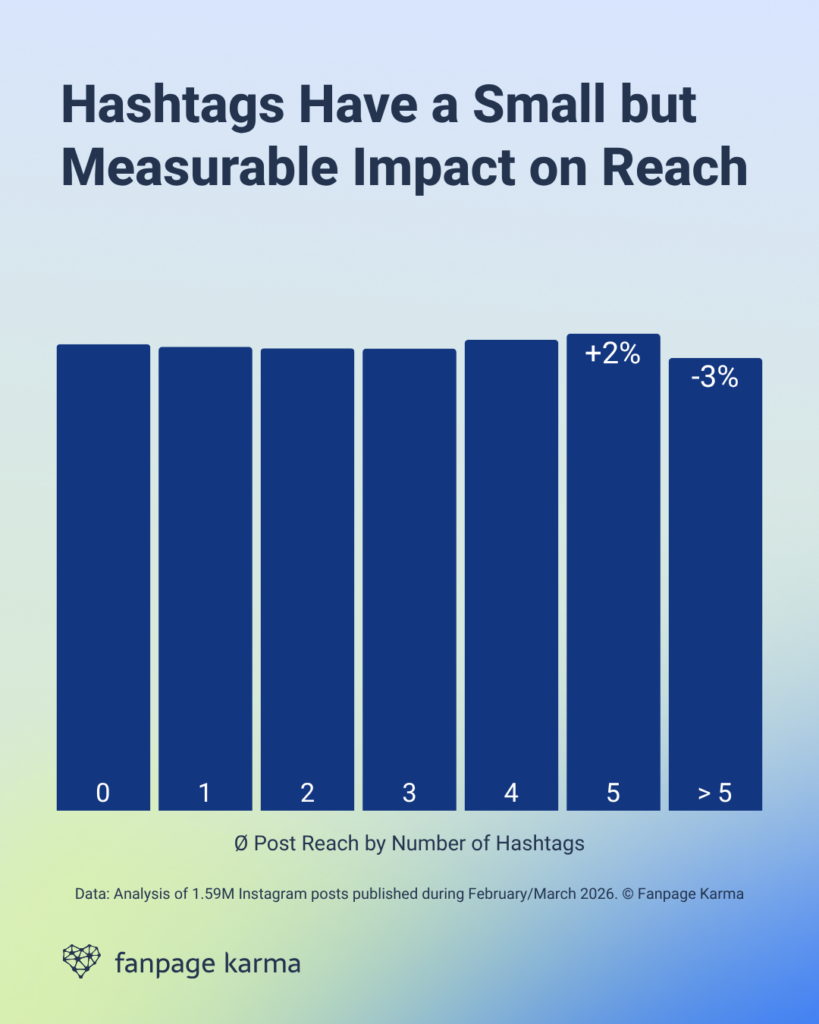
For maximum visibility, it is therefore worth consistently using the 5 available hashtag slots. However, since reach isn’t the only relevant metric, we also analyzed how the number of hashtags used affects average engagement.
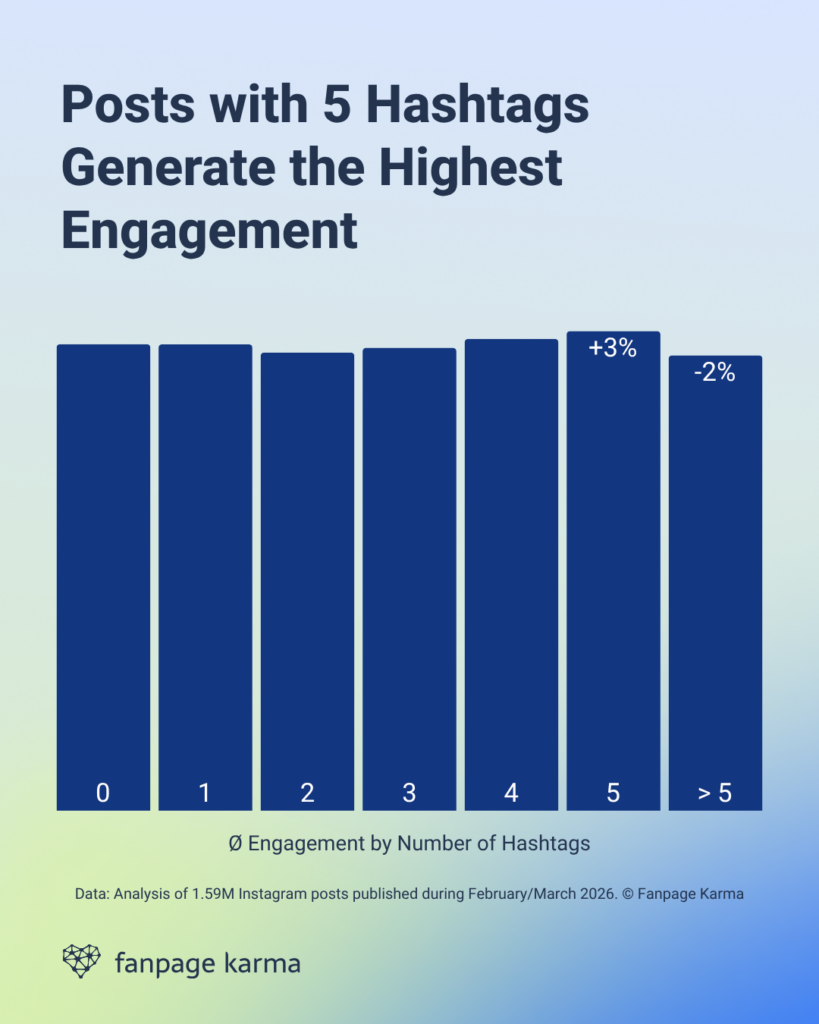
Key findings:
- Posts with 5 hashtags achieve the highest engagement.
- Posts with 2–3 hashtags perform worse than posts with 0–1 hashtags.
- Posts with more than 5 hashtags perform the worst.
The numbers clearly show that the strategic use of hashtags can positively influence the performance of posts. If you are wondering if you should still use hashtags on Instagram, the answer is yes, albeit with a refined focus. While up to 30 hashtags were previously allowed, the rule today is: The maximum number of 5 hashtags should be utilized, but not exceeded, to avoid risking a decline in performance.
How to Choose 5 Instagram Hashtags That Actually Work
The number of hashtags is only part of the equation. Our analysis indicates that the combination plays a decisive role. While large hashtags can provide additional visibility, they are too vague on their own. Only when combined with more specific hashtags do they send a clear signal to the algorithm, making your content more relevant to the right audience.
A balanced mix of popular, medium-sized, and niche hashtags helps the algorithm better categorize content and display it to the right audience.
Our data confirms this pattern: combinations of medium and large hashtags perform best, while unbalanced sets with predominantly small or one-sided tags perform significantly worse.
Successful hashtag sets follow this principle:
- 2–3 large, high-reach hashtags
- 1–2 medium-sized hashtags
- 1 specific niche hashtag
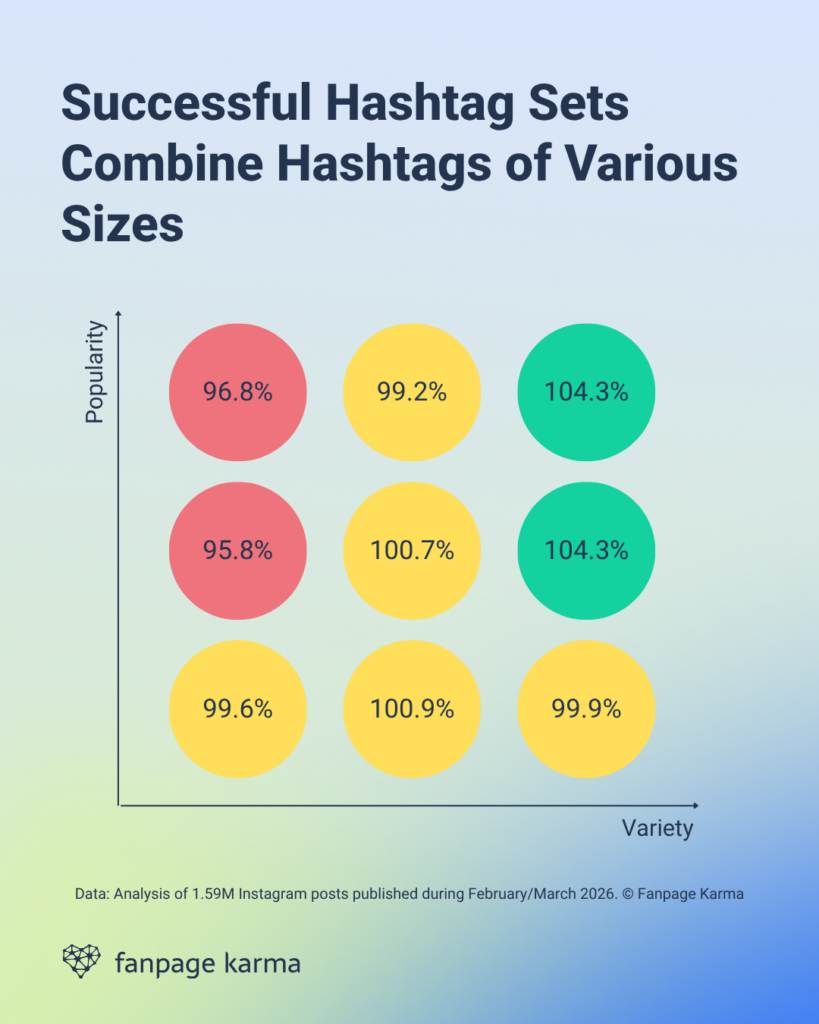
Please note: Hashtags have a measurable but limited impact on overall performance. Content quality, format, topic, and target audience continue to have the greatest effects. Hashtags do not replace good content, but they remain an effective optimization tool for unlocking the full potential of your posts.
Rethinking Hashtags: From Reach to Context
The data clearly shows that the way hashtags work on Instagram has changed significantly. Their role is shifting away from pure distribution toward structure, orientation, and community. While in the past as many hashtags as possible were used to maximize reach, today the focus is more on categorizing content in a meaningful way for the algorithm and users.
Hashtags increasingly serve as thematic anchors within the platform. Community hashtags like #bookstagram, #skincarecommunity, or #vanlifeliving group content into clearly recognizable thematic clusters, make them discoverable for users, and foster a stronger sense of belonging within these thematic worlds. In this way, they become an important link between the brand and the community. Using a social media analytics tool can help you find the best Instagram hashtags for your own business, industry or target audience.
For brands, this represents a clear shift in perspective. Instagram hashtags still work, but the focus is less on reach and more on helping to categorize posts by topic, set expectations, and target the right users.
5 Hashtag Strategies That Work in 2026
1 – Make Strategic Use of All 5 Hashtag Slots
Our data shows that 5 hashtags deliver the best performance. Consistently use the available slots and fill them with relevant tags that clearly categorize the content to improve reach and engagement.
2 – Combine Broad, Medium, and Specific Hashtags
Don’t rely exclusively on popular or niche tags. The best results come from balanced sets that combine reach with precision: 2–3 broad, 1–2 medium, and 1 specific niche hashtag.
3 – Use Hashtags as Part of Social SEO
Hashtags help Instagram categorize content by topic. Strategically supplement the keywords appearing in captions, on-screen text, and content with relevant hashtags, using them as an additional signal for Social SEO.
4 – Use Community and Industry Hashtags Strategically
Avoid generic hashtags like #love or #instagood. Instead, research relevant hashtags within your industry, your topic, or your community. This reduces wasted reach and helps you reach more relevant users.
5 – Continuously Test and Optimize Your Strategy
Hashtag strategies are not static. Regularly analyze your performance and determine which combinations truly lead to greater reach and engagement within your target audience.
Conclusion
Even though their glory days may seem to be over, hashtags on Instagram will still be important in 2026. Our data shows that hashtags deliver a measurable but limited performance effect. Those who use the 5 available hashtags precisely can continue to positively influence reach and engagement with the help of a targeted hashtag strategy. The key lies in the right selection and combination. At the same time, hashtags are gaining importance as a tool for categorization, topic relevance, and community.
Instagram hashtags no longer function in isolation today, but only in conjunction with strong content, a clear target audience strategy, and social SEO. Instead of maximizing reach independently of the actual topic, they help make posts understandable to the Instagram algorithm and users by neatly categorizing content. When used correctly, they thus remain an important component of any social media strategy as a precise optimization factor.
To find out which hashtags really work, we recommend using a social media tool with powerful analytics features. If you want to measure and improve your performance with Fanpage Karma, you can now try it free for 14 days. The all-in-one social media tool combines features for benchmarking, research, publishing, and community management. Fanpage Karma also offers a free weekly webinar that shows you how to improve the overall quality of your social media results.