AI vs Human Influencers: What the Data Shows and What to Test

- AI-Generated Social Media Content Meets Human-Led Creativity
- AI vs Human Influencers: The Instagram and TikTok Accounts Compared
- Instagram AI Influencers vs Real Cats: Sickman, George, and Merv
- Virtual Influencers vs Human Creators: Content Focus and Format
- Human-Led Content vs AI Influencers: Gabriella’s Success and Denise’s Output
- Marketing Tests for AI-Generated and Human-Led Content
- Methodology: Limits of This Social Media Engagement Analysis
- Conclusion: Test the Creative Approach, Not Just the AI Label
AI-Generated Social Media Content Meets Human-Led Creativity
AI-generated cats go on fictional adventures, virtual influencers release music, and synthetic personalities attract audiences on Instagram and TikTok. But how does their content perform compared with posts from human-led accounts?
There is more here than a simple AI-versus-human ranking. Some AI influencers achieve exceptional engagement, while human creators also deliver viral successes and publish at high volumes.
Using Fanpage Karma data, we compared selected AI-generated and human-led accounts to explore what social media managers can learn and which content ideas might be worth testing.
AI vs Human Influencers: The Instagram and TikTok Accounts Compared
Our Fanpage Karma benchmark covers nine creator identities across Instagram and TikTok, representing 18 profiles. We examined two broad content categories. The first focuses on cat entertainment: Sickman AI and Casual Chaos AI publish AI-generated cat content, while Merv the Cat and George the Bengal Cat feature real cats on human-managed accounts. The second covers fashion, lifestyle, fitness, and related content. It includes virtual creators Milla Sofia and Aitana López, CGI-based virtual influencer Lil Miquela, and human creators Gabriella Athena Halikas and Denise Bobe.
These groups offer useful comparisons, but they are not identical. A music-focused virtual personality serves a different audience need than a fitness creator or a real-cat entertainment account. One distinction is particularly important: AI-generated content and automated social media accounts are not the same thing. A synthetic image or virtual character tells us something about the content, but not whether humans handle creative decisions, publishing, or community management.

Instagram AI Influencers vs Real Cats: Sickman, George, and Merv
One of the most striking comparisons comes from Instagram. Sickman AI and George the Bengal Cat had relatively similar audience sizes during the analysis, making them an interesting starting point for comparing engagement. Among Instagram Reels published between September 9 and October 3, 2026, with usable interaction rates, Sickman’s 10 Reels recorded a median interaction rate of 155.04%, compared with 1.23% for George’s four Reels. This is a substantial difference within the selected sample. However, it does not mean that 155% of Sickman’s followers interacted, nor does it prove that AI-generated cat content generally outperforms videos of real cats. The groups contain different numbers of posts, and the accounts have different creative approaches.
Sickman’s content features fictional characters and imaginative scenarios. George’s content centers on a real cat and everyday experiences. Meanwhile, Merv the Cat demonstrates that human-managed cat entertainment can also build a large, highly engaged audience. But even within a successful AI-generated account, results vary dramatically.
A Sickman Reel published on September 6 generated 336,948 public interactions. Another Reel published just two days earlier recorded 1,307 interactions. The difference becomes clearer when looking beyond individual hits. Across the 17 Sickman Instagram posts with usable interaction-rate data, the median number of public interactions was 47,830, while the mean was approximately 111,528. A handful of exceptional posts pushed the average well above the typical result.
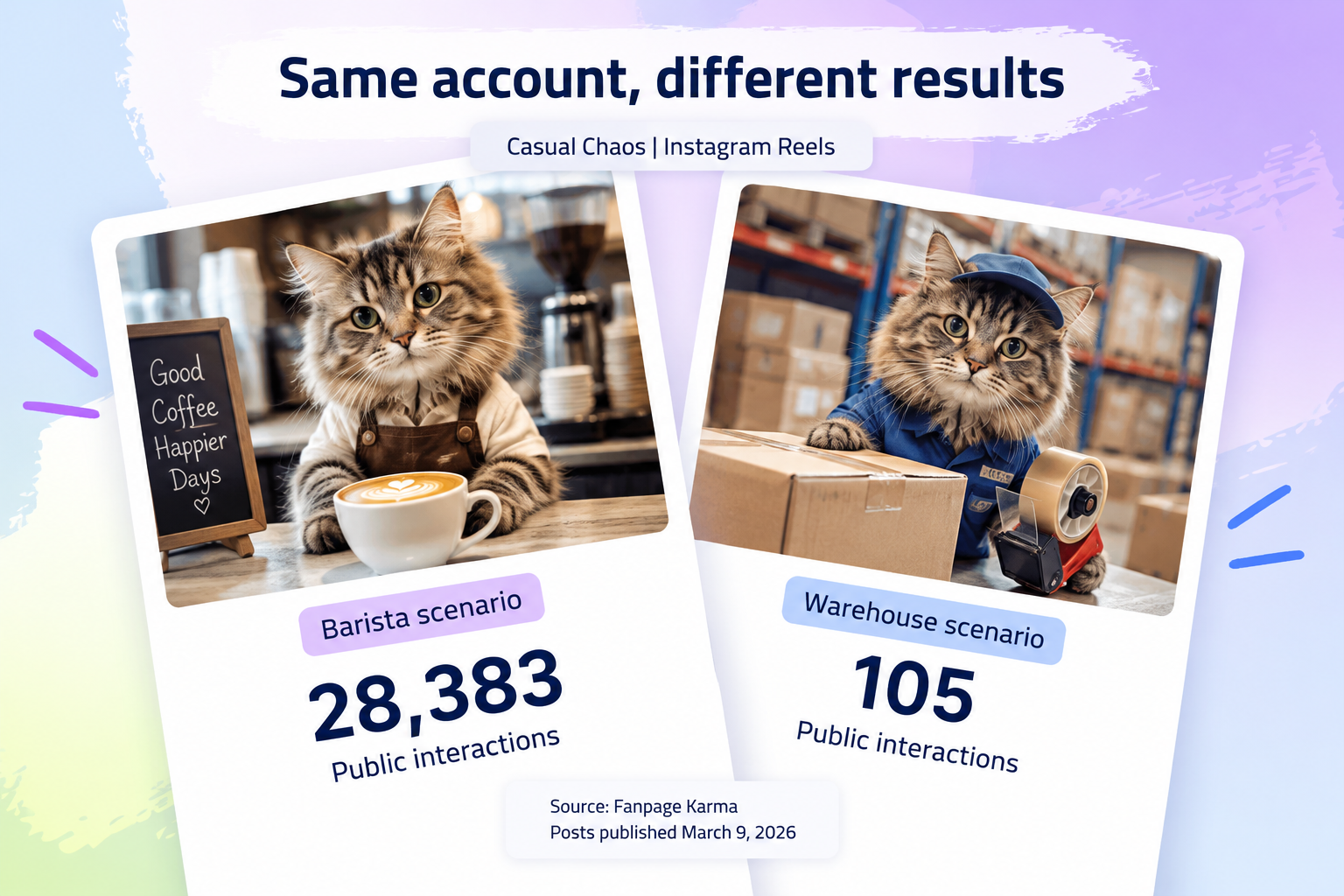
Casual Chaos AI shows a similar pattern. On March 9, a Reel featuring a cat in a barista scenario generated 28,383 public interactions. A warehouse-themed Reel published on the same day received 105. Both posts used fictional cats in recognizable workplace settings, yet their results were dramatically different.
What marketers can learn: When assessing AI influencer engagement, examine the creative idea behind each post rather than assuming synthetic content is automatically engaging. Recurring characters, familiar situations, and imaginative storytelling are promising approaches to test, but they still need to earn audience attention.
Virtual Influencers vs Human Creators: Content Focus and Format
Virtual influencers are often discussed as though they form one consistent category. The data shows a more varied picture.
On Instagram, the reported mean post interaction rates for three virtual creators differed considerably:
- Milla Sofia: 2.92%
- Aitana López: 0.375%
- Lil Miquela: 0.0161%
These figures do not establish a definitive ranking. The accounts differ in their content, audience size, and measurement coverage.
Milla Sofia illustrates why content context matters when comparing virtual influencers. Although she is frequently grouped with virtual fashion and lifestyle influencers, her public content increasingly emphasizes music. In a January 1, 2026 caption, she identified music as a focus of her feed.
That makes a direct comparison with fashion recommendations or fitness content less straightforward. A virtual personality built around music offers something different from an account focused on outfits, workouts, or everyday lifestyle advice.
Format is also relevant when comparing TikTok AI influencers with CGI-based virtual creators such as Lil Miquela. Across her complete set of 13 TikTok posts in the analysis period, four carousels achieved a median of 1,563 public interactions, compared with 927 for nine videos. That does not establish that carousels perform better than videos. The posts may differ in topic, timing, and audience appeal. But it does suggest that format is worth examining alongside creator identity.
What marketers can learn: A virtual persona is not a content strategy on its own. Define what the account offers its audience, whether entertainment, music, inspiration, information, or something else, and test formats that support that purpose.
Human-Led Content vs AI Influencers: Gabriella’s Success and Denise’s Output
AI-generated content is not the only source of dramatic engagement spikes.
Human creator Gabriella Athena Halikas provides a striking example on TikTok. Her May 25, 2026 video, connected to behind-the-scenes Swim Week content, generated approximately 1.4 million likes. That single post accounted for around 60.5% of all likes recorded on her TikTok posts published between January 1 and October 7, 2026.
A human-led creator experienced the same kind of concentrated success seen in the AI-generated cat accounts. The lesson is not that one type of creator has a unique ability to go viral. A few exceptional posts can shape an account’s overall performance and make averages misleading.
Publishing frequency challenges another common assumption. AI tools can make content production faster, but that does not mean virtual influencers necessarily publish more than human creators.
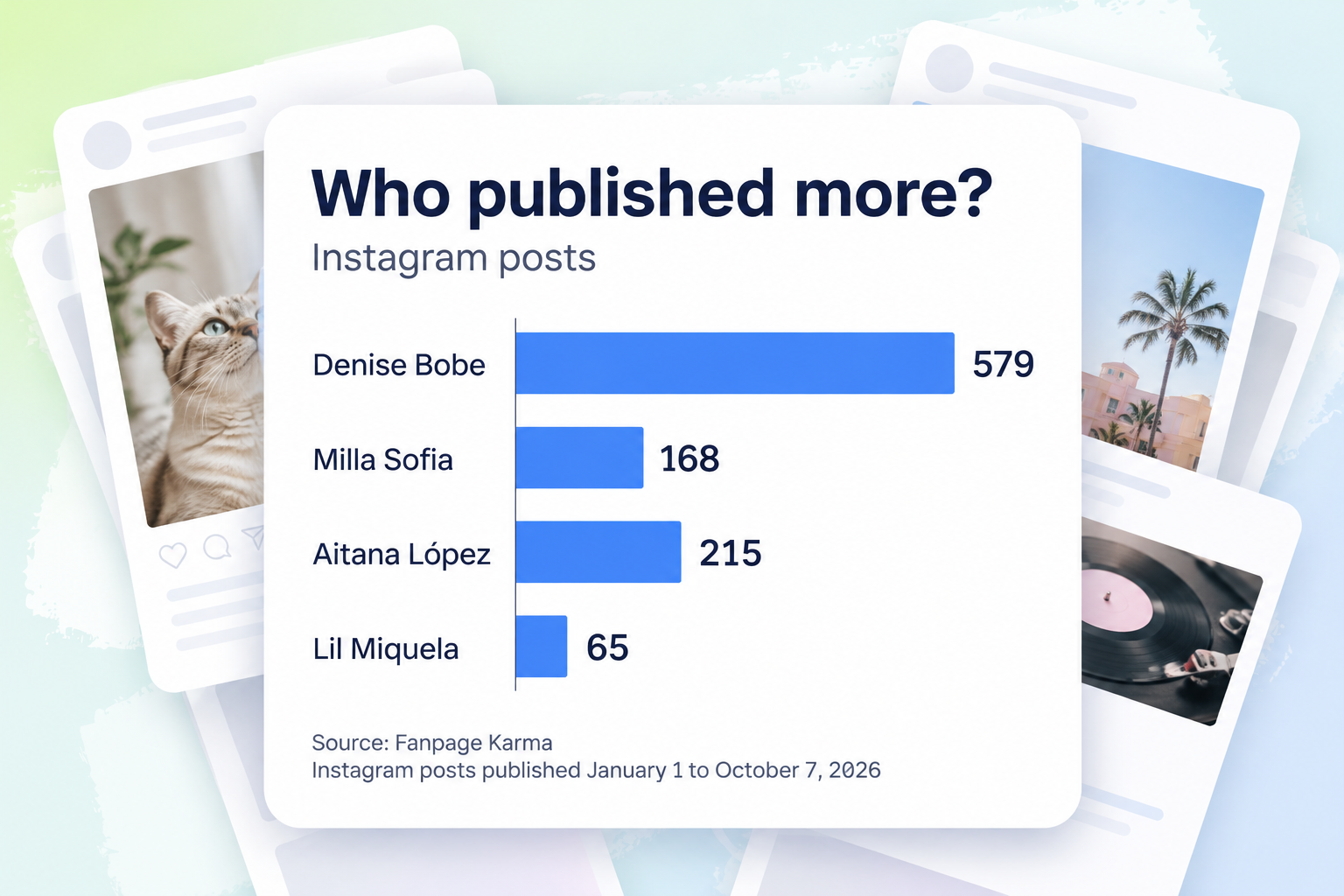
Between January 1 and October 7, 2026, Denise Bobe published 579 Instagram posts. Over the same period, Milla Sofia published 168, Aitana López published 215, and Lil Miquela published 65. Denise’s output was higher than that of all three virtual creators in this comparison. Posting volume alone, however, tells us nothing about production costs, team size, or how much work was automated.
Her content also provides a useful format comparison. In a sample of 12 Instagram posts, three carousels achieved a median of 6,046 public interactions, compared with 518 for nine Reels.
This is not a controlled experiment. The posts covered different topics and publication dates, and the carousel sample was small. Nevertheless, it offers a useful reminder that short-form video is not automatically the strongest format for every account.
What marketers can learn: Human-led creators can achieve exceptional reach and maintain high publishing volumes. Before changing a content strategy based on a viral post or a platform trend, compare several posts and consider whether the results are repeatable.
Marketing Tests for AI-Generated and Human-Led Content
The useful question is not simply whether AI or humans generate more engagement. It is which creative approaches could work for your audience and how to test them.
Here are five content experiments inspired by the benchmark.
Test recurring characters and fictional storytelling
Sickman’s fictional cat adventures suggest one creative direction: build a short series around a recognizable character.
Compare a connected series with standalone posts using similar formats and publishing conditions. Look at typical engagement across the series rather than only its biggest hit.
Experiment with humor in familiar settings
Casual Chaos places fictional cats in everyday workplaces. Its barista and warehouse posts show how differently individual scenarios can perform.
A brand could test several recognizable environments while keeping the character, visual style, and basic comedic premise consistent.
The goal is to learn which ideas resonate, not to assume that one successful scenario will always work.
Give your content a clear thematic focus
Milla Sofia’s music direction illustrates the value of a recognizable content focus.
Whether a brand focuses on education, entertainment, product demonstrations, or music, audiences should have a reason to return.
Test a consistent series around one relevant theme rather than publishing unrelated AI-generated social media content simply because it is easy to produce.
Explore human perspectives and behind-the-scenes content
Human-led creators can offer direct access to personal experiences, working processes, and real-world moments.
Brands could test a short behind-the-scenes series featuring employees, creators, or the people involved in making their products.
Gabriella’s standout TikTok result is a reminder to assess the full series, however, rather than treating one viral video as proof that a particular approach always works.
Compare carousel and video engagement
Denise’s Instagram results and Lil Miquela’s TikTok posts both provide reasons to investigate format choices.
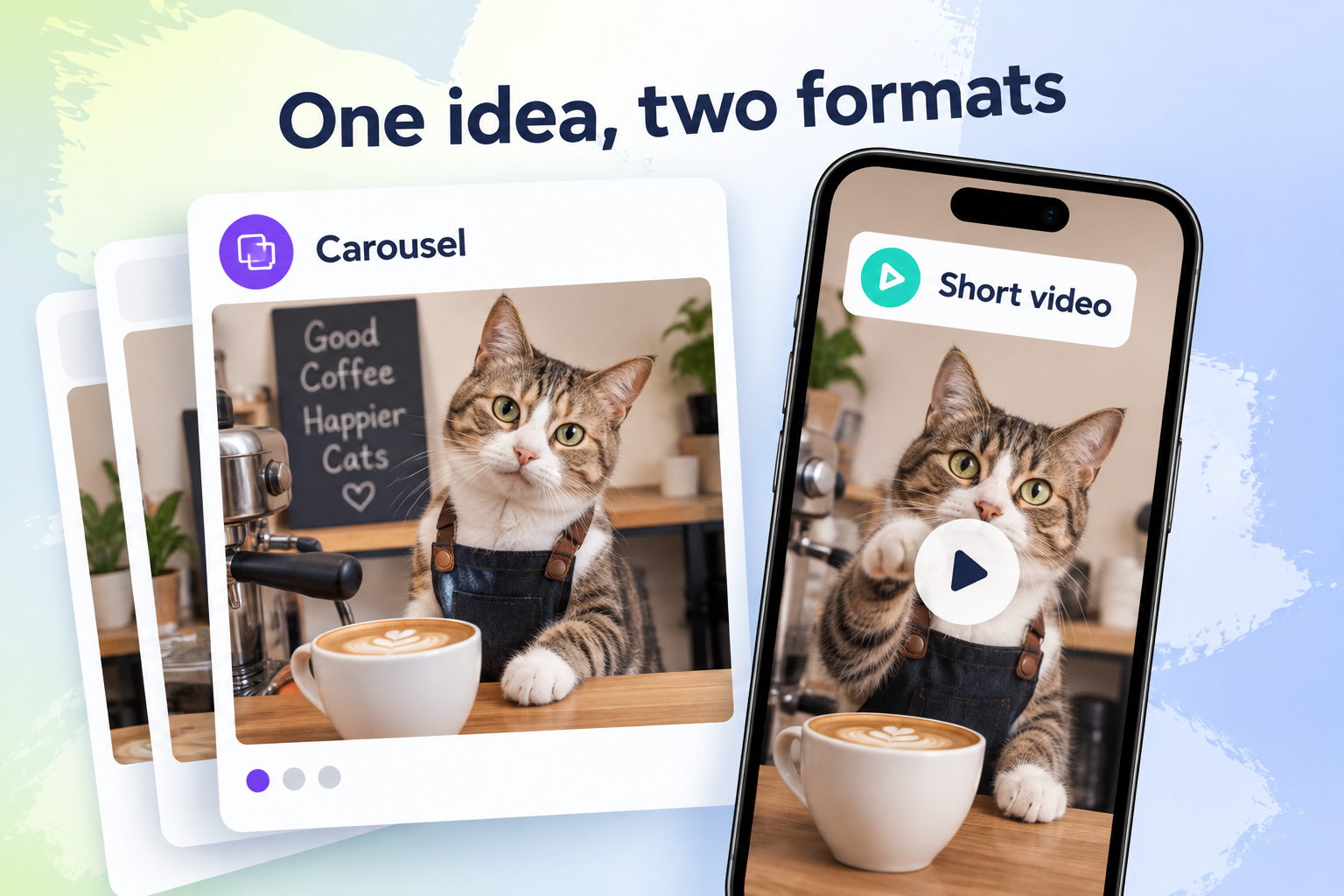
Develop the same core idea as a carousel and a short video. Publish several examples of each, keep the conditions as comparable as possible, and evaluate Instagram and TikTok results separately.
Across all five experiments, the principle is the same: test one or two ideas that fit your brand, measure typical performance, and learn from both successful and unsuccessful posts.
Methodology: Limits of This Social Media Engagement Analysis
This analysis uses a selected, non-random sample of nine creator identities across Instagram and TikTok. It is an exploratory benchmark, not a representative study of AI-generated or human-led social media accounts.
The main reporting period covers posts published from January 1 through October 7, 2026, with a narrower September 9 through October 3 window used for the Sickman and George Reel comparison.
Public interaction totals and reported interaction rates measure different things. Interaction rates should not be interpreted as percentages of unique viewers or followers. The median shows the middle observation, while the mean can be strongly influenced by unusually successful posts.
Data coverage also varies. In the sampled Instagram posts, like counts were unavailable for six of Aitana’s 12 posts and eight of Gabriella’s 12. Missing measurements are not equivalent to zero engagement.
One TikTok reporting inconsistency also deserves attention: Casual Chaos recorded 566 public interactions across eight posts despite a displayed profile-level interaction rate of 0%. The available data does not establish why those figures differ.
Format comparisons were observational rather than controlled experiments, and Instagram and TikTok results were evaluated separately.
Engagement figures cannot establish how content was prompted, edited, approved, published, or moderated. They therefore cannot demonstrate autonomous account management.
Conclusion: Test the Creative Approach, Not Just the AI Label
AI-generated accounts can achieve strong engagement. But human-led creators can also produce viral successes, publish at high volumes, and perform strongly across different formats.
The Fanpage Karma benchmark reveals substantial variation, not a universal winner.
For social media managers, the opportunity is to learn from the creative approaches behind the content. Test relevant ideas, compare results across multiple posts, and examine typical performance alongside exceptional hits.
When evaluating automation, remember that successful AI social media accounts are not necessarily autonomously managed. Assess content performance and account automation separately. Put theory into practice by trying Fanpage Karma for free, then explore the topic further in our webinar.