The Most Important Instagram Algorithm Changes 2026
Anyone serious about growing on Instagram has to pay attention to every Instagram algorithm update for 2026. When the platform adjusts its ranking logic, social media managers need to adapt fast to maintain reach, views, and interaction rates.
But understanding the Instagram algorithm is not just about preventing performance drops. Instagram positions itself as a platform for meaningful connections. That means long-term success depends on strengthening the relationship between creator and audience, not just chasing visibility.
To have success, you need to understand the logic behind the algorithm on Instagram. While the core system has not drastically changed since AI-driven recommendations were introduced, recent Instagram algorithm update news significantly affects how professionals manage Instagram business accounts.
In this article, we break down the most important Instagram algorithm changes in 2026 and walk you through the key ranking factors every marketer needs to know. We will then explore how the system really evaluates your content and what you have to do to find success on Instagram in the long term.
How the Instagram Algorithm Works in 2026
Despite the common belief, there is no single Instagram algorithm. That is because, even though we often refer to the Instagram algorithm as one system, the platform actually runs on multiple intersecting algorithms, each with its own ranking logic.
These systems are designed to keep users online by promoting content based on what the user is interested in and predicted to engage with. This means with your algorithm, Instagram shapes your experience around what you watch, like, and interact with. Feed and Stories prioritize content from people you engage with regularly, while Explore focuses on discovery. Different goals require different systems, so you need to adapt your approach to get the most out of each content format.
If you want to unravel how the Instagram algorithm actually works, you need to consider how it operates across different parts of the platform: Feed and Stories, Reels, and Explore. Instagram collects thousands of signals to predict what users will engage with. Some are simple, like language or location. Others are behavioral, like what users watch, like, save, or share. These signals are weighted differently based on how well they predict future interest.
The algorithm then ranks posts based on how likely they are to spark a user’s interest and drive engagement. To really understand how each of the Instagram algorithms works in 2026, let us take a look at how each section is set up. In the following, we will break down how the system ranks content in:
- Feed and Stories
- Explore
- Reels
Feed and Stories: How the Instagram Algorithm Works in 2026
Feed and Stories are relationship-first environments. Unlike Explore or Reels, this part of the Instagram ranking algorithm prioritizes who you care about over what is trending. The system analyzes how users interact with accounts they already follow to curate a personalized mix of content it predicts will keep them interested and engaged.
Therefore, relationship signals carry the most weight. The more you interact with an account, the more likely their content is to appear higher in your Feed and Stories. This includes:
- Likes and comments
- Replies to Stories
- Profile visits and taps
Content signals like recency and overall engagement still matter, but they do not outweigh a strong interaction history. The system continuously predicts how likely you are to:
- Spend time on a post
- Like or comment
- Reshare content
- Visit the profile
Bottom line: Feed and Stories reward consistent interaction and relationships, not viral spikes.
Explore: How the Instagram Algorithm Works in 2026
It is essential for marketers, or anyone with a growth mindset, to understand how the Instagram Explore algorithm works. Explore is built for discovery, which means relationship history has little to no weight in how content is ranked. Performing well here is critical for brands, as it increases discoverability and creates opportunities to reach entirely new audiences.
Instead, the system is focused on what topics you’re interested in. For this, the algorithm analyzes your past interactions, including:
- Posts you liked
- Content you saved or shared
- Comments and engagement patterns
From there, it identifies users with similar behavioral patterns and maps what types of content these related groups engaged with. In Explore, the quantity and speed of interactions matter more than in the Feed.
The Instagram algorithm then predicts how likely you are to:
- Spend time on the post
- Like, save, or comment
- Share it with someone
Bottom line: The Explore section on Instagram rewards topical relevance and fast engagement. It is less about who you know and more about what consistently holds user attention.
Reels: How the Instagram Algorithm Works in 2026
If Explore is interest-driven, the Instagram Reels algorithm is retention-driven. In 2026, this part of the system shifted even further toward viewing behavior, with relationship history playing almost no role.
Within the Reels section, Reels are primarily shown to users that do not follow the creator. That means the Instagram algorithm focuses on how people watch and engage with the content itself, especially:
- Watch time
- Completion rate
- Replays
- Total time spent on the video
These signals outweigh follower count or past interactions. The system continuously predicts how likely you are to:
- Watch a Reel all the way through
- Rewatch it
- Engage or interact with the audio
Bottom line: The Instagram Reels algorithm rewards content that captures and retains attention from start to finish.
Instagram Algorithm Updates 2026
At the end of 2025 and the beginning of 2026, the Instagram algorithm news was dominated by one major change in Reels: the Instagram “Your Algorithm” update.
But the Instagram algorithm for 2026 introduced several additional shifts that affect ranking priorities across the platform. Here are the most relevant updates:
- “Your Algorithm”
- Original Content priority removed for Stories
- Growing Importance of Negative Signals
- AI Translations to Boost Reach
- The Creator-Audience Relationship
- Increased Importance of Shares as a Ranking Factor
- Trial Reels
1. Instagram launches “Your Algorithm”
The Instagram “Your Algorithm” update made machine learning partially explicit. Instead of relying only on passive behavior, users can now actively signal what they want to see more or less of in Reels. This is handled through a simple input feature where users can type in topics they wish to see more or less of in their Reels feed. The algorithm uses these inputs as direct user preference signals, which the system may then use alongside behavioral data to refine the recommendation system.
This Instagram algorithm update increases the weight of user-declared interests. Training or retraining the system is now far less complex, as users can influence recommendations instantly. Thus, adjustments take effect immediately, giving users real-time control over what appears in their feed.
2. Original Content Priority removed for Stories
Earlier Instagram algorithm changes favored platform-original content over recycled posts. With the Instagram algorithm 2026, reposted content in Stories no longer negatively affects ranking. This shift reflects how Stories are actually used nowadays, especially for sharing information, activism, or time-sensitive content.
In practice, this shift means that resharing content to your Story:
- Doesn’t negatively impact reach anymore.
- Can strengthen your presence on Instagram.
- Can amplify important or trending content
- Creates a space for conversation
3. Growing Importance of Negative Signals
Negative feedback now impacts distribution more strongly. Hiding posts, tapping “Not interested,” muting, unfollowing, reporting, or quickly skipping a Reel all signal dissatisfaction with ranked content. When these actions are repeated across users, negative behaviors can significantly reduce reach following these new Instagram algorithm changes.
Bottom Line: Critical comments still count as regular engagement. Only actions like hiding, reporting, or unfollowing function as true negative ranking signals in the Instagram algorithm. As a result, even controversial content or “ragebait” can generate high engagement, since the algorithm values interaction more than sentiment. However, brands need to weigh this carefully, as negative perception can directly impact how audiences respond to them.
4. AI-Translations Expand Reach
Meta AI voice translation now allows automatic dubbing and lip-syncing for Reels. The feature is opt-in and creator-controlled.
Currently available in:
- English
- Spanish
- Portuguese
- Indian languages: Hindi, Bengali, Tamil, Telugu, Marathi, Kannada
This Instagram algorithm update removes language barriers because AI-translated Reels can reach users who demonstrate interest in the same topics, even if they do not share the creator’s language. This expands content reach to a broader audience and significantly increases the pool of potential customers. As a result, internationally operating brands are less restricted in their reach and can communicate their message more effectively across markets.
5. The Creator-Audience Relationship
The Instagram Algorithm 2026 continues to prioritize meaningful interactions between the same users and creators.
High-value interactions include:
- Conversations via DMs
- Conversations in comment sections
- Replies to Stories
- Sharing content across Meta
Engagement depth matters more than surface-level activity. Follow-up behavior, such as saving or viewing more content after interacting, strengthens ranking signals.
Brands on Instagram can tap into these signals by actively encouraging deeper interaction with their audience. By asking for opinions, sparking discussions, or prompting users to share content with friends, you can increase engagement depth and strengthen long-term ranking signals.
The goal is to move beyond passive consumption and create content that actively encourages user responses. Building this kind of interactive space not only strengthens your connection with your audience but also positively influences the Instagram algorithm.
6. Shares Gain Higher Ranking Power
As more interaction moves into private spaces, shares have become a stronger ranking factor because they directly signal a perceived value for another user. A share with added commentary is weighted even more strongly, as the newest Instagram algorithm update considers such behavior to be indicative of content sparking further conversations. The Instagram algorithm increasingly interprets sharing behavior as proof of relevance beyond public metrics.
7. Trial Reels
Trial Reels allow creators with over 1,000 followers to test content with non-followers before showing it to their own audience.
The connection to how the Instagram algorithm works in 2026 is clear:
- Trial Reels test discovery logic without relying on existing relationships.
- Early performance signals such as watch time and completion rate influence expansion.
- Weak results do not negatively impact follower-based ranking.
Trial Reels make Instagram’s testing phase more transparent without changing the underlying predictive system.ts what users will actually see or learn is more likely to retain attention and perform consistently under the current algorithm.
How to Win the Instagram Algorithm
Now let’s turn this knowledge into action. Once you understand how the Instagram algorithm works, there are clear, practical ways to improve your content’s performance.
To do this, we break down how to optimize your strategy for each part of the platform, helping the Instagram algorithm better understand your brand and distribute your content to the right audiences.
Here are 6 practical tips to guide you on your path to Instagram success.
- Win Through Early Engagement and High Retention Rates
- Optimize Your Content for Meaningful Interactions
- Increase Visibility with the Right Keywords
- Use Competitor Data to Optimize Your Posting Strategy
- Create Community With Your Audience
- Remove Technical Hurdles Limiting Your Reach
1. Win through Early Engagement and High Retention Rates
One of the key factors in your Instagram performance following the Instagram algorithm update in 2026 is early engagement. One of the best ways to ensure that your content gains traction early on is by identifying the times at which posting volumes in your market niche were low but your target audience was online and interacting.
At first glance, the task of determining when to post for maximum engagement may seem like a difficult task. Making guesstimates based on target groups, regions, or seasons just isn’t good enough. With how the Instagram algorithm works in 2026, you need real data to back up your decision of when to upload. Luckily, getting this data is easier than one might first expect. You need to conduct a best time to post analysis.
These analyses use historical data within a defined time frame of accounts in a given market to identify periods with higher ranking potentials within the Instagram algorithm. The ‘best time to post’ takes competitor activity and audience behavior into account and looks for correlations between time slots and engagement patterns.
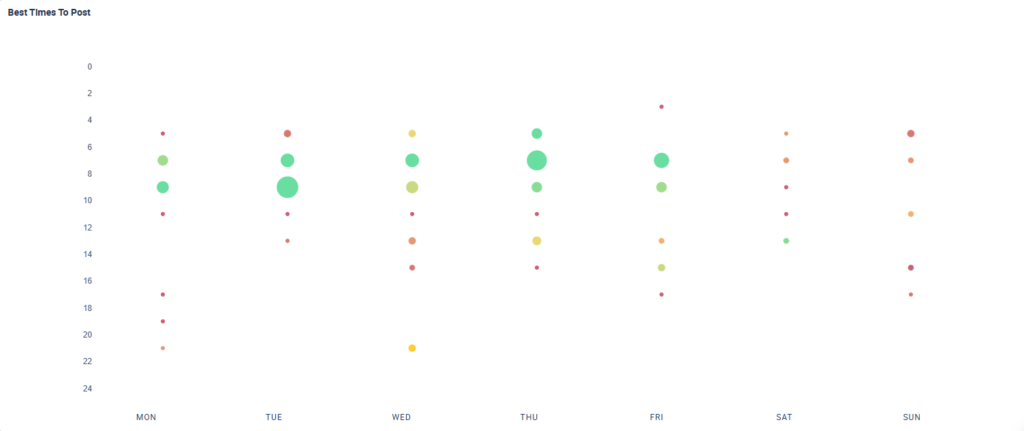
Below is an exemplary best-time-to-post analysis based on five major camera brands: Canon, Nikon, Sony Alpha, Panasonic Lumix, and Leica Camera. The visualization below illustrates the relationship between posting volume and engagement as follows:
- Larger dots mean higher posting volume
- Darker green means a higher interaction rate
This allows you to quickly spot time windows with strong engagement potential by identifying the smaller green dots.
However, early engagement isn’t everything. You should also aim to optimize your content for high retention rates.
- Use strong hooks that stop the scroll (for longer videos: rehook mid-video).
- Be concise. Clarity beats rambling.
- Loop your videos to increase replays and total watch time.
- Use captions for accessibility and silent viewers.
All of these tactics strengthen early engagement and watch time, two of the strongest retention signals for ranking on Explore.
2. Optimize Your Content for Meaningful Interactions
Not all engagement is equal. The platform has long weighted interactions differently, and the Instagram algorithm 2026 reinforces this. A share signals more value than a like. A thoughtful comment carries more weight than emojis alone. Depth beats volume.
To encourage stronger signals:
- Create save-worthy content like tutorials or insights.
- Prompt shares through clear calls to action.
- Ask real questions to drive discussion.
- Use interactive elements to lower engagement barriers.
- Use Notes to increase inbox visibility.
If you want to utilize how the Instagram algorithm works, focus on driving engagement that signals genuine interest, not passive scrolling.
3. Increase Visibility with the Right Keywords
If you want your content to reach its full potential, it needs to be searchable. That is where SEO comes in. Strong optimization supports both users and the Instagram algorithms by making your content easier to categorize and surface through:
- The use of relevant keywords naturally in your captions.
- The strategic addition of hashtags to clarify topic and context.
- The focus on a defined niche and post about it consistently.
- The use of on-screen text to reinforce what your content is about.
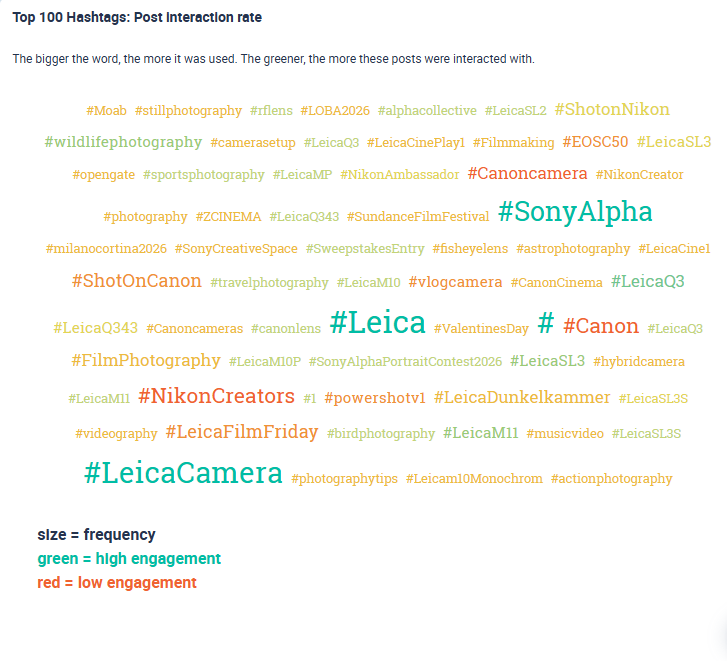
But how do you find most effective keywords for Instagram? The answer lies in performance data. By combining your own historical data with that of your competitors, you can identify patterns across accounts that target the same audience. A dataset enriched by competitor performance data can reveal which keywords consistently resonated with your shared target audience. This makes it easier to align your strategy with the Instagram algorithm.
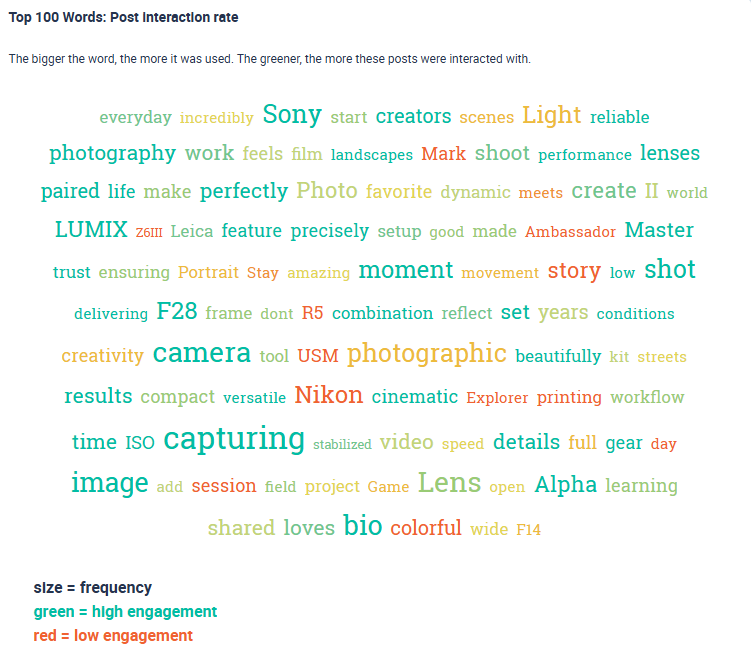
Instead of guessing, you base decisions on proven engagement trends and use them to guide future content. This directly impacts how your content is distributed since the clearer your signals, the easier it will be for the Instagram algorithm to accurately match your content with the right audience. A practical way to support this is through targeted social media SEO strategies. To illustrate this, we’ll use the same camera brands to show how you can identify the most relevant keywords and hashtags driving interaction in your niche with the Fanpage Karma tool. In the example below:
- Larger hashtags indicate higher usage frequency
- Color intensity shows engagement level, revealing which terms generate stronger interaction
4. Use Competitor Data to Optimize Your Posting Strategy
If you want to improve performance following the Instagram algorithm changes in 2026, competitor data is one of your most valuable resources. Instead of guessing what your shared target audience likes, you can expand your learnings to see what worked for your competitors and what didn’t.
Competitor data allows you to identify patterns such as:
- Which formats drive the highest interaction rates?
- Which posts generate saves and shares?
- What topics or hooks trigger conversations?
- When do competitors see peak engagement?
To make these insights actionable, you need a structured way to analyze your content. This is where tagging analyses come into play.
A tagging analysis works by assigning specific labels (tags) to individual content elements and then comparing their performance. The data typically comes from your own posts and competitor accounts. By combining this performance data associated with posts from a specified timeframe with assigned tags, you can systematically evaluate which content characteristics drive engagement.
Marketers are not limited in how they may define these tags, but there are some commonly used tags that allow you to investigate your content from different angles:
- Emotional tone (e.g. inspirational, provocative, humorous)
- Content format (Reels, carousel, static post, Story)
- Hook type (question, statement, trend-based opening)
- Visual style (UGC, polished brand visuals, behind-the-scenes)
- Call-to-action (comment prompt, save prompt, share prompt)
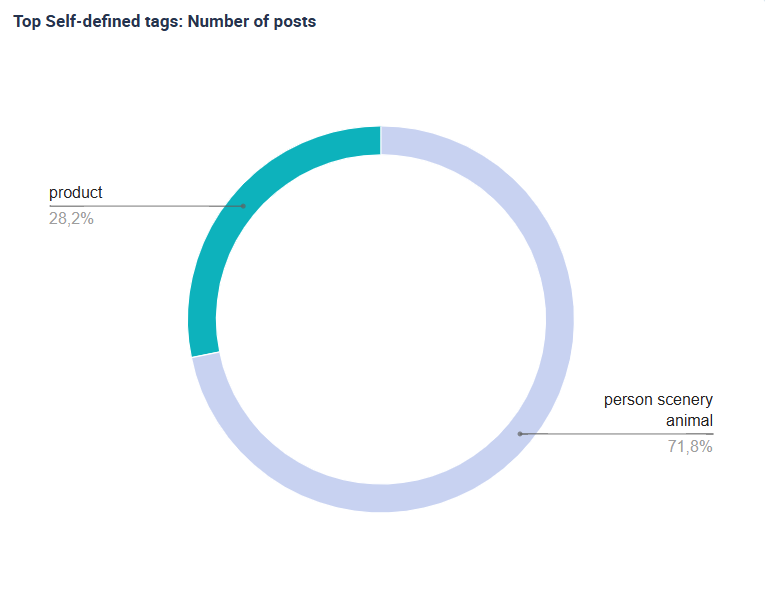
In our example, we analyzed posts from five camera brands and tagged them into two categories:
- Product-focused content (clear product highlight)
- Non-product-focused content (person, animal, scenery)
We then compared posting frequency and interaction rates across both tags. While non-product-focused content made up about 72% of the dataset, product-focused posts achieved higher average interaction rates as you see below.
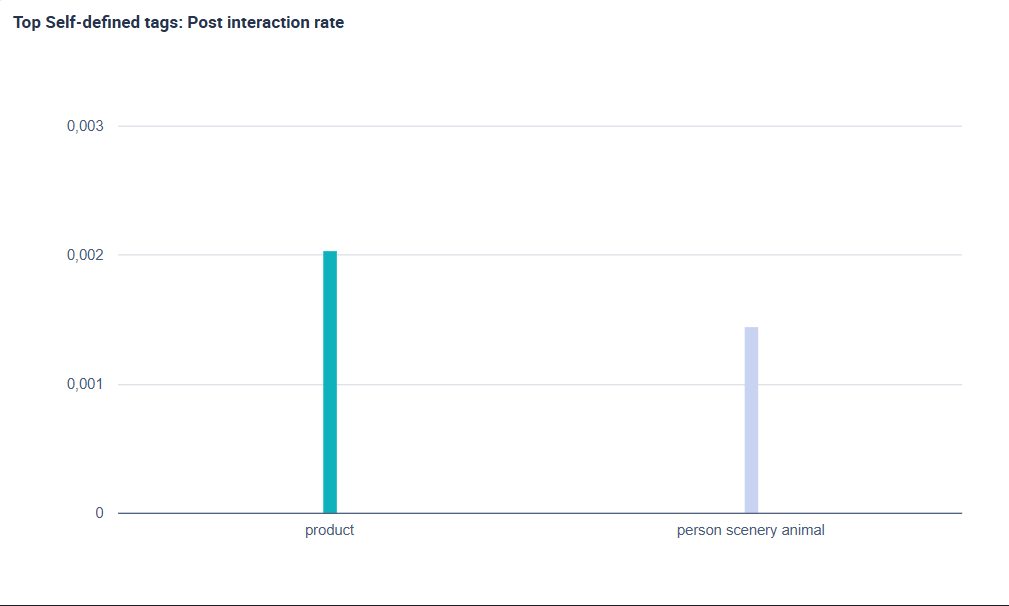
This type of analysis reveals what actually drives engagement in your niche. Since the Instagram algorithm rewards posts that generate strong interaction signals, identifying which content category performs better allows you to adjust your strategy based on historical data.
5. Create Community with Your Audience
Social media is not a broadcast channel but a two-way communication channel that allows brands to connect with their target audiences. The Instagram algorithm rewards ongoing interaction patterns, especially between the same accounts. That means community management is a ranking strategy.
Think in two directions:
- Connected audiences: Engage actively in your comments, DMs, and Stories. Strengthen existing relationships.
- Unconnected audiences: Interact outside your page. Comment on competitor posts. Show up where your target audience already is.
Following the Instagram algorithm changes, sustained conversation matters more than ever. Brands that behave socially have a better chance at having their content ranked higher.an be applied across niches to better understand what your audience responds to.
6. Fix Technical Settings that Limit Your Reach
Before optimizing content, make sure your setup is not limiting distribution. Small technical settings and production decisions can directly impact how far your content travels.
- Enable recommendations to non-followers
- Turn on high-quality uploads
- Remove watermarks
- Use original audio
- Allow embeds and sharing to Stories
- Turn on “recommend on Facebook”
- Translate Reels
- Check account status

How to Reset your Instagram Algorithm
If you’re wondering how to reset your Instagram algorithm, you have several options. A soft reset requires consistent action. You can retrain your feed by actively searching for topics you want to see more of and giving negative feedback on content you’re no longer interested in. If your Reels feel off, the “Your Algorithm” feature lets you fine-tune recommendations. Instagram is also planning on expanding user control to Explore, giving you more influence over suggested content.
If you’re looking for a faster way to reset Instagram algorithm settings, here is a step-by-step description of how to clear your Instagram algorithm:
- Go to your profile settings
- Navigate to section “What You See.”
- Click on “Content preferences.”
- Select “Reset Suggested Content.”
- Click “Next.”
- Review the suggested accounts in “all accounts that you follow” or “most shown in feed” and unfollow accounts you no longer want to influence your recommendations.
- Click “Manage ad topics” to customize what ads you are seeing.
- Click “Reset suggested content” to achieve a full reset.
- Confirm reset.
If none of these steps work and you still want to clear your Instagram algorithm, the only complete reset option left is to delete your profile and start from scratch.
Conclusion
The Instagram algorithm 2026 prioritizes retention, relevance, and meaningful interaction across Feed, Explore, and Reels. Watch time, shares, saves, and sustained conversations now carry more weight than passive engagement. On top of that, early performance signals and strong audience relationships now determine how far your content is distributed.
The latest Instagram algorithm update makes one thing clear: growth is no longer about posting more, but about posting strategically. Clear positioning, smart timing, optimized formats, and community management all influence ranking potential.
Tools like Fanpage Karma support this process by combining analytics, scheduling and publishing, and community management in one platform. The tool also supports you in discovering new topics, collaborators, or competitors.
If you’d like to see how it works, join a free weekly webinar or start a free trial to test it yourself.