The Facebook Algorithm: Update 2026

If you work in social media management or actively use social platforms, you likely already have a general idea of how the Facebook algorithm works. At its core, the Facebook algorithm determines which posts appear in a user’s feed and in what order.
In this guide, we explain how the algorithm works, why it matters, and what has changed over time. We cover the major shifts introduced in 2024, how Meta’s ranking systems evolved, and how those foundations carry into the Facebook algorithm update of 2026. You will learn what influences reach today, how Facebook distributes content, and which signals matter most when evaluating performance on the platform.
Most importantly, this article focuses on what you can actively do to succeed with the algorithm, from learning how to fine-tune your feed to improving content performance and growing your account. And if you’re wondering how to change your algorithm on Facebook, we’ll also explain how to reset your algorithm on Facebook.
How does the Facebook algorithm work?
Before we dive into how the Facebook algorithm works when ranking content for individual users’ personalized feeds, it helps to zoom out and look at the bigger picture. Facebook’s ranking system is multi-layered and based on the following 4-step model:
- Taking Inventory: Facebook gathers new posts of your Facebook Friends, Pages you follow, and Groups you are a member of.
- Analyzing Signals: Facebook looks at how you have responded to similar content in the past by evaluating what you liked, shared, commented on, or who you followed.
- Making Predictions: Facebook’s algorithm combines two types of information to make predictions. First, it uses your past interaction behavior to predict future interactions. Second, the algorithm pushes out surveys imploring user’s opinions on specific posts.
- Establishing a Ranking Score: The Facebook algorithm then ranks content according to a relevance score system to ensure the value of posts. In this ranking, the algorithm also balances out content types.
As of now, you have a solid baseline understanding of what the Facebook algorithm does, but that alone isn’t enough to succeed. Visibility on Facebook isn’t just about knowing how the system works, it’s about understanding how to work with it to win at it.
Familiarizing yourself with the ins and outs of the ranking system, as well as keeping up with the Facebook algorithm news, is important since it helps you evaluate your content more strategically and improve performance over time. The following section breaks down the key ranking factors that influence success before moving on to the Facebook algorithm change in 2026 and what you need to know to maintain and grow your visibility.
The order in which posts appear in the feed directly impacts visibility and reach. Content that ranks higher is far more likely to be seen, engaged with, and ultimately perform well.
The algorithm on Facebook uses this relevance score to prioritize posts that are most useful or interesting to each individual user. To do this, it processes thousands of algorithm signals, combining static data like language, location, and device with much more important behavioral data of each respective user.
And this behavioral data is precisely what you want to tap into. The Facebook algorithm evaluates detailed interaction patterns, including:
- How often users like, comment on, or share posts
- How much time they spend on specific content
- Whether they consistently engage with certain creators
- Signals like skipping, hiding, or muting content
These behavior-based signals help Facebook continuously refine what it shows, making the feed feel highly personalized and constantly evolving.
Ranking Factors and the Facebook Algorithm Update 2026
Here’s the latest Facebook algorithm update news in a nutshell: Facebook hasn’t removed any existing ranking factors, but the update has changed how they are weighted and which signals now have the strongest influence on ranking outcomes.
The following sections break down the 7 most important Facebook algorithm changes in 2026 that directly impact organic reach. Each change reflects a shift in ranking priorities and highlights where social media managers need to adjust their Facebook marketing strategy to maintain visibility. The key changes include:
- Engagement Quality Over Quantity
- Time Spent and Watch Behavior as Core Signals
- Heightened Meaning of Reels
- Original Content Over Reposts
- Stronger Creator-Audience Relationships
- Increased Impact of Negative Feedback
- Matching Content to User Expectations

1. Engagement Quality Over Quantity
Like many other social platforms, Facebook has shifted toward prioritizing more meaningful engagement. Facebook has long weighted comments and saves more heavily than likes and shares, with added commentary more than passive shares.
What’s new in the Facebook algorithm update is a more nuanced evaluation of comment quality. The algorithm now assesses how much a comment contributes to the conversation. When evaluating the value of a comment, Facebook increasingly looks at factors like:
- Does the comment go beyond emojis or single-word replies?
- Does it express an opinion, ask a question, or meaningfully react to the content?
- Does it trigger replies or an ongoing discussion?
- Does the original poster engage and continue the conversation?
What this means is that engagement baits and low-effort interactions are losing value and contribute less to organic reach than they have in the past. Brands and creators that can spark real conversations in their comment sections are seeing more consistent organic reach and visibility in the feed.
2. Time Spent and Watch Behavior as Core Signals
The time your audience spends engaging with your content is one of the most important behavioral signals for the Facebook algorithm. Simply put, the longer users stay with a post, the stronger the signal. This applies not only to Reels, but also to static posts that manage to hold attention in the feed.
It’s important to understand that watch time is not a single metric, but a combined evaluation of 3 important behavioral data types.
- Scrolling patterns: Did users scroll past the post, did they stop, and how long did they stay?
- Time spent: Is viewing continuous? Do users skip parts? Where do drop-offs occur?
- Subsequent behavior: Likes, comments, shares, profile visits, or follows.
The early watch behavior of your audience plays a key role in the ranking of content, as the Facebook algorithm uses initial watch and scroll signals to determine whether content should be shown to a wider audience.
3. Heightened Meaning of Reels
Reels have gained significantly more importance with the Facebook algorithm update 2026. Reels give Facebook a reliable way to test how well content holds attention, as they are distributed through different sections of the platform. Watch time, completion rates, and replays can be measured quickly and at scale, reaching audiences that have no prior relationship with the brand or creator. This makes Reels one of the strongest drivers of organic reach and traffic under the current algorithm.
4. Original Content Over Reposts
Publishing original content helps Facebook build a clearer understanding of a page’s identity and relevance. Consistent formats, topics, and creative approaches make it easier for the Facebook algorithm 2026 to predict who is likely to engage and stay longer. This turns originality into a long-term performance factor that benefits the relationship between brand and audience and leads to more stable organic reach.
This preference exists to maintain the value of posts for users. Repetitive or recycled posts lose their impact over time, no matter how well they performed in the past. As a result, users are more likely to scroll past content quickly or leave the platform altogether, both of which signal low satisfaction and are outcomes the Facebook algorithm update aims to avoid.
5. Stronger Creator-Audience Relationships
The new Facebook algorithm 2026 is increasingly interested in who the users are that interact with your content. Repeated interactions from the same users are important relational behavior data that signal familiarity and relevance.
Following the Facebook algorithm update, content is more likely to be ranked highly for users who:
- Commented on previous posts
- Replied to or engaged in discussions
- Watched multiple content pieces from the same brand or creator
This also matters for overall performance, as stronger creator-audience relations improve the baseline of your content’s distribution. When Facebook can reliably predict which users are likely to engage, watch longer, or return for future posts, the Facebook algorithm 2026 is more confident in showing that content more consistently.
6. Increased Impact of Negative Feedback
Negative feedback on Facebook can be defined as user actions that signal dissatisfaction or disinterest in a post, page, or type of content. These signals tell the Facebook algorithm that content did not add value to the user’s feed and similar content should be shown to the user less frequently. We’ve listed some common negative feedback signals below:
- Hiding a post from the feed
- Hiding all posts from a page or creator
- Unfollowing a page or profile
- Marking content as irrelevant or misleading
- Reporting a post
- Quick scrolling or early exits after seeing a post
Negative reactions to content often carry a higher weight in the Facebook algorithm’s ranking decisions. Such feedback primarily affects what individual feeds look like, but when it occurs consistently across users, it becomes a broader signal that can reduce overall distribution.
7. Matching Content to User Expectations
To reduce clickbait and misleading posts, the updated Facebook algorithm increasingly evaluates whether content delivers on the expectations set by its caption, title, or thumbnail. Posts that promise information, entertainment, or outcomes they fail to provide often trigger early drop-offs, quick scrolling, or negative feedback, all of which limit distribution. Following this update, steer clear of:
- Exaggerated claims
- Vague teasers that withhold the intent
- Hooks designed to force clicks
Content that accurately reflects what users will actually see or learn is more likely to retain attention and perform consistently under the current algorithm.
How to Optimize Your Content for the Facebook Algorithm 2026
We want you to win over your Facebook target audience with each post, which is why we have created the following list of the 5 most important tips to optimize your content for the new Facebook algorithm:
- Post at the Best Times
- Learn From Competitor Data
- Use Keywords That Drive Engagement
- Create a Balanced Content Mix
- Use Tagging to Identify Your Most Engaging Content
1. Post at the Best Times
Knowing when your community is online and ready to engage is key, especially since early engagement is one of the strongest signals in the Facebook algorithm ranking system 2026. But finding the “best time to post” is not about guesswork, but rather it is related to analyzing data. The more data points you have, the more reliable your conclusions.
This is where competitor analysis becomes valuable. Your competitors’ audiences often overlap with yours, so their performance data can strengthen your own insights. By including competitor data from the same timeframe, you expand your dataset and get a much clearer picture of when your content is most likely to perform.
You can identify the best time to post on Facebook by analyzing when engagement rates have historically been highest. In addition, reviewing competitor activity can provide useful context, showing when similar content is published and surfaces in the feed, helping you avoid posting at the same time as your competitors.
To show how a best-time-to-post analysis works in practice when adapting your content for the algorithm on Facebook, we use Facebook accounts from the soft drinks industry as an example, including Coca-Cola, Sprite, Dr Pepper, Monster Energy, Pepsi, Fanta, and Red Bull. The analysis is based on historical data and compares posting frequency with interaction rates across different times of day within the selected timeframe.
The visualization below was created using the Fanpage Karma tool:
- Larger dots represent higher posting activity
- Greener dots indicate stronger post interaction rates
- Smaller green dots highlight underused time slots with relatively high engagement potential
You can identify the best times to post in the example dataset by looking for time slots where competitors post less but interaction rates remain high (the small green dots). Based on this sample data, the strongest time frames are Thursdays and Saturdays around 6–7 pm.
The visualization below was created using the Fanpage Karma tool:
- Larger dots represent higher posting activity
- Greener dots indicate stronger post interaction rates
- Smaller green dots highlight underused time slots with relatively high engagement potential
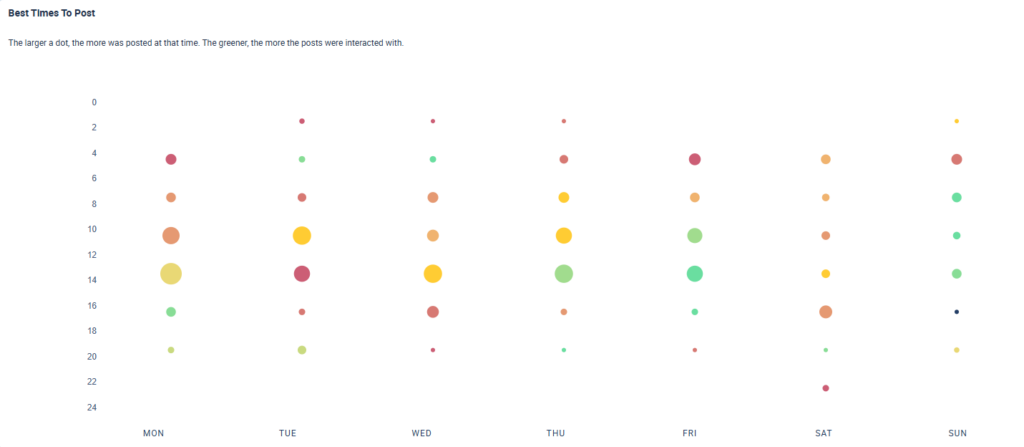
You can identify the best times to post in the example dataset by looking for time slots where competitors post less but interaction rates remain high (the small green dots). Based on this sample data, the strongest time frames are Thursdays and Saturdays around 6–7 pm.
2. Learn From Competitor Data
Competitor data analysis can offer valuable insights into your own target audience, as your competitors’ followers often overlap with the audience you want to reach.The real strength of these analyses lies in the larger data pool, which makes insights more reliable and less biased and allows you to spot patterns and correlations between posting behaviors and user feedback. Facebook competitor analysis and benchmarking highlights which topics, formats, and posting patterns are most likely to drive attention and engagement and thus will have higher chances of getting picked up by the Facebook algorithm.
Studying your competitors is particularly useful when trying to identify patterns in user behavior through analyses such as:
- Content format distribution, linking post formats to engagement levels
- Posting frequency vs. performance, showing how output impacts interaction rates
- Engagement quality patterns, focusing on comment depth rather than raw reactions
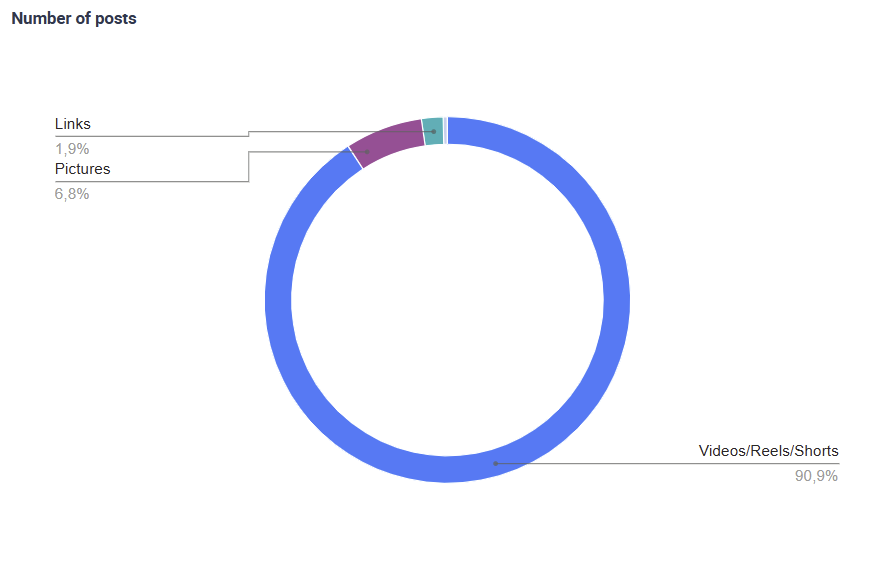
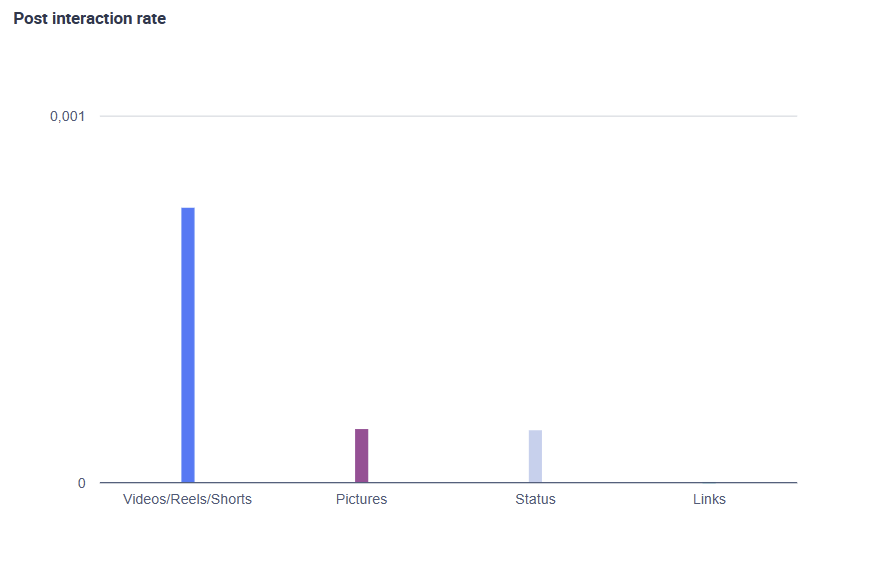
One example is shown below. In this analysis, we looked at which content types soft drink brands publish most frequently and compared this distribution with interaction rates by format. For this, we used data from the Facebook accounts of the earlier mentioned brands and compared the number of posts by format with the post interaction rate side by side, helping illustrate how optimization for the Facebook algorithm works in practice.
The insights are valuable because the accounts we are tracking are comparable in terms of market niche, size, and audience. The results indicate that around 90% of posts on the soft drink brands’ Facebook accounts in the last 28 days were Reels, which aligns with user behavior, as interaction rates within the target group are also highest for this content type.
3. Use Keywords That Drive Engagement
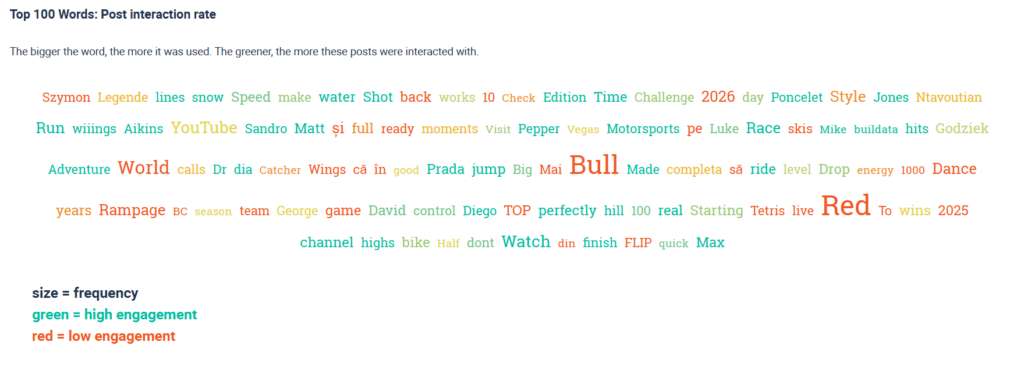
A keyword analysis is one of the most useful tools when trying to identify the topics that your target group is most interested in. By analyzing captions at scale, social media tools can identify the words and topics that appear most often in your posts and highlight the keywords that consistently drive higher interaction rates. Looking at these correlations between keywords and user behaviors of the posts from profiles in your dataset, you can better understand how the Facebook algorithm works and what content resonates most with your audience.
These insights help you identify relevant and trending topics that resonate with your audience. At the same time, you can use the derived keywords to refine your Facebook SEO strategy. Both approaches make it easier for the Facebook algorithm to correctly interpret and surface your content to the right audience, increasing your chances of higher rankings.
The example below illustrates this using soft drink brands over the last quarter (October to December 2025), where larger text indicates higher keyword usage and greener terms reflect stronger engagement.
4. Create a Balanced Content Mix
While Reels play a central role in distribution, relying on a single format limits how much the Facebook algorithm can learn about your audience. A diverse content mix gives the algorithm more signals to work with, such as which users prefer video, carousels, or static posts.
This matters because the algorithm doesn’t just rank content, it matches formats to user behavior. By publishing different formats, you increase the chances that your content aligns with individual preferences, leading to stronger engagement signals and broader distribution.
Balance doesn’t mean using every format equally. The right mix depends on how your audience consumes content, so regular analysis is key, as preferences can vary significantly between target groups.
5. Use Tagging to Identify Your Most Engaging Content
A content tagging analysis enables you to label posts according to what can be seen in the post, but also to other factors such as content type, topic, tone, format, or creative elements. On Facebook, this makes it possible to identify patterns between specific content attributes and how users engage.
This can be an important analysis for social media pros since it can help you uncover which characteristics of posts consistently correlate with higher interaction rates. Instead of guessing which content might work, you can clearly see which elements drive engagement signals that the algorithm uses for ranking, allowing you to replicate and scale successful content more effectively.
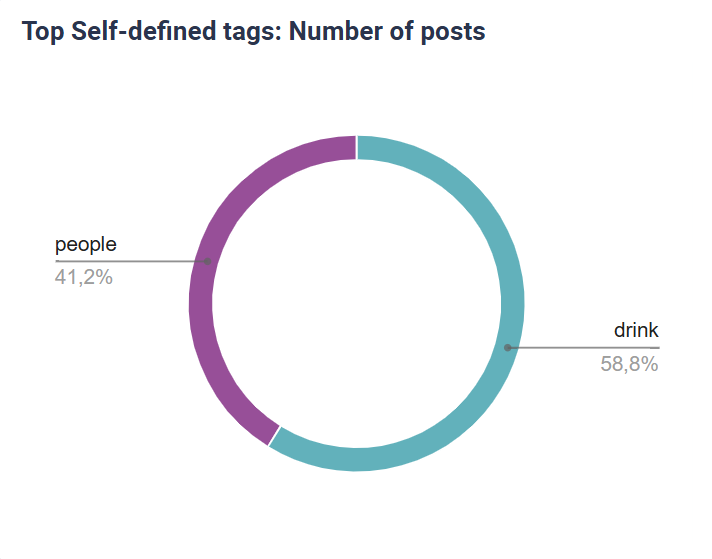
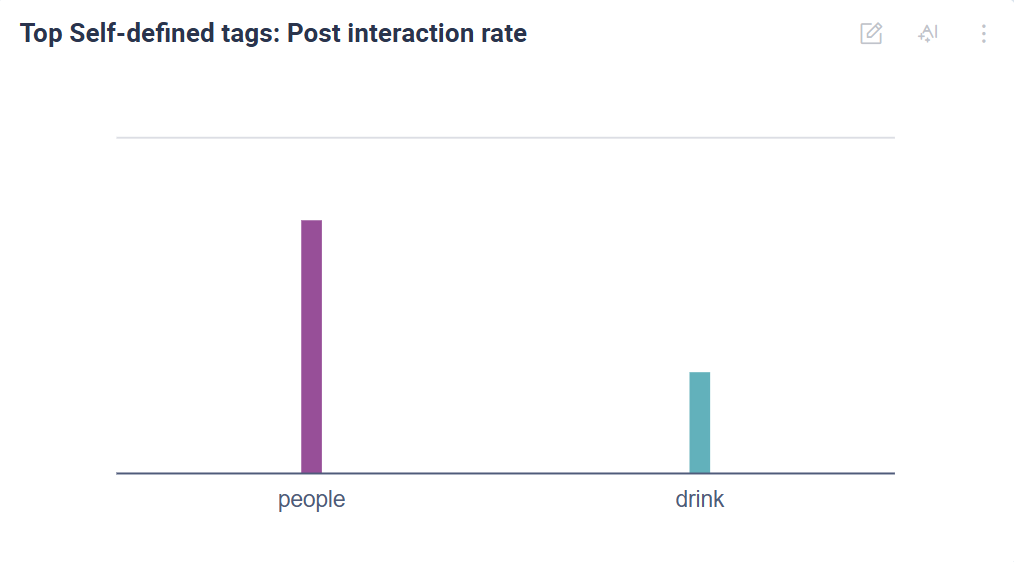
To lead with a practical example, we tagged posts from soft drink brands on Facebook based on whether the content focused on the product itself or on people. The goal was to identify which content characteristics correlate with higher interaction rates and therefore send stronger signals to the Facebook algorithm.
The results show a clear pattern:
- Posts featuring drinks are overall more frequent (58,8%) than people-focused posts (41,2%).
- However, when comparing post interaction rates, posts centering people showed higher interaction rates (0,015%) than drink-centred posts (0,006%).
This suggests that, during the analyzed timeframe, human-centered content generated more engagement on the Facebook accounts of the soft drink brands. These insights give you a clear direction for optimizing future content and can be applied across niches to better understand what your audience responds to.
How to Reset the Facebook Algorithm
You might want to reset your Facebook algorithm when your feed no longer reflects your interests, engagement feels irrelevant, or performance drops despite consistent quality. Over time, repeated interactions, skips, or negative signals can train the system in a direction that no longer matches your goals.
If you’ve been wondering how to clear your Facebook algorithm, it’s important to know that Facebook does not offer a reset button tied to your account. A true hard reset would require starting over with a new Facebook account. However, a soft reset allows you to gradually retrain the system rather than starting from scratch. This can be achieved through:
- Actively engaging with the type of content you want to see more of
- Hiding posts and unfollowing pages that no longer match your interests
- Adjusting ad preferences and removing outdated interests
- Clearing app cache and browsing activity to reduce short-term bias
- Spending more time with relevant content formats (Reels, videos, discussions)

Conclusion
The Facebook algorithm 2026 clearly prioritizes relevance, attention, and consistent value to ensure that the content meets the viewer’s expectations long-term. Content performance is additionally shaped by real user behavior, including watch time and meaningful interactions. While Reels and videos remain key for discovery, performance depends on originality, strong audience relationships, a balanced content mix, and minimizing negative feedback. Understanding these signals and optimizing based on real performance data is now essential for anyone managing a Facebook account.
Social media management tools can support marketers across many aspects of content creation and performance. When adapting your content to the new TikTok algorithm update in 2025, Fanpage Karma’s publishing and community management features help streamline the posting process. The community management tool helps you keep track of incoming interactions across all your social media accounts. In addition, the platform’s integrated analytics tool provides the insights needed to fine-tune your Facebook strategy based on real performance data.If you’d like to explore how Fanpage Karma can help improve your results, you can join a free weekly webinar or try the tool by starting your free trial.