Learn How to Reach More People on Instagram

Whether you run a small business or manage an international brand, your reach on Instagram clearly shows whether your strategy is working. As a KPI, reach is the starting point for everything that follows. Engagement, conversions, and long-term brand growth only happen if your content is visible to the right audience first.
That is why you need to think strategically about how to improve your Instagram reach when defining broader business goals, because reach is not isolated from performance but the basis of growth. In this guide, you will get practical, execution-focused insights on how to reach more accounts on Instagram, including whether Instagram is the right channel for your audience, how distribution works, and which levers you can realistically pull to maximize your visibility.
The insights in this guide are grounded in multiple data-driven studies designed to uncover what actually helps brands increase Instagram reach, covering emotional impact, hashtag strategy, content formats, and the role of different CTAs in content distribution.
How Well Can You Actually Reach Your Followers on Instagram?
Reach is a critical KPI for social media managers because it is the earliest indicator of how widely Instagram distributes your content. While it does not guarantee you are reaching the right audience, it shows whether the algorithm is surfacing your content at scale and gives you the first signal of distribution performance.
Before getting into how to increase Instagram reach, let’s ask a more fundamental question: can you actually reach your followers on Instagram? This social media network is obviously popular, but is it actually effective at reaching your followers?
We have looked into this issue and found that the number of users reached by a post on Instagram is surprisingly high. This is especially true of small profiles, which reach more than half of their followers with a single post. In our study we saw that, for profiles with between 500 and 1,000 followers, 48% of the followers see the post on average.
But not all the users who are reached with a post are necessarily followers of the profile. Through hashtags or the Discover function, posts can also reach users who are not connected to the profile. We should also note that, as the number of followers increases, the reach per follower decreases. However, there is no reason to complain. As you see below, even large followings have a solid amount of reach.
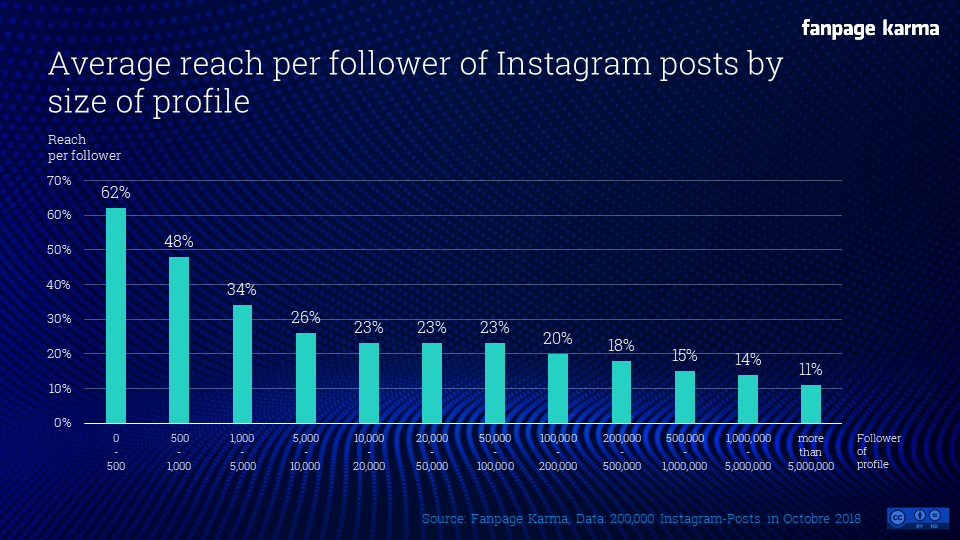
Keep in mind that these values are only averages. Performance varies depending on content quality and audience behavior.
Reach is also dynamic. As your account grows, Instagram recalibrates distribution based on past performance, interaction history, and topic consistency. Your content trains the system who to show your posts to.
That is why reach should never be optimized in isolation. It is directly connected to the following strategic goals:
- Grow your follower base: Follower growth acts as a trust and momentum signal. This is why the question of how to get more followers on Instagram directly impacts future distribution potential.
- Increase your engagement rate: Engagement confirms content quality. If you want to increase Instagram reach organically, consistent interaction signals that your content deserves broader exposure.
- Maintain content consistency: Clear and repeated topic signals help Instagram categorize your account correctly and match it with the right audience.
Growth expands your potential pool. Engagement determines how far each post travels. Together, these signals shape your long-term reach performance.
How to Reach More People on Instagram
As we have seen, you can reach both followers and non-followers on Instagram. The real question is how to increase Instagram reach in a reliable and scalable way. There is no shortage of advice online, but much of it is based on opinion rather than evidence.
This guide focuses exclusively on insights derived from data-driven studies analyzing large volumes of Instagram content. Instead of repeating common assumptions, we highlight patterns that consistently correlate with higher distribution and visibility.
Based on this research, four core levers to increase reach on Instagram stand out:
- Generate Strong Emotions
- Use the Right Hashtags
- Pay Attention to Content Formats
- Think About Your CTAs
Generate Strong Emotions
Let’s start with emotions. We have conducted a study where we focused specifically on Instagram Reels and wanted to answer a simple question: whether strong emotions in Reels lead to higher reach and engagement, and, if so, which of all the emotions resonate best with the Instagram users.
In the following section, we will first be highlighting 3 key empirical findings of our study related to emotions in Instagram Reels. Then we will show you how to get these results for your own market niche by employing a tagging analysis.
- Reels that trigger strong emotions are a key to increasing reach and engagement
- Positive sentiment in Reels leads to the highest reach and engagement rate
- Conduct a tagging analysis to find what content resonates with your audience
1. Reels That Trigger Strong Emotions Are Key to Increasing Reach and Engagement
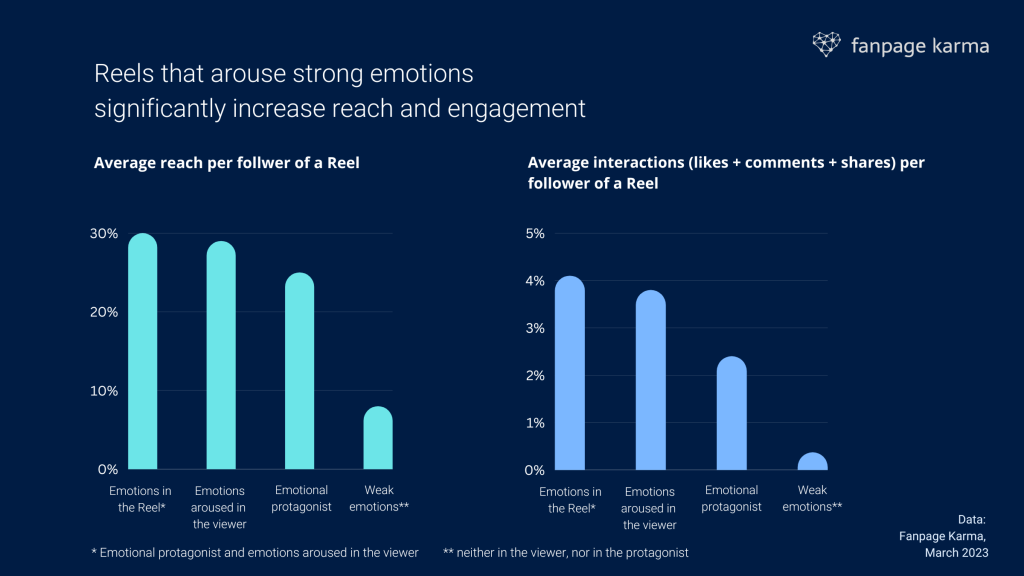
It turns out that if you’re looking for ways on how to improve Instagram reach, emotions should be at the center of your strategy. Our study of 700+ Reels shows a clear pattern:
- Reels with strong emotions reach 30% of followers on average, compared to just 8% for Reels with weak emotions.
- That means emotionally strong Reels reach nearly four times more people.
- They also generate 11x higher engagement rates.
- Average engagement rate for strong-emotion Reels: 4.1%.
- Average engagement rate for weak-emotion Reels: 0.37%.
The difference isn’t subtle. Strong emotions dramatically increase both visibility and interaction.
2. Positive Sentiment in Reels Leads to the Highest Reach and Engagement Rate
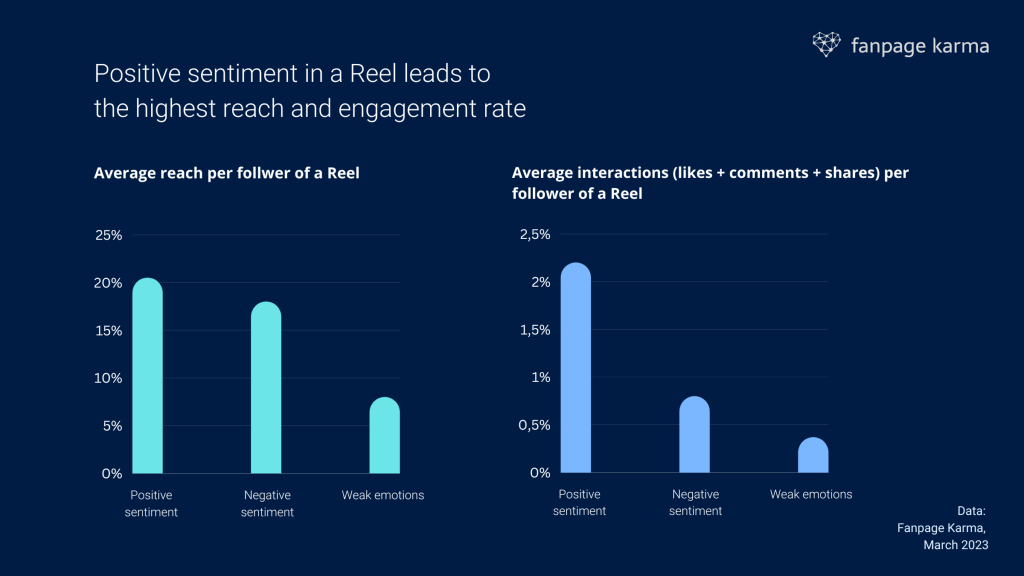
The second study related to increasing Instagram reach has to do with generating positive sentiments. In analyzing the sentiment of Instagram Reels, we found that Reels that contain positive sentiments achieve on average 2.5 times higher reach than Reels with weak emotions, and also 14% higher reach than Reels with negative sentiments.
Unsurprisingly, funny content works well in Instagram Reels. After all, people who make us laugh usually earn our likes, and these may be predominately the Reels we share with our friends. In fact, funny Reels reach almost four times as many people on average as Reels that arouse only weak emotions.
Likewise, Reels that create empathy significantly increase reach on Instagram. Our analysis shows clear performance differences based on emotional intensity:
- Empathy-evoking Reels reach 3.5x more people than Reels that trigger only weak emotions.
- Joy-eliciting Reels appear 4.5x more often in feeds compared to emotionally neutral content.
- On average, joyful Reels achieved 36.5% visibility vs. just 8% for Reels with weak emotional impact.
The takeaway: the stronger the emotional response, the higher the reach.
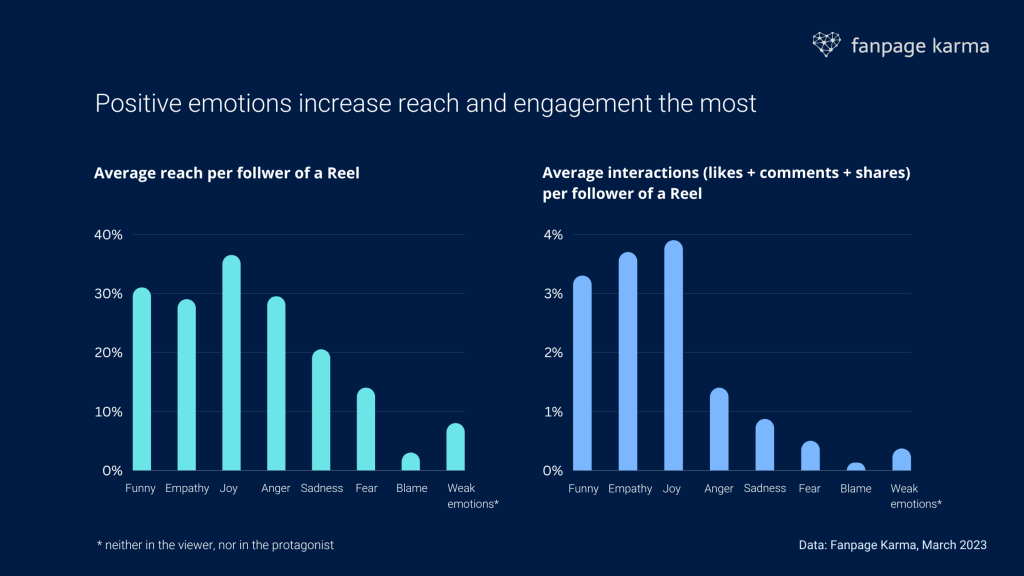
Although the effect is less pronounced than for positive emotions, most strong negative emotions also lead to an increase in reach. For instance, grief-filled Reels reach more than 2.5 times as many people as Reels with weak emotions. Fear-producing Reels also land on nearly twice as many screens.
3. Conduct A Tagging Analysis to Find What Content Resonates With Your Audience
A tagging analysis helps you identify which content characteristics actually drive interaction and understand why some posts perform better than others. Instead of only looking at KPIs across a bulk of posts, you analyze individual content pieces to uncover patterns in how users engage with them. By assigning structured tags to each post, you can systematically evaluate your content and uncover insights that standard KPI analytics alone cannot reveal:
- Tone of voice (inspirational, humorous, serious, provocative)
- Emotional framing (joy, empathy, anger, urgency, neutrality)
- Content focus (educational, community-driven, activist, product-focused)
- Content format (Reel, carousel, static post, Story)
- Call-to-action type (question, save prompt, share prompt, link in bio)
- Visual style (UGC-style, polished brand visuals, behind-the-scenes)
- Narrative structure (storytelling vs. direct information)
- Value proposition (entertainment, practical tips, inspiration, discounts)
Tagging these variables helps you identify which combinations actually drive saves, comments, and shares. These engagement signals influence the algorithm and play a central role in how to reach more people on Instagram.
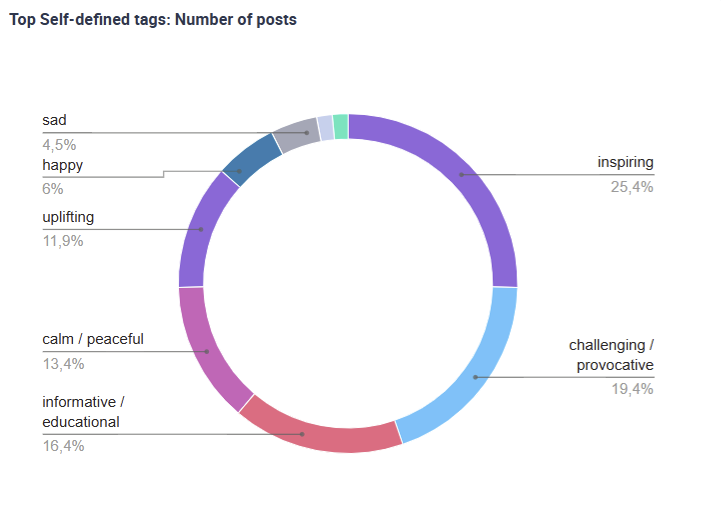
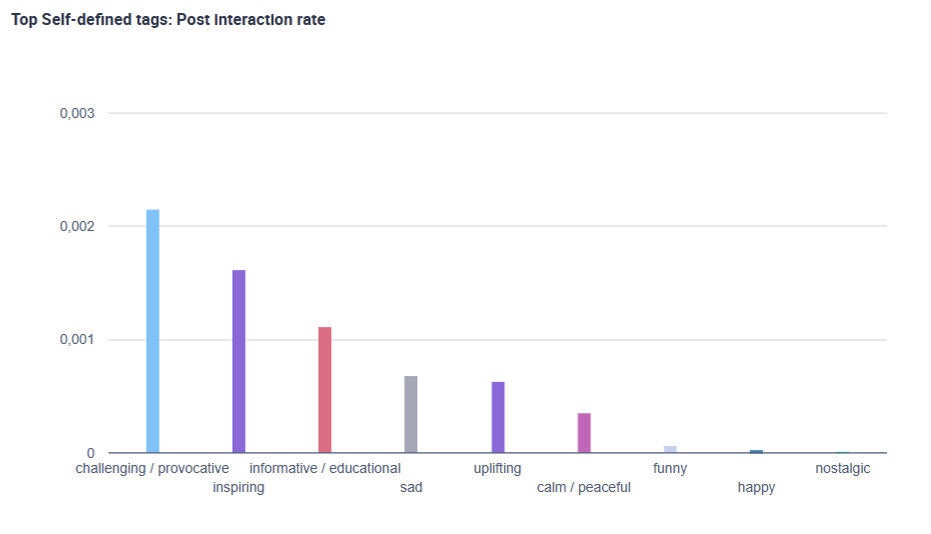
To illustrate this, we analyzed Reels published between October 2025 and December 2025 across six sustainable outdoor & performance apparel brands: Patagonia, Girlfriend Collective, Houdini Sportswear, prAna, Cotopaxi, and tentree. By tagging each Reel according to its dominant emotional mood, we were able to compare interaction rates and identify recurring performance patterns across brands.
The first chart shows how often each emotional tag appears. Inspiring content leads with 25.4% of posts, followed by challenging/provocative (19.4%) and informative/educational (16.4%), while happy (6%) and sad (4.5%) content appear much less frequently.
The second chart shows interaction rates by emotional tag, revealing what actually performs. Challenging/provocative content achieves the highest interaction rate (around 0.002+), followed by inspiring (~0.0016) and informative content (~0.0011), while happy and nostalgic content remain close to zero.
The tagging analysis reveals clear patterns in how emotional framing influences interaction rates and in that also how brands plan their content. Some of the main findings are summarized below:
- Content strategies are fairly balanced across emotional tones
- Challenging or provocative Reels achieve the highest interaction rates
- Inspirational content performs strongly and is widely used
- Happy, funny, and nostalgic content types underperformed.
Use the Right Hashtags
In the following, we will explore how the logic of hashtag usage has changed and what you need to know if you want to increase your reach on Instagram today. Most importantly, we advocate for a more intentional, data-driven use of hashtags instead of relying on gut feeling. Here’s how we will break this down step-by-step:
- Hashtags Work…. Use Them!
- Highly Specific Hashtags Work Best!
- Choose your Hashtags Wisely
Hashtags Work…. Use Them!
While some may see hashtags as a relic of social media’s early days and associate them more with passing trends than with real strategy, they are far from outdated. Used intentionally and with clear relevance, hashtags still contribute to helping you increase your reach on Instagram.
Your social SEO strategy helps you optimize your social media content so it aligns with how users search inside platforms like Instagram. Just like traditional SEO, it focuses on matching keywords and phrasing with user intent, only here the search happens within captions, profiles, and hashtags. That makes hashtag selection more strategic than ever. With Instagram’s new five-hashtag limit, each hashtag must support search intent and accurately reflect what your content is about. In this context, hashtags play an important role when faced with the question of how to reach non-followers on Instagram, since relevant and well-chosen terms make your content discoverable when users actively search for specific topics.
Highly Specific Hashtags Work Best!
Just a few years ago, the rule for hashtag use on Instagram was simple: the more hashtags, the better. That no longer applies. Instagram now limits posts to five hashtags, which changes the logic of how to improve reach on Instagram significantly. Using hashtags that hit the nail on the head has now become essential.
Instagram recommends using highly relevant, specific terms instead of broad tags like #explore or #reels. Generic hashtags drown your content in oversaturated feeds and can even have the opposite effect of what you intend, since they fail to send strong signals to the algorithm. With only five spots available, each hashtag needs to clearly define your niche so Instagram knows exactly who to show your post to.
Choose Your Hashtags Wisely
Because effective hashtags are critical if you want to increase your reach on Instagram, you should base your selection on real performance data. Instead of guessing, analyze past posts from your own account and your competitors to see which hashtags consistently generated higher interaction rates.
Competitor data in a hashtag analysis is especially valuable because you compete for the same audience. It expands your dataset, reveals industry patterns, and helps you identify hashtags that historically improved engagement and may indicate stronger ranking signals within the Instagram algorithm.
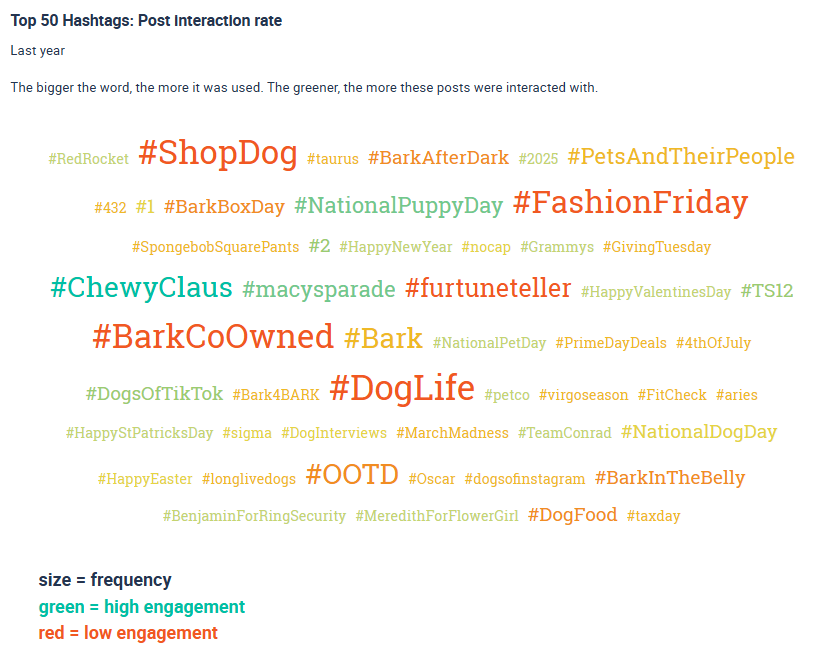
In a practical example, we show how you can use hashtag performance data to improve your Instagram reach. We analyzed posts from the past six months, July 2025 to December 2025, across six major pet brands: kongcompany, bark, chewy, petco, thefarmersdog, and wildone. The graph on the right, created with the Fanpage Karma analytics tool, visualizes hashtag success based on usage frequency and interaction rates:
- Larger font size = the hashtag was used more frequently across analyzed posts.
- Deeper green color = the hashtag was associated with higher interaction rates, indicating stronger engagement performance.
Pay Attention to the Content Format
Another tip related to how to reach more accounts on Instagram is to pay attention to the content format you use. On Instagram, this mainly means choosing between static images, Carousels, Reels, and Stories. While static posts, Carousels, and Reels remain on your profile grid without a time limit, Stories disappear after 24 hours. However, you can save them as Highlights, which are displayed above your post grid.
For social media managers, comparing these formats is essential. It helps you understand which formats perform best overall, which formats complement which types of content, and how to build the right content mix for your account.
In the next two sections, we’ll explore both large-scale data insights and industry-specific findings to better understand how different content formats perform on Instagram:
- Posts Generate the Greatest Reach
- Conduct Your Own Market-Specific Research
Posts Generate the Greatest Reach
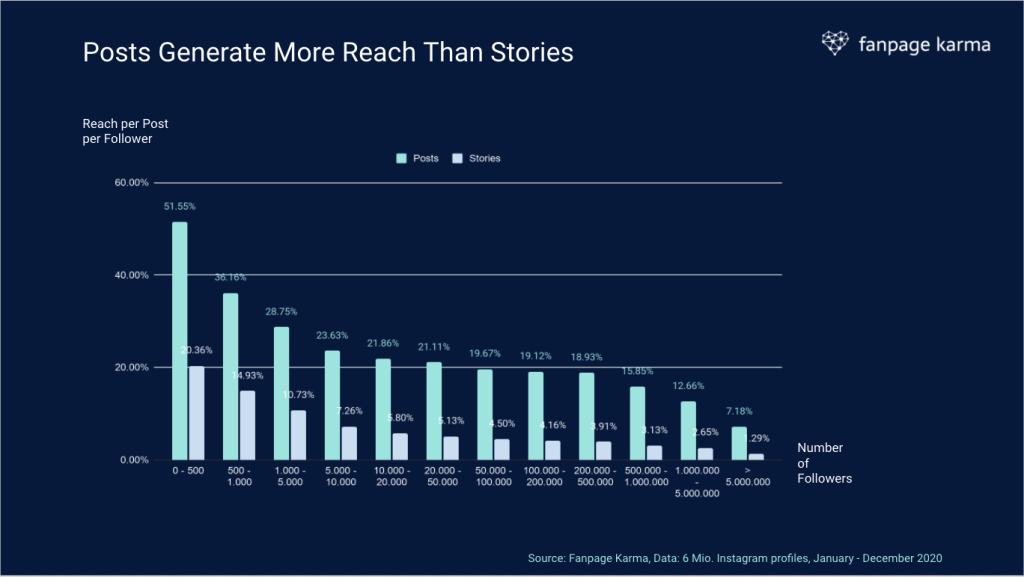
We started with a simple question: do posts or Stories generate more reach on Instagram? The data gave us a clear answer. Feed posts achieve significantly higher reach than Stories. At the same time, reach declines when posting frequency increases, regardless of format.
To compare profiles of different sizes fairly, we analyzed reach per post per follower. This is crucial because larger accounts will always generate higher absolute reach. For example:
- A profile with 50,000 followers and 20% reach reaches 10,000 people per post.
- A profile with 1,000 followers and 30% reach reaches 300 people per post.
Even though the smaller account has a higher percentage reach, the larger account still reaches more people overall. That’s why dividing reach by follower count is necessary to make performance comparable. The results of our study show that:
- A post from a 20,000-follower profile reaches 21.86% of followers on average.
- A Story from the same profile reaches 5.80% of followers on average.
One reason for this difference is visibility duration. While Stories disappear after 24 hours, posts remain accessible. Posts are also distributed further as they can be shown to non-followers in Explore.
That said, Stories still play an important strategic role. They often generate repeated views, and these recurring impressions can strengthen brand awareness and audience relationships over time.
Conduct Your Own Market-Specific Research
While the data in the previous section is based on more than 6 million Instagram accounts and therefore highly robust, your own niche-specific analysis can uncover insights that large-scale studies cannot. If you want to refine your strategy and better understand how to set it up, focus on the following:
- Stay on top of performance shifts within your niche instead of relying only on global averages
- Identify high-performing content types and formats that resonate specifically with your audience
- Broaden your competitive landscape by analyzing adjacent brands or emerging players
- Prioritize the metrics that match your marketing goals, whether that’s saves, shares, reach, or conversions.
Social media competitor analysis and benchmarking isn’t just about seeing how you compare to others. It’s one of the most effective ways to understand your audience’s behavior and optimize your content for what they actually respond to. We’ve already shown you a few levers throughout this article, but here are some additional key analyses to focus on when optimizing your content and posting strategy to increase Instagram reach:
- best time to post analysis: Identify when your audience is most active and when your content gets the highest reach or engagement
- Content format performance: Compare how Reels, Carousels, and images perform based on interactions like likes, comments, and shares
- Engagement pattern analysis: Understand which posts drive saves, shares, or comments and what that says about content quality
- Frequency vs. performance correlation: Analyze how posting more or less often impacts reach and engagement
Think about your CTAs
When looking into how to increase reach on Instagram, you won’t find many discussions about CTAs. Yet the question is obvious: do calls to action actually influence reach?
To answer this, we analyzed 540 Instagram Reels to understand how different CTA types affect performance. The results reveal clear best practices. Below, we break down the key findings.
- Do not Engage in Obvious Advertising
- Logos and Slogans in Reels Are Considered Advertising
- Beware of Calls-to-Action in Reels
- These Calls-to-Action Do Not Improve Your Reel’s Reach
- These Calls-to-Action Actually Lead to Greater Reach
1. Do not Engage in Obvious Advertising
It goes without saying that many companies and influencers use Instagram Reels as a sales tool. However, our study shows that if a Reel contains direct product advertising, its reach drops drastically. Reels without advertising reach almost twice as many people as those that promote a product, regardless of whether the content is exciting, creative, or inspiring.
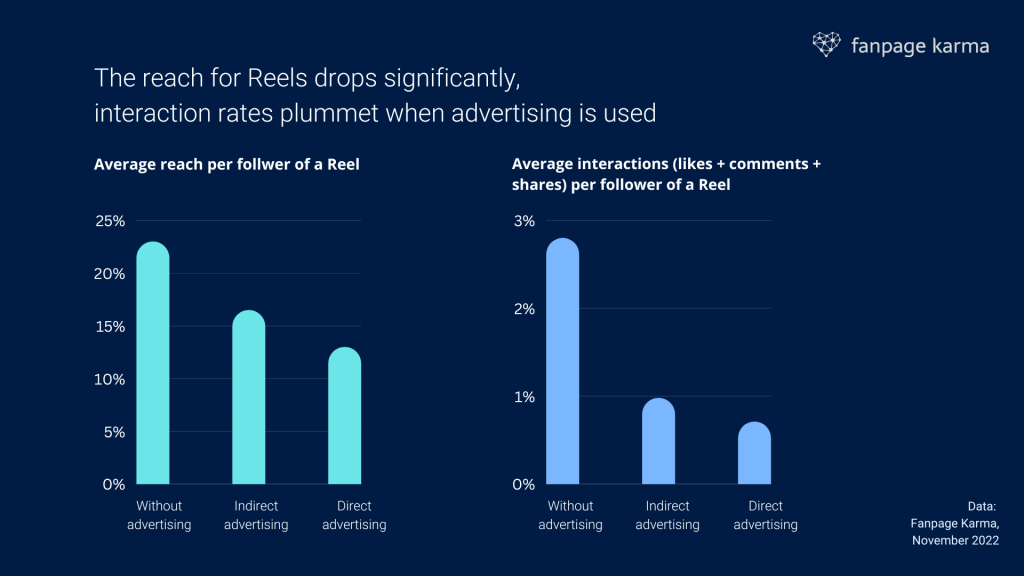
With this data in mind, indirect advertising is usually the smarter approach. Instead of pushing products directly, focus on value and emotional positioning. For example:
- Show expertise by sharing insights, tips, or industry knowledge
- Highlight innovation such as concept products or behind-the-scenes development
- Create positive brand associations by placing products in inspiring or relatable contexts
- Trigger emotions that make your brand feel aspirational or trustworthy
- Add brand-specific twists to popular trends that align with your brand
However, even indirect promotion has a measurable cost:
- Around one third lower reach compared to non-promotional Reels
- Around two thirds fewer interactions
Whether that trade-off is worth it depends on your goals, margins, and long-term brand strategy.
2. Logos and Slogans in Reels Are Considered Advertising
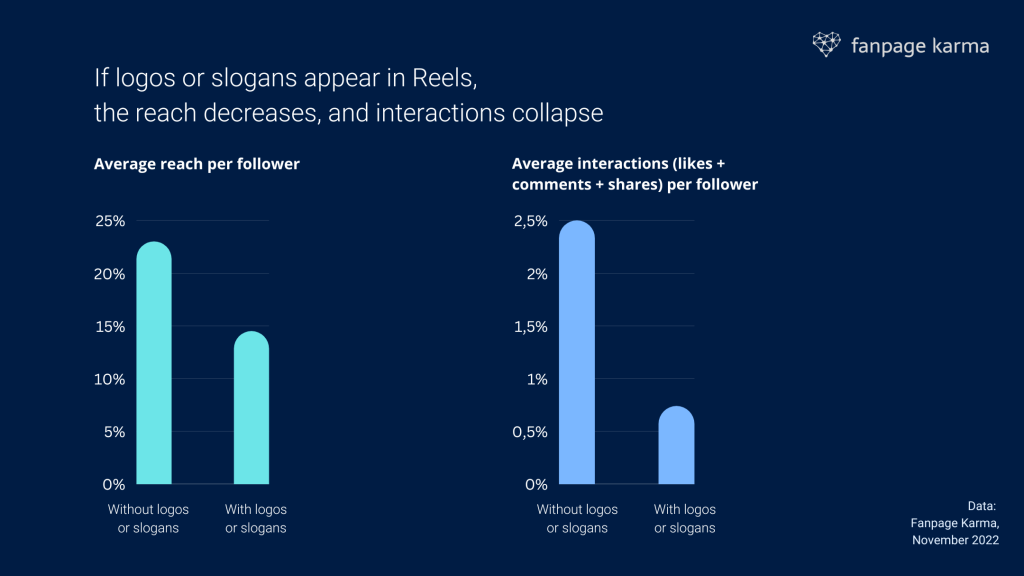
Many brands place their logo or slogan at the end of a Reel. But if you’re thinking about how to improve Instagram reach, this tactic can backfire. Including a slogan or logo works like subtle advertising and can reduce the performance of your content.
Our research shows that Reels displaying logos or slogans lead to measurable losses:
- 36% lower reach on average
- 70% lower interaction rates
If your goal is to increase reach, it’s often more effective to replace the logo outro with a clear call to action.
3. Beware of Calls-to-Action in Reels
When analyzing how to increase reach on Instagram, we wanted to answer two specific questions:
- Do CTAs influence the overall performance of a Reel?
- Does the type of CTA used make a difference?
Our data shows that Reels with a CTA actually performed worse overall than those without one. Here’s what we found:
- 11% lower reach for Reels with a CTA
- 33% fewer likes and comments compared to Reels without a CTA
- No significant difference between CTAs spoken out loud, shown visually, or placed in the caption of the Reel
That said, not every call to action performs the same. Let’s take a closer look at which types can support performance and which may hurt it.
4. These Calls-to-Action do not Improve your Reel’s Reach
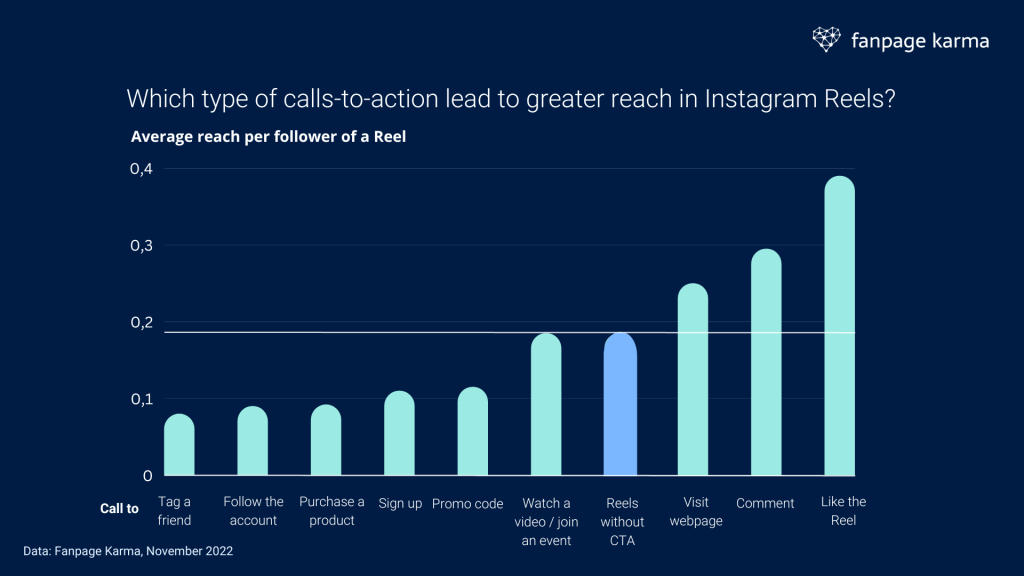
Our analysis shows clear differences depending on the type of CTA used. Reels that ask viewers to tag friends, follow an account, or buy a product performed worst. Their reach was 60–65% lower compared to Reels without these prompts.
Reels featuring discount codes or registration prompts also underperformed, reaching only about half as many people as Reels without a CTA. Even softer prompts, such as inviting users to watch another video or attend an event, still resulted in a 25% drop in reach.
5. These Calls-to-Action Actually Lead to Greater Reach
As seen in the graph above, there are some CTAs that still drive engagement, leading to an increase in reach on Instagram. Here is a breakdown of the types of CTAs that benefitted the the content’s performance:
- Reels inviting viewers to visit a website show no loss in reach and even achieve 9% more reach than Reels without a CTA.
- Reels prompting users to comment generate 43% higher reach per follower.
- Reels that explicitly ask viewers to like the Reel reach 86% more people on average.
The pattern suggests that CTAs encouraging low-barrier engagement, such as liking or commenting, perform significantly better than prompts that require higher commitment, such as purchasing or registering.
Conclusion: How to Increase Instagram Reach
When thinking about ways to increase reach on Instagram, you should rely on data-driven best practices rather than assumptions. As we’ve shown, performance depends on multiple factors: using strong emotions to trigger interaction, selecting hashtags strategically, choosing the right content formats, and applying effective, low-barrier CTAs. Reach is rarely driven by a single tactic. It’s the combination that creates sustainable visibility.
It also helps to have a social media tool that supports your analytics process. The Fanpage Karma Tool comes with powerful data-analysis options to help you benchmark competitors and optimize your content. On top of that, Fanpage Karma comes with industry-leading community management, publishing, and research functions for social media. Try the free 14-day trial to see for yourself, or test one of our weekly free webinars to learn how to turn data into actionable insights.