TikTok vs. Instagram Reach: Who Really Sees Your Content Beyond Your Followers?
- One dataset, four very different reach patterns
- TikTok moves far beyond the follower base
- Reels come closest to an even split
- Images lean toward the audience you already have
- Stories stay closest to current followers
- Different formats reach different audience mixes
- Give every format a clear job
- Do not build a strategy around one percentage
- Conclusion: Match the format to the audience
Social media teams often plan around a simple assumption: publish a post, and followers will make up most of its audience. After all, those people have already chosen to follow the account. Yet reach does not always stay inside that familiar circle, and the balance between followers and non-followers can change dramatically from one platform or format to another.
So how much reach comes from existing followers, and how much comes from people who have not followed the account yet? We ran a study in April 2026, covering more than 6 million profiles across all countries, which offers a revealing snapshot about reach in terms of both followers and non-followers. The figures separate TikTok reach from three Instagram formats and show why content teams should look beyond one headline reach number when deciding what to publish where.
One dataset, four very different reach patterns
Our study divides reach into two audience groups: followers and non-followers. Each split adds up to 100%. In other words, the percentages show where a platform or format received its reach from. They do not show how many people it reached in total.
That distinction matters. A format can receive a large share of its reach from non-followers while still producing less total reach than another format. Conversely, a follower focused format could generate substantial reach, even if only a small share comes from outside the existing audience. Because the dataset does not include absolute reach totals, it cannot tell us which option delivered the highest overall volume. However, it does give us some interesting insights about reaching followers and non-followers on Instagram and TikTok.
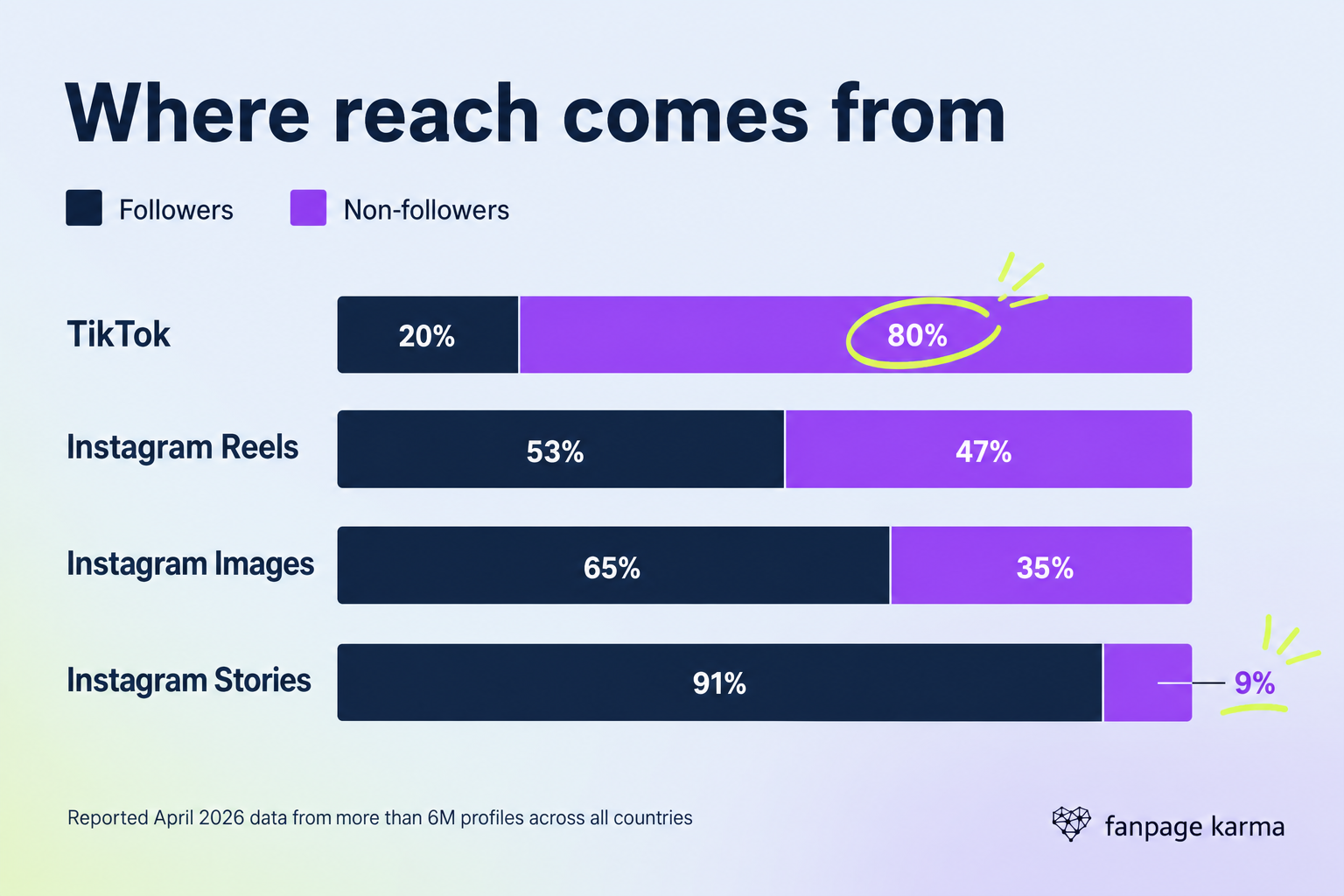
The results are hard to miss. TikTok sits at one end with a clear non-follower majority. Instagram Stories sit at the other, with reach concentrated heavily among followers. Reels and images occupy the middle, although their audience mixes are still noticeably different.
TikTok moves far beyond the follower base
TikTok produced the most striking split in the dataset. Non-followers accounted for 80% of reported reach, while followers contributed 20%. Put simply, most of the reported TikTok reach came from people who had not already followed the account.
For social media teams, this makes TikTok especially relevant when the aim is to move content beyond an established audience. The result points to a strong role in audience discovery, but it does not explain why the split occurred. The dataset provides no information about recommendation systems, content types, posting behavior, or other factors that might have influenced distribution, so the percentage should not be turned into an algorithm claim.
In sum, here are the main takeaways of our study for TikTok:
- It shows that non-followers provided the majority of reported TikTok reach.
- It does not reveal the total reach generated by the profiles.
- It does not show whether non-followers watched, interacted, clicked, or followed afterward.
- It does not mean that every TikTok account will receive the same audience split.
The 80% figure is a helpful signal, not a growth guarantee. Reaching people outside the follower base creates an opportunity to introduce an account to new audiences. Whether that attention turns into meaningful results depends on information this dataset does not include.
Reels come closest to an even split
Instagram Reels had the most balanced audience mix in the reported data. Followers generated 53% of reach, and non-followers generated 47%. With only 6 percentage points between the groups, neither side held a commanding lead. Reels reached the existing audience while also receiving almost half of their reach from people outside it.
This balance makes Reels worth examining when one format needs to serve two purposes: remaining visible to followers and introducing content to people who have not followed the account. That is not a fixed rule for every profile, but it is the clearest pattern among the Instagram formats listed here. Reels had the highest non-follower share on Instagram, without losing the slight follower majority. A few things to keep in mind:
- Current followers still formed the slightly larger audience.
- Non-followers contributed almost half of reported reach.
- The audience split was much closer than it was for images or Stories.
- Reels should be assessed separately instead of being folded into one general Instagram reach figure.
Images lean toward the audience you already have
Instagram images received 65% of their reported reach from followers and 35% from non-followers. Followers therefore led by 30 percentage points. Even so, image reach was not confined to the existing audience. More than one-third came from people who did not follow the account, although the format was clearly more follower-focused than Reels.
One label leaves an important question open
The source uses the category Instagram images but does not define it further. It is unclear whether that label includes carousels or refers only to individual image posts. The available data cannot support separate conclusions about those formats. Teams comparing the result with their own reporting should therefore keep their definitions consistent and avoid combining images and carousels unless the categories genuinely match.
Stories stay closest to current followers
Instagram Stories showed the strongest follower majority. Followers accounted for 91% of reported reach, while non-followers accounted for 9%, creating an 82 percentage point gap. Among the listed Instagram formats, Stories had the lowest share of reach from people outside the follower base.
Low discovery does not mean low value
The finding does not make Stories ineffective. It only describes where their reach came from. The data does not measure whether Stories strengthened audience relationships, generated replies, supported customer communication, or produced another useful outcome. What it does suggest is a more follower-focused role: Stories may be better suited to communicating with people already connected to an account than to broad discovery. Individual account data is still needed to confirm that role.

Different formats reach different audience mixes
Ranking the four results by non-follower share makes the contrast particularly clear:
- TikTok at 80%
- Instagram Reels at 47%
- Instagram images at 35%
- Instagram Stories at 9%
The wider lesson is not that one format wins and the others lose. It is that social media reach is not one uniform metric. The audience behind that reach changes substantially by platform and format. Even within Instagram, the non-follower share ranges from 47% for Reels to 9% for Stories, so a single combined Instagram percentage could hide differences that matter for content planning.
There is one catch in the TikTok comparison
TikTok is represented by one overall platform figure, while Instagram is separated into Reels, images, and Stories. The source does not clarify whether the TikTok number includes every content format or how different TikTok formats may have been combined.
The figures can still show a broad contrast in the reported audience mix, but they should not be presented as a controlled format comparison. The Instagram results are more directly comparable with one another because they come from the same platform and reporting period. Even there, missing methodology means the differences should be treated as directional rather than universal.
Give every format a clear job
Before choosing a platform or format, decide who the content needs to reach. Is the post meant for current followers, people who have never encountered the account, or both? The largest percentage is not automatically the right answer. The useful choice is the format whose observed audience mix fits the purpose of the content.
When you want to reach new people
The data supports testing discovery-focused content on TikTok and Instagram Reels. TikTok had the largest reported non-follower share overall, while Reels led the listed Instagram formats. Content created for this purpose should make sense to someone with no previous knowledge of the account. The team can then compare its own follower and non-follower reach with the broader pattern instead of assuming the same split will appear automatically. The following are some things to keep in mind:
- Does the topic make sense to someone seeing the account for the first time?
- Can the post be understood without background from earlier content?
- Does the opening establish the subject quickly and clearly?
- Are non-followers becoming a meaningful part of the audience over several reporting periods?
When current followers are the priority
Stories provide the clearest follower-focused example in the dataset, followed by images. That does not make them secondary formats. It indicates that their reported reach was more concentrated among people who had already chosen to follow the account. Depending on the profile’s own results, that audience mix may suit updates for an established community, continuing topics that need prior context, or regular communication with followers. Some of the main topics may include:
- Updates intended for an established audience
- Ongoing topics that depend on previous context
- Content that continues an existing conversation
- Posts designed to support regular communication with followers
When both audiences matter
Reels offer the most balanced starting point in the reported data, with a slight follower majority and a substantial non-follower share. Teams can examine this format when they want to remain visible to followers without relying entirely on the existing audience. A mixed plan is usually more informative than forcing every format into the same role. Assign a purpose to each format, then judge it against that purpose.
Do not build a strategy around one percentage
Audience share needs context. A format with a high non-follower percentage may still have limited absolute reach, while a follower-heavy format may play an important role in ongoing communication. Neither outcome can be judged from the split alone. The practical response is to combine these broad findings with data from the account itself. Be sure to take into account the following points when planning your content strategy for reach on TikTok and Instagram:
- Define whether each content type is intended primarily for followers, non-followers, or both.
- Review follower and non-follower reach separately for every available format.
- Compare audience percentages with absolute reach instead of relying on the split alone.
- Keep platforms and formats separate so unlike categories are not combined.
- Review several reporting periods before treating a pattern as stable.
- Connect the source of reach with the performance measures that matter for the account.
This workflow keeps reach in its proper place. It becomes evidence for a content decision rather than a score that decides everything. A social media analytics platform such as Fanpage Karma can help organize cross-platform reporting and compare format performance over time, especially when teams need to keep several audience and content categories separate.
Conclusion: Match the format to the audience
The central pattern is clear. TikTok received 80% of its reported reach from non-followers. Instagram Reels were much more balanced, with 47% coming from non-followers. Images reached a more follower focused audience, with a 35% non-follower share, while Stories stayed closest to existing followers at just 9%.
Use those figures as a starting point, not a ready-made strategy. TikTok and Reels deserve attention when discovery matters, while images and especially Stories may be better suited to communication with the audience already in place. Give each format a clear purpose, check whether your own data supports that role, and review the pattern over time.
Fanpage Karma can support that analysis by bringing format and platform reporting into a consistent workflow. With leading analytics features and unlimited profile tracking, Fanpage Karma gives you the tools you need to analyze your performance and that of your competitors. Try Fanpage Karma’s free 14-day trial or take part in its free weekly webinar.