Your Ultimate Guide to Content Repurposing for Social Media

Social media is characterized by a constant flood of content, where reach is no longer a given. New formats, shorter attention spans, and algorithmic changes mean that even well-written content often only reaches a small portion of the target audience. Sometimes even great content doesn’t get seen, at least in the first go-around.
Repurposing content for further social media posts is a highly useful way to make sure your creative content ideas live on beyond one post. The reality is that recycling social media posts, content, and images can give you added opportunities to get your message out there. Moreover, it can help boost efficiency by allowing your team to more quickly create content.
In this article, we’ll show you how to take advantage of this development with social media content repurposing. We will highlight how to repurpose content for social media with proven techniques and give you insights as tips for perfecting your repurposing processes.
Get More Out of Existing Posts with Content Repurposing
Content repurposing for social media means specifically reworking old content and reusing it multiple times on different channels or in different formats. Not only does this save you from having to constantly search for new post ideas in time-consuming brainstorming sessions, but it also offers many other advantages:
- Reaching new target groups: Over time, your community changes. Recycled content reaches people who never saw the original post.
- Taking advantage of algorithmic benefits: Reposts and revisions of posts that have worked before have a good chance of being pushed again by the algorithm in their revised form.
- Saving time and resources: No complete restart since existing material is reused in a meaningful way. This results in less production effort without compromising on quality.
- Extending the lifespan of good ideas: Users expect relevant content, not always new content. Content that has performed well in the past appears trustworthy. Evergreen topics in particular can be refreshed regularly in this way.
- Strengthening core messages: Repetition increases brand awareness and thought leadership. It ensures that important statements and brand messages really stick with your target audience. This is especially true of content that requires explanation and needs to be played out several times before it gets through.
- More presence across all channels: The same topic can be implemented differently depending on the network. Adapted to different platform formats, an idea can become a video for TikTok, an Instagram carousel, or a detailed LinkedIn post.
Step-by-Step Guide to Content Repurposing for Social Media
Content repurposing works best when it’s not spontaneous but embedded in a clear process. Many social media teams already recycle content intuitively. However, only structured content repurposing strategies for social media ensure that ideas are reused systematically. Our step-by-step guide to repurposing content for social media includes the following four steps:
- Content Audit & Analysis
- Central Content Library
- Reimagine & Repurpose
- Distribution & Testing

1 – Content Audit & Analysis
Before content can be reused, you need an overview of what already exists. Conduct a content audit of your social media channels and ask yourself the following questions:
- Which posts have worked well in the past and why?
- Which ideas were strong in terms of content but were presented in the wrong format?
- Which materials from other areas (blog articles, white papers, newsletters, presentations) can be adapted for social media?
The more often these audits take place, the easier it is to continuously discover new content ideas with repurposing potential. Ideally, you should include these questions directly in your monthly social media reporting.
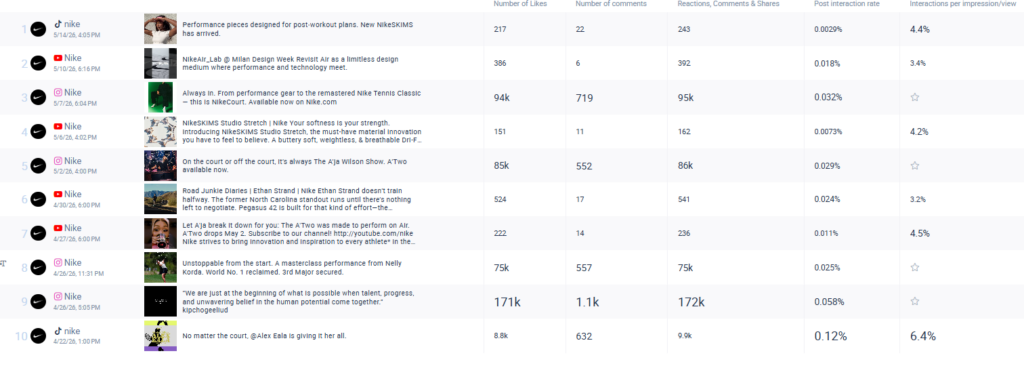
If you are looking to repurpose social media content, it makes sense to constantly audit your performance and look for high-performing content across different metrics. For instance, if you are a sports apparel brand such as Nike, you may want to start out by looking at all your top content in a table with the ability to filter the table for both timeframes and specific metrics, such as what posts got the most number of likes, comments, or the overall interaction rate. This can help you sort as you see in the table below:
Your strategy for social media content repurposing should also be based on data that analyzes not only your own performance but that of other competitors or similar profiles as well. Social media competitor analysis helps you learn from what others are doing and can be an important step in the content recycling process.
In the example below, we look at not only the performance data of the Nike Instagram account but also the Instagram accounts from Reebok, Puma, Lululemon, and Gymshark. Let’s say that earlier you posted on Instagram with a simple image and content. You may be wondering if you can reuse the content and/or image in a different format. After looking at the bar chart below, you see that carousels have a higher average post interaction rate. You can use this data point for content recycling here, which would be to repurpose your original post as a carousel since these have traditionally performed better in terms of post interaction.
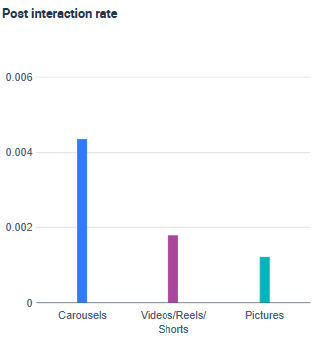
The reality is that you can use social media analytic data for further optimizing your content as part of the social media content recycling process. This involves analyzing the data from the past and can give you a clear indication of what to post in the future as part of a content recycling project. Most importantly, when done right, it can greatly enhance the way in which you repurpose your content.
2 – Central Content Library
Once it is clear which ideas have recycling potential, this content should be collected in one place, whether it is a social media publishing tool, a shared folder, or a shared board. It is crucial that all assets, such as visuals, hooks, copy, data, links, etc., can be found quickly.
A central content library ensures that ideas are not lost and prevents duplication of work. This structure is invaluable, especially in larger marketing teams that manage many social media channels or in agencies where many different people work together.
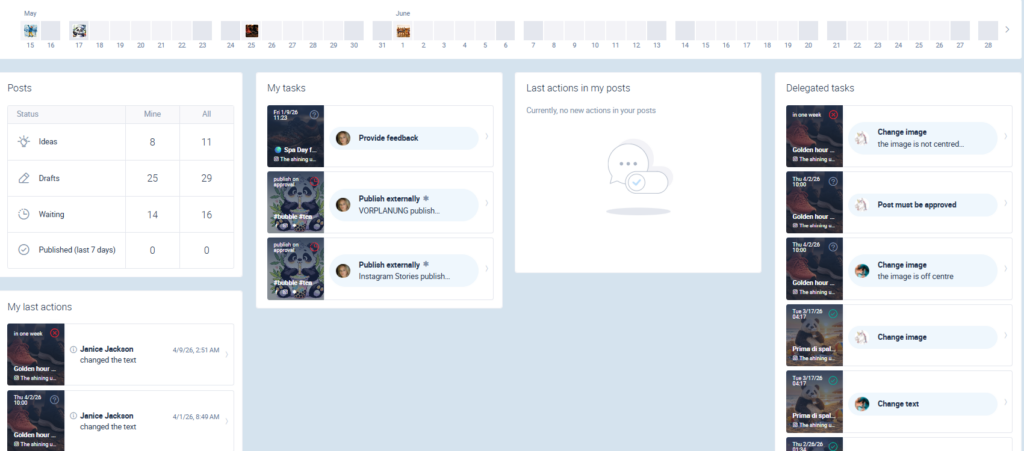
Keep in mind that effectively repurposing social media content requires organized planning. Simply having a content library is not enough. Rather, using the project management features of your social media publishing tool can make organizing all the tasks associated with recycling content on one common platform much easier. Mostly, it is important to have an overview of the tasks assigned to different colleagues so the process proceeds smoothly. As you can see in the example below, having an overview of all content tasks can be helpful for teams:
3 – Reimagine & Repurpose
The third step is to give the content identified during the content audit a new twist. Depending on the original idea, this can take many different forms: a different perspective, a new hook, a current example, a compact summary, or conversion into an entirely new format.
It’s not just creativity that matters here, but also which implementation best suits the respective target group and platform. Here are some practical examples of how to repurpose content for social media:
- A blog article becomes an Instagram carousel.
- A LinkedIn post becomes several short clips for TikTok.
- An infographic becomes a story format with interactive elements.
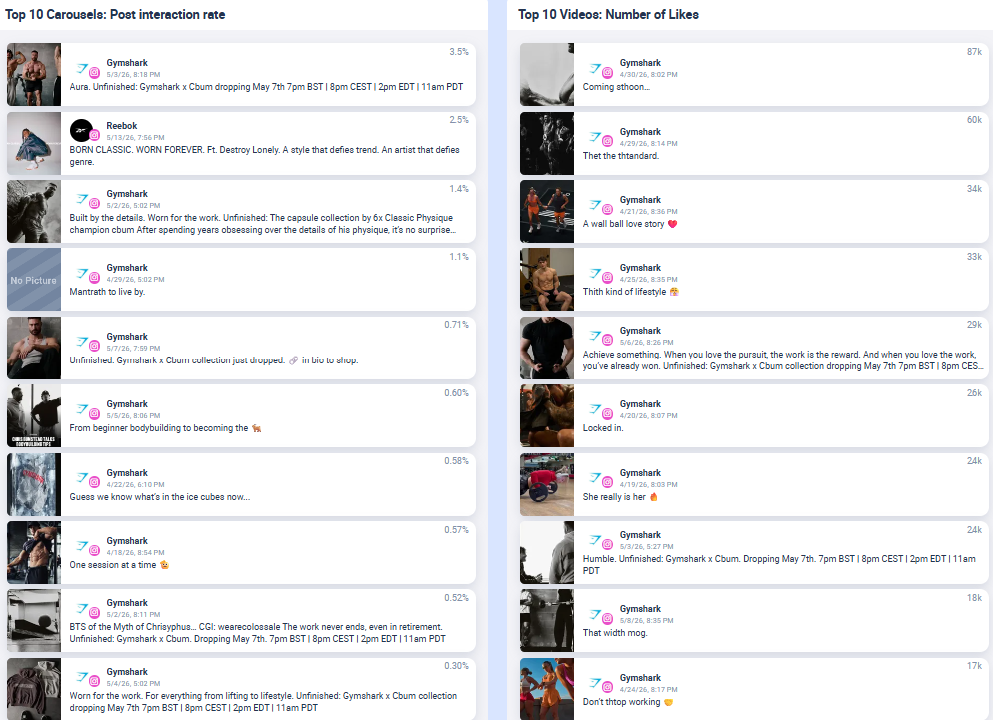
As mentioned above, content optimization research is important in the overall process of repurposing social media content. In addition to looking for trends, you may just want to look at the top-performing content to help inspire you. For instance, you use a social media analytics tool to sort for the top-performing content in various formats, in this case carousels or videos on Instagram, as shown below:
Further down in this article, we have collected even more specific content repurposing tips and quick ideas for everyday social media use.
4 – Distribution & Testing
Even recycled content only has an impact when it is actively implemented. That’s why a practical content repurposing strategy always includes a clear distribution plan (i.e., when, where, and how the content should be published).
In most cases, the formats defined in step 3 already determine on which network and in which format a piece of content should be published. To ensure that the new post ideas are picked up by the algorithms and played to the respective target group, it is important to find the best posting time for each social media platform, industry, and target group.
Once you’ve published your posts, the cycle starts again with step 1 of this guide. It is important to conduct regular content audits to check whether the new version is performing better than the original posts, and incorporate your findings into the next recycling rounds.
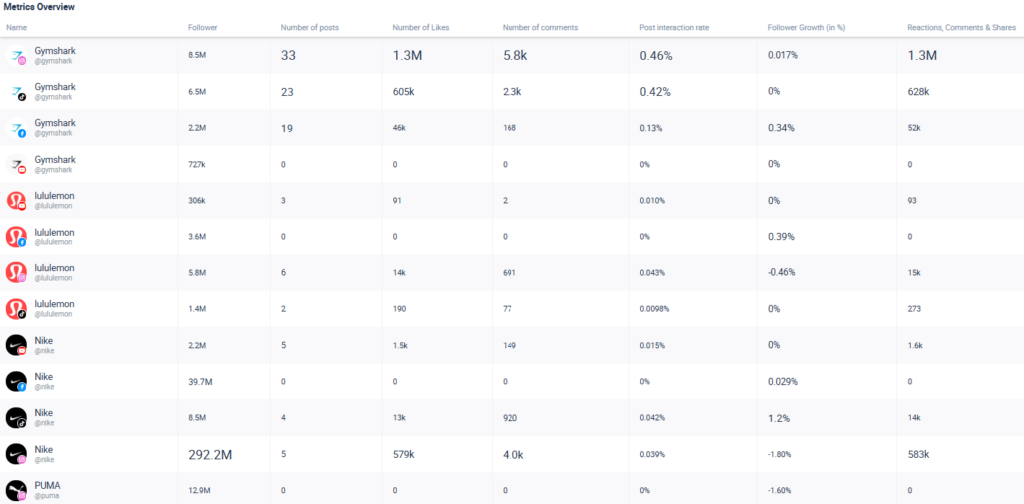
Below we see an example of a benchmarking table, which can help you better compare profiles across different metrics. With the option to adjust various dates for longer or shorter timeframes, we can get a sense of how well the aforementioned sports apparel brands are performing. This can help you better see how your profiles are trending vis-a-vis other competitors over time and shows you if your strategy is working or if it needs a change.
13 Ideas for Smart Content Repurposing
In everyday social media, quick, practical solutions are what count. We will present a number of social media content repurposing strategies to show how existing content can be reimagined and efficiently repurposed without much effort. In doing so, we will provide some social media content repurposing examples to help you get going.
Rethink Content Creatively
Some of the most straightforward content repurposing strategies for social media involve making some creative changes to existing posts’ content. These can involve updating the CTA or making the “hook” more appealing. Here are some examples:
- Renew your hook
Example: Turn “3 tips for more reach” into a different hook, such as “This one thing is costing you reach every day.” - Choose a new angle
Example: Turn “How to use hashtags correctly” into “These hashtag mistakes are sabotaging your posts.” Approach each topic from different angles, such as a list of mistakes, best practices, mini-stories, or tool recommendations. - Actively adapt the CTA
Example: Turn “Read more about it” into “Implement this tip right away and tag us in the result.”
Vary & Expand Formats
As we showed above, you can use data to give you some clues about reusing social media content in other formats. However, this can also go beyond social media. For instance, repurposing blog content for social media can help give you a leg up on the content creation process. Below are some strategies you can employ:
- Transform an old idea into a new format
Example: Turn a long caption into a carousel where each slide carries a clear message. - Start a post series from individual posts
Example: Split “10 hooks that work” into several posts: the 3 best hooks for Reels, LinkedIn, or TikTok. - Turn it into an infographic
Example: Turn a longer statistics passage from a blog article into a compact “3 Key Insights” graphic. - Design a quiz or survey
Example: Turn “5 social media myths” into an interactive “Myth or fact?” format.
Involve Your Community
Sometimes content repurposing on social media doesn’t even involve your own creativity, but is about getting your community involved. Your community may be the best way for you to find out what to post next, based on your current content:
- Respond to questions and comments directly
Example: Collect frequently asked questions and turn them into “The 5 questions we are asked every week.” - Build FAQs as a recurring format
Example: “FAQ Friday: How many hashtags currently work best?” - Use strong community comments as content
Example: Turn a particularly good comment into a quote graphic (“Your comment of the week”).
Update & Extend Content
The final strategy we will discuss related to social media content recycling is ensuring your posts are up-to-date with the latest designs or data. Here are some ways you can do this:
- Give existing posts a fresh design
Example: Give text-heavy posts a clean, modern template. - Update content with new examples or data
Example: Update a post about the Instagram algorithm with current figures and features. - Adapt evergreen content to the season
Example: Turn a general planning post into a “Summer Posting Guide” or “Q4 Boost Guide.”

Better Social Media Performance Through Content Repurposing
Content repurposing is one of the most sustainable ways to get more impact from existing social media content. Regularly reviewing which posts have potential and skillfully adapting them increases reach, recognition, and efficiency at the same time.
With a clear process, spontaneous repurposing becomes a long-term strategy. Regular audits, a central content library, and a structured social media content repurposing strategy ensure that good ideas are not lost but work for better results in the long term.
If you want to evaluate, organize, and publish your social media content even more easily in the future, you can try all the features of the all-in-one social media tool Fanpage Karma free for 14 days. Fanpage Karma also offers a free weekly webinar that shows you how to improve the overall quality of your social media results.