What to Do when Your Social Media Performance Starts to Drop

Reach is down, social media engagement has slowed, or clicks are heading in the wrong direction. Suddenly, a handful of weak publications can put the entire content strategy on trial. The pressure to find an immediate explanation is understandable, but short fluctuations are normal. If you change topics, formats, timing, and frequency too quickly, you may make the actual problem much harder to identify.
A more useful response starts with evidence rather than panic. This article walks through a practical workflow for detecting a real decline, diagnosing its source, prioritizing possible fixes, testing them clearly, and measuring whether performance recovers.

First, prove the decline is real
A few disappointing publications do not establish a lasting trend. Compare equivalent time periods and, as far as possible, similar publishing conditions. Check whether campaign activity, publication volume, seasonal effects, or an unusually successful earlier publication have distorted the comparison. A period that included more publications or additional campaign support should not be treated as directly equivalent to a quieter period.
The KPI also needs to match the objective. Choose the measure that describes what the content was meant to achieve:
- Reach and impressions for visibility
- Engagement and interactions for audience response
- Link clicks for traffic goals
- Follower growth for audience development
- Conversions for business outcomes
Not every declining metric represents a meaningful performance problem. A drop in reach may matter less if clicks, conversions, or another KPI tied to the original objective is improving. Define the decline in concrete terms before trying to fix it. Without a relevant KPI, a historical baseline, and a consistent comparison period, the team is reacting to a feeling rather than a measurable change.
Put the drop under a microscope
An account average can hide where the trouble actually sits. The decline may affect one platform, topic, format, campaign, or publishing pattern rather than the full content program. Breaking the data into meaningful groups separates a broad account problem from a limited weak spot and keeps the investigation focused.

Review the results through the dimensions that shape your publishing activity:
- Platform and account
- Topic or content category
- Format, such as Reels, carousels, images, or links
- Organic and campaign supported content
- Publishing frequency
- Publishing day and time
- Individual campaign or recurring content series
Historical performance provides the essential context. Compare current results with the account’s typical level and with relevant competitors or peer accounts during the same period. If comparable accounts show a similar decline, the cause may be broader than the account’s own content strategy. Fanpage Karma can support this stage by bringing historical analysis, channel comparisons, and competitor benchmarking into one workflow instead of scattering the investigation across separate tabs and reports.
Turn guesses into hypotheses
The algorithm, a new format, or the publishing time may look like an obvious culprit, but timing alone does not prove a cause. Review what changed before the decline, then treat each possible explanation as a hypothesis until the data supports it. This small shift in language matters because a hypothesis can be tested, while a vague assumption usually leads to random changes.
Possible explanations worth investigating include:
- Recent topics are less relevant to the audience
- A previously strong format is losing effectiveness
- Creative execution has become too repetitive
- Publishing frequency has increased or decreased
- Changes in publishing timing may be affecting audience response
- Campaign support has changed
- The content mix no longer reflects the account’s main goals
“Carousel reach declined after the account reduced practical, saveable publications in favor of promotional content” is useful because it connects a specific change with a specific result. “The algorithm does not like us anymore” offers no clear variable to examine and no obvious way to measure improvement.
Pick the fix with evidence behind it
Not every plausible explanation deserves immediate action. Rank the hypotheses according to the strength of the evidence, their expected impact on the declining KPI, and the effort required to investigate them. The first test should target the explanation with the clearest support and the most relevant potential effect.
Use these questions to decide what should move to the front of the queue:
- What evidence supports this explanation?
- Which KPI should improve if the explanation is correct?
- How large could the impact be?
- How much time and effort will the change require?
- How does this hypothesis compare with the alternatives?
The aim is not to collect every possible explanation. It is to choose the hypothesis with the strongest combination of evidence and relevance to the objective. Other ideas can remain in the queue until the first test provides a clearer direction.
Test without muddying the result
A useful recovery test does not require advanced statistical knowledge. Whenever possible, change one major variable at a time and keep the surrounding conditions consistent. Before the test content goes live, document exactly what you expect to happen and how the result will be judged.
Every recovery experiment should include four elements:
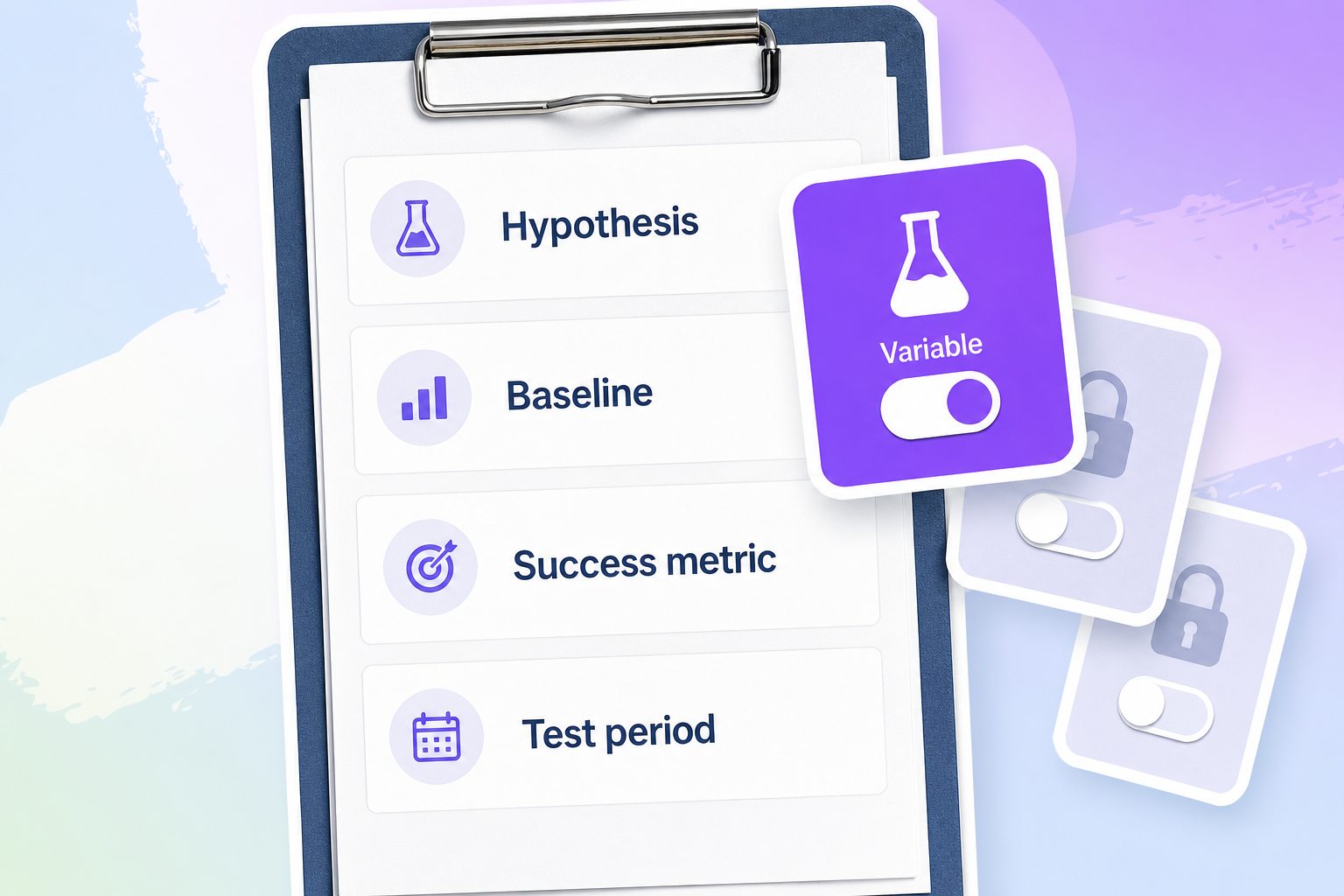
- Hypothesis: State what change should improve performance and why.
- Baseline: Record what normal performance currently looks like.
- Success metric: Choose the KPI that must improve for the test to count as promising.
- Test period: Decide how long the test will run or how many comparable publications it will include.
For example, historical analysis may show that practical carousels designed to encourage saves were associated with stronger reach than recent promotional content. That evidence provides a reason to test a return to the educational carousel structure while keeping the topic, publishing rhythm, and campaign support as consistent as possible. One strong publication is not enough to declare a recovery. Avoid drawing conclusions from one or two publications; use enough comparable content to separate a repeatable pattern from normal performance variation. Look for an improvement that appears across comparable content and can be repeated without changing several other conditions at the same time.
Look beyond the headline number
Recovery should be measured with both early signals and outcome metrics. Early signals show whether the content is gaining attention or prompting a response. Outcome metrics reveal whether that activity contributes to the original objective. Recovery does not mean that every metric has to return to its previous level. It means the content is again improving the metric connected to the objective. A higher interaction count may look encouraging, for example, but it does not automatically mean that traffic, audience growth, or conversions have improved.
Pair the signals according to the goal you are pursuing:
- For traffic, monitor early engagement alongside link clicks
- For audience growth, review reach and profile activity alongside follower growth
- For conversions, track content response and clicks alongside completed actions
- For community goals, assess participation and response quality rather than interaction volume alone
Use Fanpage Karma to compare each test with the original baseline across channels and continue monitoring the relevant metrics beyond the planned test period. This makes it easier to see whether improvement continues over time rather than mistaking a temporary lift for a stable recovery.
Make the response repeatable
A performance decline should not require a new rescue plan every time. Document the original drop, the diagnosis, the selected hypothesis, the test design, the result, and the final decision. Successful tests can inform future planning, while unsuccessful ones still show which explanation or action should not receive priority next time.
Turn that documentation into a lightweight working routine:
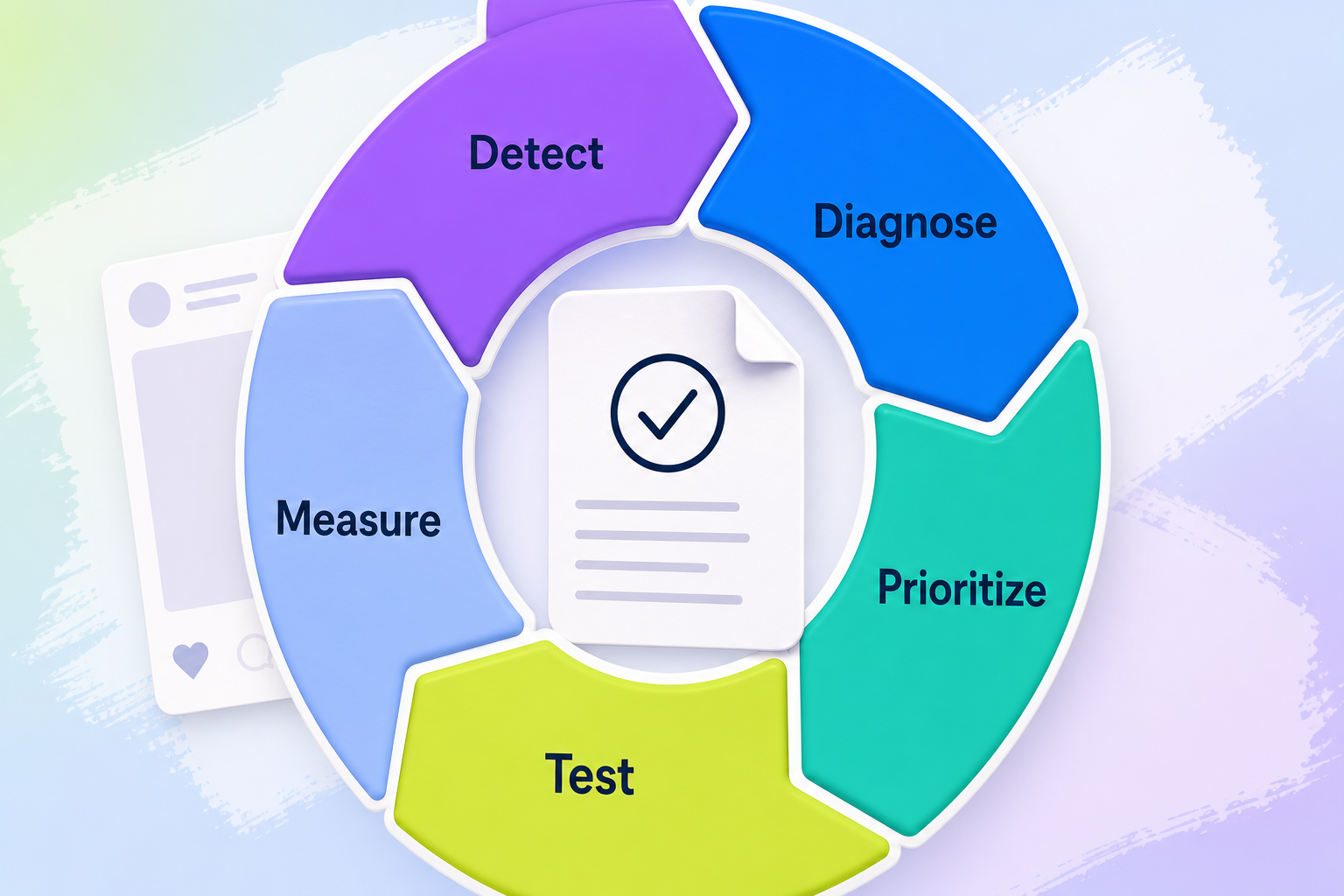
- Detect the decline using a relevant KPI and consistent comparison periods
- Diagnose the source by segmenting the data
- Prioritize explanations based on evidence, impact, and effort
- Test one major variable wherever possible
- Measure early signals and outcome metrics
- Document the result and continue monitoring
Conclusion: Replace panic with a process
A drop in content performance calls for investigation, not a hasty change in strategy. Confirm that the drop is real, pinpoint its source, prioritize the best-supported explanation, and run a well-defined test. Then, measure both the initial responses and the outcome that truly matters for the content’s objective. With Fanpage Karma, you can gather historical data, compare channels, and contrast each test with its original baseline to verify whether the improvement is sustained over time. Apply this process of detecting, diagnosing, prioritizing, testing, and analyzing your performance during your next performance review so that the team can respond with clearer evidence and incorporate each useful lesson into future planning. The goal isn’t to prevent any drop in performance. It’s to know what to do when it happens.