How to get more Followers on Facebook: 12 Best Practices to Follow
For those who are serious about their social media profiles, it wouldn’t be surprising if you wondered more than once about how to increase your followers on Facebook. After all, a strong follower base supports brand visibility, strengthens credibility, and helps turn social media activity into measurable results.
With that said, there is no special formula to increase Facebook followers. Sustainable growth requires a clear strategy, consistent execution, and content decisions based on performance data. That is why, in this article, we present 12 proven ways to increase the number of your Facebook followers.
Why Increasing your Number of Facebook Followers is Important for Success
Facebook followers can influence how your page is perceived, how your content performs organically, and how effectively you can optimize your strategy over time. Facebook followers are still a relevant metric when evaluating your Facebook profile because:
- They act as a social proof. When people see that a page already has a large number of followers, they’re more likely to trust it and consider following it themselves. A visible audience signals relevance and credibility.
- Followers are naturally more interested in your content, which makes them more likely to interact with your posts through likes, comments, and shares. This consistent engagement helps extend your organic reach and keeps your content visible in the feed.
- Facebook also provides helpful analytical insights about those following your account, which can help you further refine your content approach and make data-driven decisions.
12 Best Practices to Increase Facebook Followers
Unfortunately, there is no hack to increase Facebook followers that helps you double, triple, or quadruple your Facebook follower count overnight (outside of buying followers, which is not the best idea). Gaining more followers on Facebook isn’t about just posting more, but about making the right content, timing, and engagement decisions consistently.
The good news is that our best practices to increase followers on Facebook can help you sustainably build your following. Below, we will highlight how to increase Facebook followers with 12 best practices:
- Create Engaging and Shareable Content
- Know what Content Formats your Audience Prefers
- Benchmark Yourself against Competitors
- Post Often, Consistently, and at the Right Times
- Encourage People to Follow your Page!
- Be Active and Engage with your Audience
- Find the Right Hashtags to Use
- Use Contests and Giveaways to your Advantage
- Expand your Reach Through Collaborations
- Link to your Facebook Page
- Become a Member of Relevant Facebook Groups
- Analyze Audience Sentiment
1. Create Engaging and Shareable Content
When trying to gain more followers on Facebook, you should never ignore the importance of continually crafting engaging content that people want to consume. For this reason, when asking yourself how to increase followers on your Facebook page, you need to be aware of what topics or themes will pique your audience’s interest. Is your audience interested in humor, sports analysis, or thought-provoking content in a specific field? What interesting take do you have in your focus area?
This is where a tagging analysis becomes especially powerful. A tagging analysis involves labeling each post with attributes that are specific to your business and content decisions. This turns your content into a structured dataset, which helps you make more informed decisions about what to post.
For example, you might want to tag posts by:
- Topic (product, educational, promotional)
- Tone (emotional, humorous, neutral)
- Call to Action (shop now, learn more, join us, get inspired, stay tuned)
- Visual style (high-contrast, vibrant colors, minimalist design, retro aesthetic, action shots)
Let’s say you are creating content for a food brand. In this case, you could tag posts by cuisine, meal type, or dietary focus. Alternatively, if you are working for a fashion brand, you might tag content by product category or content angle (outfit inspiration, product close-up, sale promotion).

Below is a practical example of how this works. We have created tags for general categories that correspond to one of four categories: personal, fashion, events, and promotional. You can view two charts with the results:
- The first chart illustrates the distribution of posts by self-defined tags. In this case, most Facebook posts were tagged as Fashion (37.9%) and Personal (27.6%), followed by Event content (17.2%). Promotional and Artistic posts made up a much smaller share of the content mix. This view shows what brands publish most often, but not what performs best.
- The second chart compares the average post interaction rate for each tag. Here, a clear pattern emerges: Personal, Fashion, and Event posts generate the highest interaction rates, while Promotional content performs significantly worse. Artistic posts show minimal engagement despite being part of the overall content strategy.
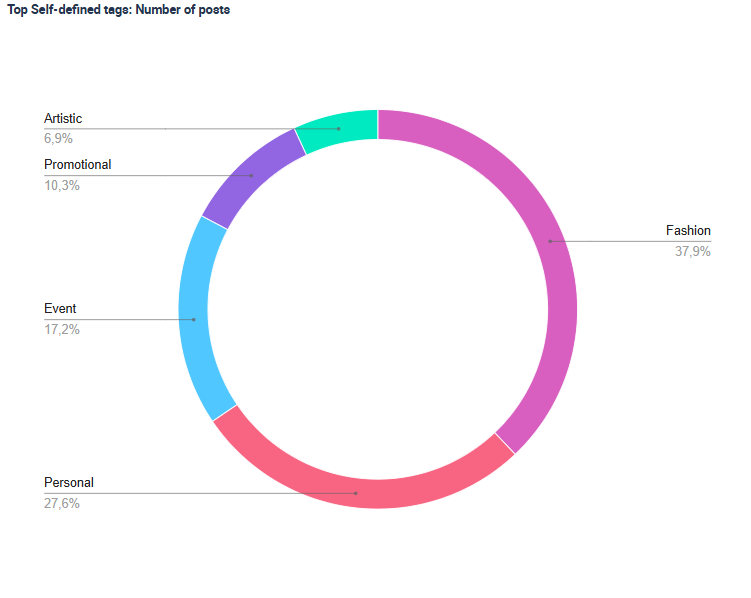
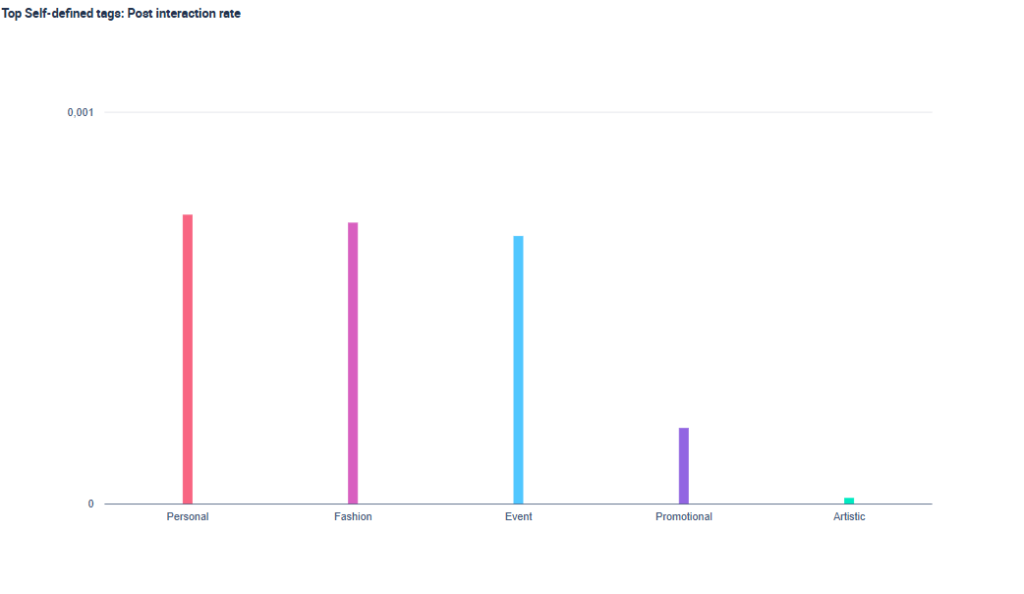
This contrast highlights the real value of a tagging analysis. It reveals which content categories are overused, which are underutilized, and which actually drive engagement. Instead of guessing what your audience prefers, tagging allows you to focus on the content decisions that consistently deliver results.
People generally are more likely to share content that they find, for example, funny or thought-provoking. When others share your content, it makes it more likely that others will see it, enjoy consuming it, and want to follow you.
2. Know what Content Formats your Audience Prefers
You should always know who your target audience is and what content they prefer. Obvious, right? However, do you know what content format typically generates the most reactions in your niche? You might not. Along these lines, one important element in understanding how to increase your Facebook page followers is related to what content formats are preferred by your audience. In other words, you need to research trends to see what content format is performing the best in your niche or industry.
For instance, with the right social media tool, you can analyze different content formats on Facebook, whether it is Stories, Pictures, Reels, etc., and see which format is correlated with better metrics, for example, post-interaction rates. If you see that Reels are getting much more traction than posts with pictures, then it makes sense that more of your posts should be in a Reels format.
For instance, the charts below illustrate how different Facebook formats perform when comparing usage frequency with post interaction rate:
- Format distribution: The first chart shows how often each format is used across the analyzed Pages. In this case, Reels and Videos (55,6%), and pictures (40,4%) dominate the publishing strategy, while Links were only used 4%.
- Post Interaction Rate: The second chart reveals how those formats actually perform. In the example below, pictures delivered the best results in terms of interaction, while Links only brought a few interactions.
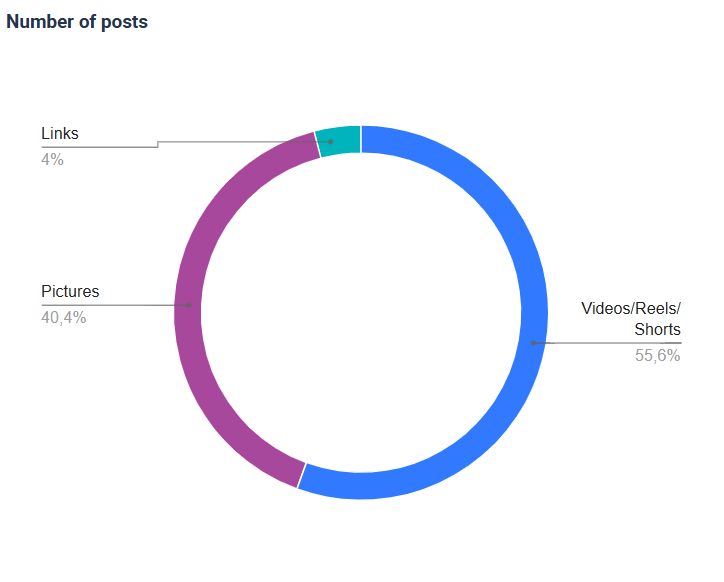
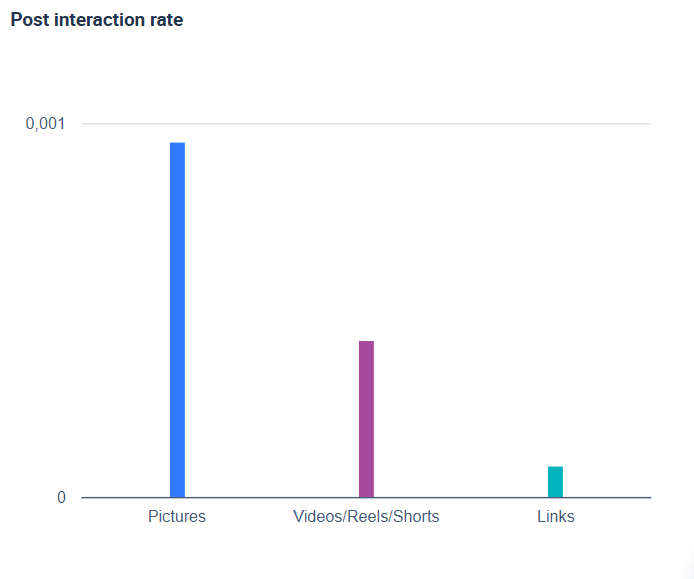
While this generic example shows us is how the posting frequency of a particular content format does not necessarily mean that it is the format you should use most often. The goal is to understand which formats your audience wants to see and to consider posting more often using that format.
This comparison allows you to spot misalignments between what you post most and what your audience responds to best. As shown in the example, Videos and Reels were the most frequently used format, but not the most successful in terms of interaction. Based on this insight, we can align our content strategy to produce more Pictures, which correlate with a higher interaction rate per post.
3. Benchmark Yourself against Competitors
In keeping with the theme of social media research, it can also pay off to benchmark yourself against your competitors to see where your profile currently sits in relation to others in your industry or niche. This is important for goal setting and understanding what is realistically achievable for your Facebook page. It can also be a great way to learn from others.
The first table provides a metrics overview at Page level, comparing several Facebook Pages across key indicators such as total followers, number of posts published, likes, comments, post interaction rate, reach per day, and Page Performance Index. This overview helps you understand how audience size, posting frequency, and engagement relate to one another.
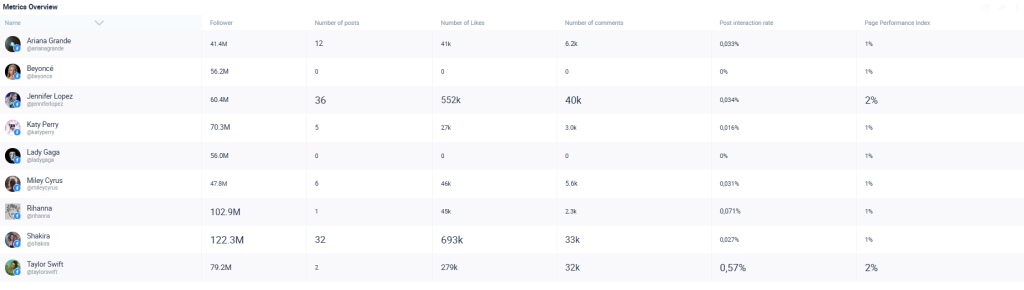
One important takeaway from this table is that follower count alone does not explain performance. Some Pages with very large audiences publish few posts and generate limited engagement, while others post more frequently but still achieve relatively low interaction rates. The post interaction rate metric is particularly useful here, as it allows you to compare engagement performance independently of Page size.
Remember, comparing only the number of followers you have with other profiles is helpful for goal setting, but not much else. However, benchmarking and studying other profiles can help you understand WHY they may have more followers on Facebook. For instance, looking at overall engagement rates for profiles and other metrics such as post per day can help you see the type of metrics that are associated with high follower counts. In analyzing other profiles, you should also look at the various metrics associated with individual posts to see what content is performing best. Using a social media tool for benchmarking and content analysis can help you understand what is performing at a high level, as well as things to improve upon.
The Top 25 Posts Overview below highlights the best-performing posts across the Pages included in your benchmarking analysis. By identifying the posts that generate the most likes, comments, and shares across benchmarked profiles, you gain concrete inspiration for what works with your target audience. Publishing content that consistently generates engagement is critical for Facebook organic growth. When posts receive strong interactions shortly after publishing, the Facebook algorithm is more likely to rank them higher in the feed and expand their reach to new users, increasing the chances of gaining new followers.
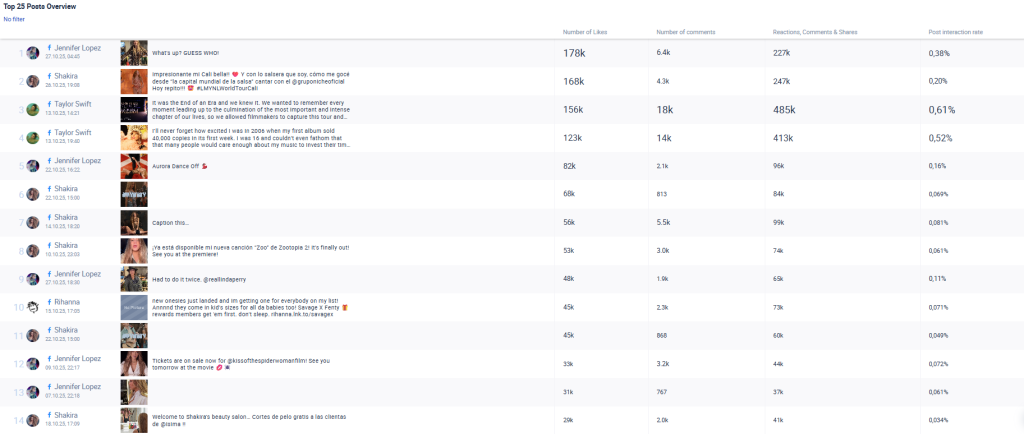
The main takeaway here is that looking at competitors or similar profiles with a high number of followers can help you spot what makes them successful. In this way, benchmarking helps you quickly sort through various metrics to see what profiles are performing well and what you might be able to learn from them.
4. Post Often, Consistently, and at the Right Times
Posting regularly and at a consistent pace is important to maintaining and growing your following. First, you always want to stay on your followers’ minds while having them look forward to your next posts. Second, the more you post, the more content of yours is out there to attract new followers.
However, consistency alone is not enough. Timing also plays a key role in how well your posts perform, especially when it comes to early engagement. Posting when your audience is most active increases the likelihood of immediate reactions, comments, and shares, which can significantly improve how the Facebook algorithm distributes your content.
Finding the right times to post on Facebook is easier than it may seem when you rely on data. With a social media analytics tool, you can analyze historical performance across your own Page and similar profiles to identify patterns that consistently correlate with higher interaction.
The charts below illustrate how posting time and frequency influence performance.
- Best times to post: The chart on the left shows when posts generated the strongest engagement across the analyzed profiles. Each dot represents a specific day and timeframe.The greener the dots, the higher the average post interaction rate. The larger the dot, the more was posted at that time.
- Posting frequency: The chart on the right illustrates the average posts per day for the analyzed profiles. In this case, the analyzed Facebook Pages posted around one post every three days. This provides a useful benchmark, showing that effective Pages balance visibility without overwhelming their audience.
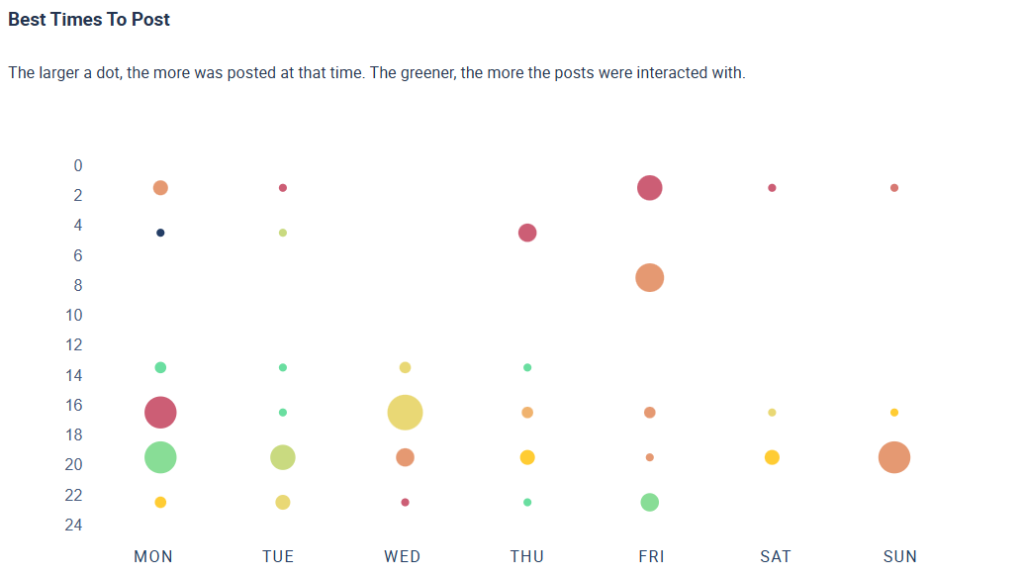
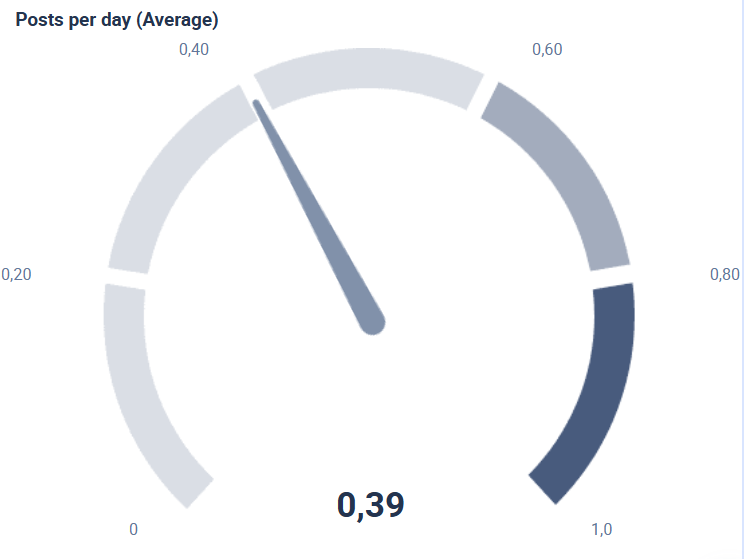
By combining these insights, you can refine both when and how often you post. Instead of posting randomly or excessively, you can schedule content for time slots that offer the best chance of strong early engagement, while maintaining a sustainable posting rhythm.
5. Encourage People to Follow your Page!
It may seem fairly obvious, but one of the keys relating to how to increase followers on your Facebook page is to actively encourage people to do just that! When you are curating your content, also be sure to ask them to follow your page. Similar to encouraging people to share your content, you should use CTAs to tell people that they should follow your page. It can also be helpful to give people a reason for following, such as the benefit of easily keeping up on all the new content on your page.
Here you have some examples that you can include in your captions or in your videos:
- “Don’t miss future updates. Follow us on Facebook.”: Best used when highlighting upcoming content or recurring formats.
- “Follow me to see more tips like this.”: Use this when sharing educational or practical content that you plan to publish regularly.
- “Follow our Facebook Page to stay up to date.”: Works well for announcements, updates, or ongoing content series.
- “Want to learn more like this? Follow our Facebook Page.”: Ideal for in-depth posts or videos where you introduce a topic and plan to expand on it.
While this doesn’t replace the need for engaging content, reminding people that they should follow you can be useful.
6. Be Active and Engage with your Audience
If you want to understand how to have more followers on Facebook, don’t forget that keeping them is almost as important as gaining them. Continuing to create engaging posts is important, but it is also crucial that you engage with your community. When you engage with your audience, it shows that you truly are interested in what they have to say and demonstrates that you care. This makes people want to stick around.

These interactions also send strong signals to the Facebook algorithm that your Page creates meaningful conversations, which can increase the visibility of your posts and support organic follower growth.
Here are some practical steps you can integrate in your community management strategy:
- Use interactive features to lower the barrier to participation
- Reply to all your comments and messages in a timely manner
- Like or react to comments to acknowledge your audience
- Ask follow-up questions to keep conversations active
As your Page grows, managing these interactions manually becomes more time-consuming. Community management tools can help you manage your conversions and be more efficient in responding to your followers. These tools allow you to organize conversations or messages you need to respond to on Facebook as well as other social media networks. Many tools also come with automation features, which can save you time and effort, which is essential once your Facebook follower count grows.
7. Find the Right Hashtags to Use
If you want to grow your Facebook followers organically, people first need to be able to discover your content. Hashtags help Facebook understand what your posts are about and decide when to surface them to users who are interested in similar topics. Used correctly, they increase visibility beyond your existing audience and support long-term follower growth.
However, using hashtags effectively is not just about adding trending hashtags to your posts. What matters is identifying which hashtags are actually linked to stronger engagement in your niche. This is where a data-based analysis for finding the best Facebook hashtags becomes essential. Here are the important steps:
- Analyze hashtag performance at scale: Use a social media analytics tool to generate a Top Hashtags overview from your own posts and similar Pages in your niche.
- Interpret the hashtag graph: The graph below shows how often hashtags are used across the analyzed Facebook posts and how they perform in terms of engagement. The larger the hashtag, the more times it was used. The greener, the higher the average interaction rates of the posts that use those hashtags.
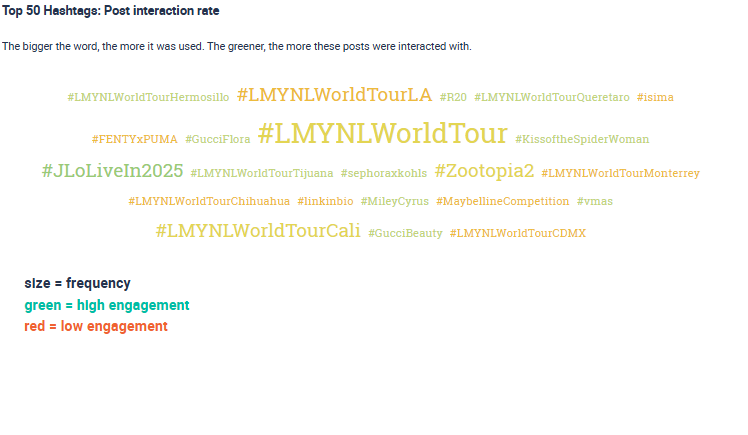
- Optimize and apply your hashtag set: Focus on hashtags that combine solid usage with strong engagement, and reduce reliance on frequently used hashtags that deliver poor interaction. Review this analysis regularly to keep improving reach and follower growth.
8. Use Contests and Giveaways to your Advantage
Many businesses uses Facebook to promote their product or services. This inevitably leads to questions about how to increase followers on Facebook business page so potential customers can always see your latest offers. Contests and giveaways can be an effective tactic to accelerate follower growth by giving people a clear reason to follow your Page.
While winning a prize or contest may be what originally brings them in contact with your page, this also gives you an opportunity to show off your brand, content and/or offers. This may be what ultimately convert these contest participants into followers. Alternatively, they may want to follow your page so they don’t miss out on the next contest or giveaway as well.
If you want to make contests contribute to organic growth rather than one-off engagement spikes, participation in a contest or giveaway should be tied to clear, strategic actions. Common examples include:
- Following your Page: This helps boost overall visibility of your content of people following you.
- Liking or commenting on a post: This helps increase early engagement, which signals to the Facebook algorithm that the content is relevant. Posts with higher initial interaction are more likely to be shown to a wider audience, including users who do not yet follow your Page. This increased visibility raises the chances of attracting new followers.
- Tagging other profiles: This expands the reach of your post beyond your existing audience. Tagged profiles may engage with or share the content, exposing it to their followers. This creates additional entry points for new users to discover your Page and decide to follow it.
These actions help increase reach, drive early engagement, and most importantly, grow your follower base in a measurable way.
9. Expand your Reach Through Collaborations
Building relationships with other Facebook pages and influencers is a great way to help increase your Facebook followers. There are many different individuals or businesses that want to gain new Facebook followers and, if the situation calls for it, why not cooperate and help each other out?
Instead of relying only on your own reach, collaborations allow you to expose your Page to new, highly relevant audiences who are already interested in similar topics. This increases the chances that people discover your Page, engage with your content, and follow you as a result.
These collaborations can take many forms. At a Page-to-Page level, cross-posting, shared content, or joint campaigns allow two brands or creators to introduce themselves to each other’s audiences. This works particularly well when both Pages serve a similar target audience. The result is a win-win situation where reach and visibility are shared organically.
The good news is that there are some easy step-by-step processes to follow and tools you can use to find the right Facebook Page or influencer:
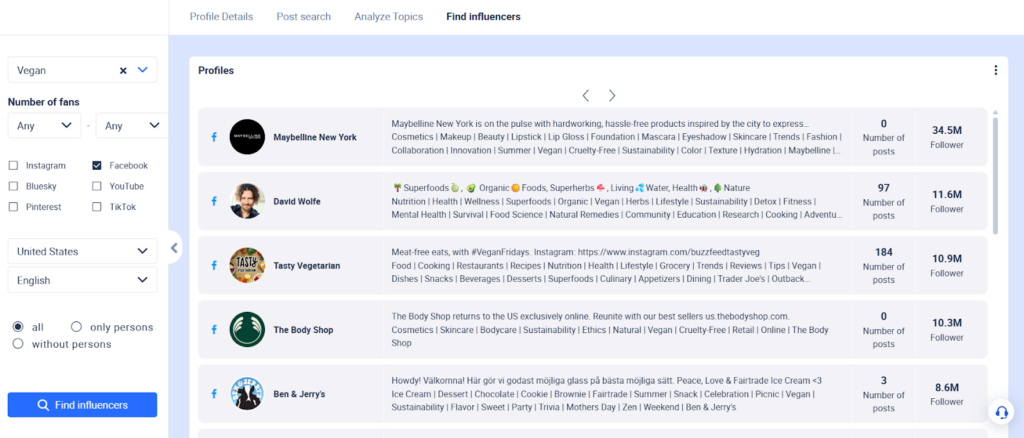
- Start by identifying Pages or influencers that share a similar target audience. With a social media research tool you can filter this by location, language, follower size, and niche. The image below illustrates an influencer discovery view filtered by the vegan niche in the US, in English. This allows you to quickly identify relevant Pages and creators within a specific topic area, compare their follower numbers and activity levels, and shortlist potential partners based on data rather than assumptions.
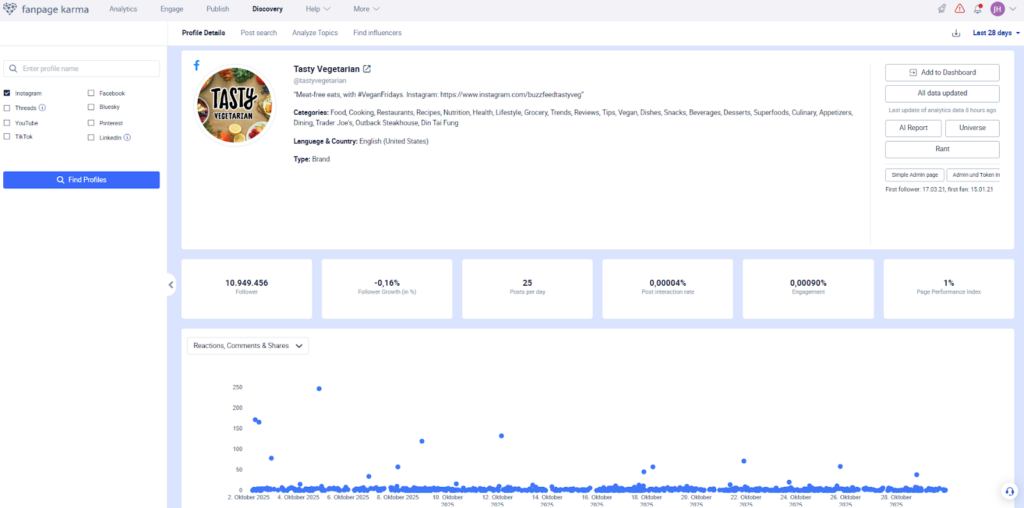
- Analyze their Page-level metrics to ensure their audience is active, not just large. You can analyze their profiles in depth, review engagement data, and even generate AI-based reports. The image below shows a profile-level overview of the Facebook Page, Tasty Vegetarian, where you can analyze a Page in detail, including follower size, posting activity, engagement metrics, and performance trends. This helps you assess whether a Page or creator has an active, healthy audience rather than just a high follower count.
- Choose which format fits the collaboration the best. Some formats include: cross-posting, joint campaigns, co-created content, or shared giveaways.
- Clearly align on goals, especially follower growth, and define how your Page will be promoted.
10. Link to your Facebook Page
One of the simplest ways related to how to increase Facebook followers for businesses is to make sure your page is easy to find across all your existing digital touchpoints. This matters because people are far more likely to follow a Page they can discover effortlessly, especially if they already interact with your brand elsewhere. The vast majority of businesses have a website as well as a host of other social media profiles on other networks. Linking your profile to other channels makes it easier for people who already follow you on those channels to find your Page, which expands your reach and makes it easier to start following you.
Make your Facebook link visible by adding it to your website’s footer, contact page, email signatures, newsletters, and bio sections on other social media platforms. The easier you make it for people to find your Facebook page, the more likely they are to follow it.
11. Become a Member of Relevant Facebook Groups
As we already pointed out above, you should know who your target audience is and what they are interested in. One of the advantages of Facebook is there are a huge number of different groups that focus on specific topics or themes. If you identify groups that are relevant for your page, why not join them?
When you actively participate in relevant Groups, your comments and contributions become visible to users who may not yet know your Page. Helpful, consistent participation can build trust and encourage users to visit your profile and follow your Page. This exposure happens in a context where people are already open to discussion, making follower growth more effective than broad posting alone.
To apply this strategy effectively, start by identifying Groups that closely match your niche and target audience. Focus on adding value, not promotion:
- Comment on discussions where you can contribute useful insights
- Answer questions related to your expertise
- Share content only when it is relevant and allowed by Group rules

12. Analyze Audience Sentiment
Sentiment analysis can help you better understand how your audience feels about your posts and your brand overall, not just how often they engage. While likes, comments, and other interactions show activity, sentiment reveals whether these reactions are positive, neutral, or negative, which is critical for long-term Facebook growth and brand perception.
By analyzing the tone of comments and messages, you can identify trends in audience perception and adjust your communication style as needed. Monitoring sentiment over time can also help you detect early signs of dissatisfaction or positive sentiment. This allows you to engage more proactively and strengthen your relationship with your followers.
The chart below shows how audience sentiment evolves over time based on comments and interactions. The horizontal axis represents the timeframe being analyzed. Values above the line indicate periods of predominantly positive sentiment, while values below the line signal negative sentiment.
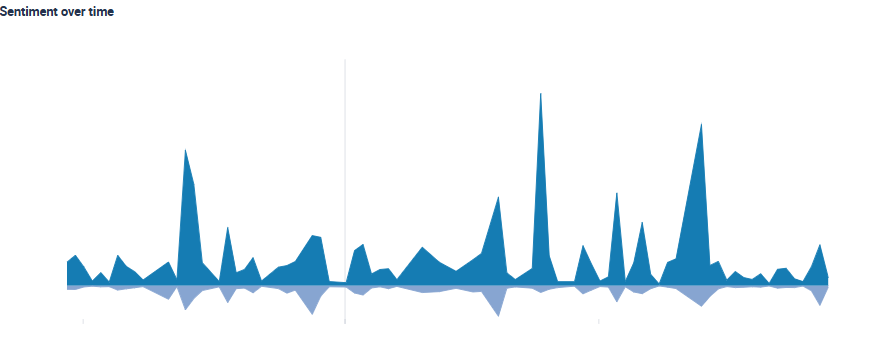
When you click on peaks above the baseline, you can see which posts generated positive sentiment and review the exact content that triggered favorable reactions. Likewise, clicking on areas below the baseline reveals posts associated with negative sentiment, helping you identify potential issues or topics that caused friction.
Conclusion: How to Increase Facebook Followers
As you have seen in our 12 best practices for how to get more Facebook followers, there is no special trick that helps you do this. Rather, it is about putting in the work and making sure you have a well-thought-out strategy which incorporates as many of the best practices listed above as possible.
Social media tools can be helpful in getting more followers on Facebook. This is because social media tools can provide you with various insights about what content format and types are driving interactions, while also helping you manage your growing community.
Fanpage Karma is an “all-in-one” social media tool that provides a free 14-day trial. Importantly, Fanpage Karma allows you to track an unlimited number of profiles, which helps you to more effectively analyze and benchmark yourself against as many Facebook pages as you want. There is also a free weekly webinar that discusses how to use the social media tool to get powerful insights, manage your social media community, research various trends, and publish your posts.