B2B Content Marketing on Social Media: How to Balance Information and Entertainment

- Information and entertainment are not rivals in B2B content marketing
- Build your B2B content marketing strategy around the action you want
- Put every B2B content idea through a simple 2 × 2 test
- Make difficult B2B topics easier to consume
- Run this B2B social media strategy check before publishing
- Which social media platform is best for B2B marketing?
- Use structural tagging to refine your B2B social media strategy
- Measure your B2B social media marketing results after publishing
- Useful B2B content should also feel worth consuming
- Bring your B2B social media workflow together with Fanpage Karma
B2B content marketing on social media requires a tricky balancing act. Brands need to signal expertise, professionalism, and seriousness so that other companies see them as credible partners. At the same time, they are publishing in feeds that people primarily use for entertainment, quick discoveries, and accessible ideas. A technically accurate post can still be ignored if it feels dry or difficult to consume. A highly entertaining post may attract attention but weaken the connection to the business problem or the brand’s expertise. That is why formulas such as 80% information and 20% entertainment cannot define the right B2B social media strategy for every audience, platform, format, and objective.
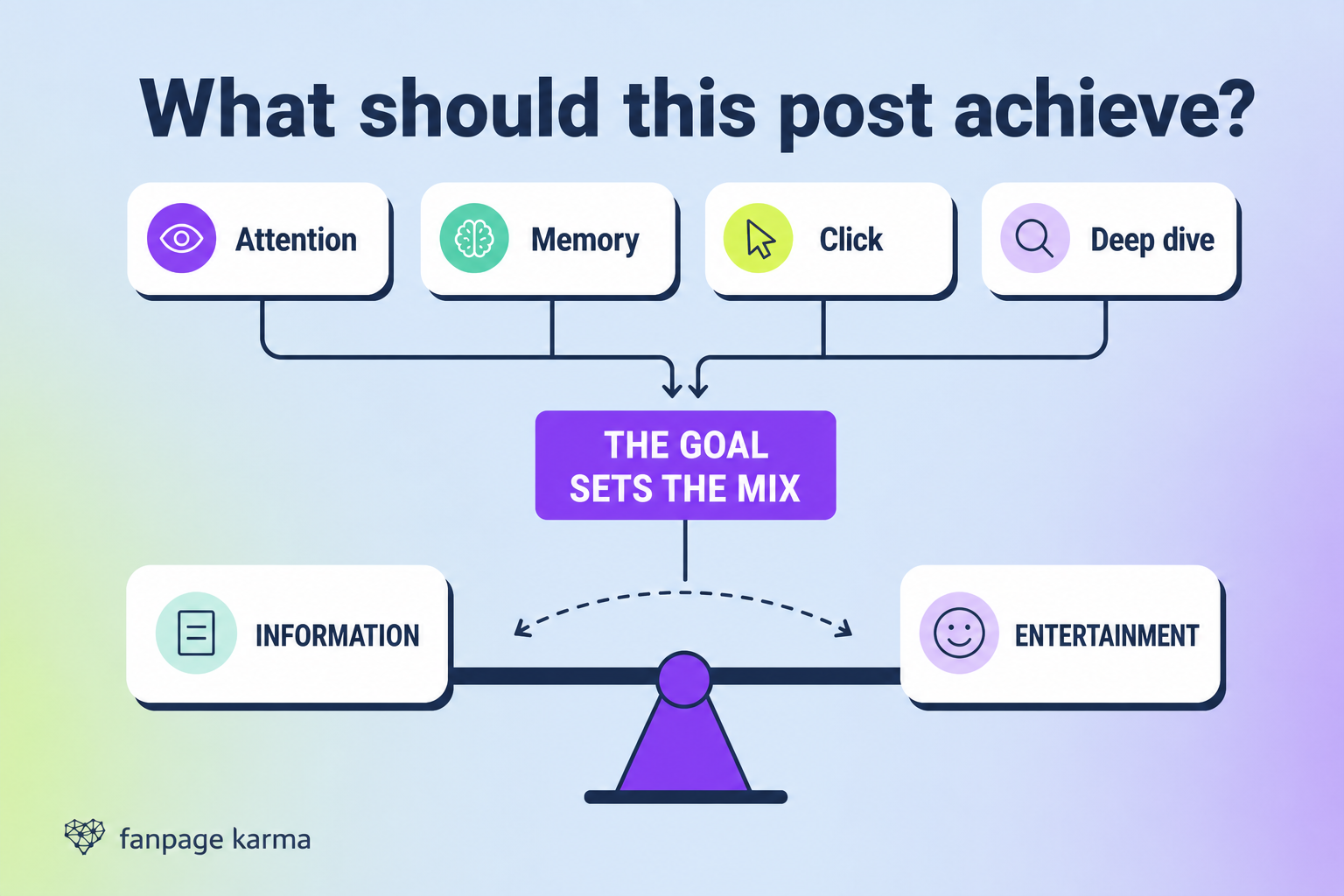
So what should guide the decision instead? In practice, B2B content marketing uses relevant content to help business audiences understand problems, evaluate options, and build trust in a brand’s expertise. This article breaks down the choices behind a useful and engaging B2B post, from the intended audience action to the metrics that reveal whether the content worked. It also offers a practical model and checklist for reviewing ideas before they reach the feed.
Information and entertainment are not rivals in B2B content marketing
Treating information and entertainment as competing ingredients creates the wrong problem. Strong B2B content can do both within the same post. It might begin with a recognizable situation or an engaging visual idea, then use that attention to explain a process, clarify a decision, or show why a business issue matters. Information provides the professional substance and gives the audience a useful takeaway. Entertainment improves the route into that substance, making the post easier to notice, process, and remember. When the two are aligned, the presentation reinforces the expertise instead of distracting from it.
In B2B content, entertainment is much broader than jokes, memes, or trend participation. It can take several useful forms:
- A short story with a recognizable conflict
- A surprising insight or contrast
- A visually clear comparison
- A frustration that feels familiar from everyday work
- An example that makes an abstract idea concrete
- A strong and relevant point of view
- Humor connected to a product or business problem
This is one reason content marketing is important for B2B: the creative execution earns the initial attention, while the professional value gives someone a reason to keep reading, save the post, share it with a colleague, or click for more detail. Without entertainment, useful information may never earn attention. Without information, that attention has little business value.

Build your B2B content marketing strategy around the action you want
Before deciding how to do B2B content marketing for a specific post, complete the following sentence: “After seeing this content, the right person should…” The answer determines what the post needs to contain and how it should present that information. A post designed for recognition should not be built or assessed like one intended to drive qualified website visits. Be specific about both the person you want to reach and the response you expect from them. That clarity helps you choose the right depth, creative approach, call to action, and primary measure of success before production begins.
Different B2B content marketing goals call for different creative and informational choices:
- For attention, use recognition, surprise, tension, or a strong visual idea.
- For memory, use a story, repetition, or a clear mental model.
- For saves, provide a process, checklist, framework, or reference.
- For clicks and lead support, connect the social post clearly to deeper value on the website.
- For evaluation, prioritize evidence, implementation details, limitations, and decision criteria.
- For trust, provide a useful explanation instead of relying on broad claims.
A B2B social media marketing plan should also account for the audience’s stage in the buying journey. Early-stage content often benefits from an accessible opening that makes a problem feel immediate. Someone comparing solutions is more likely to need depth, proof, and practical detail. Brands, therefore, need to balance entertainment and information according to what the post is meant to achieve. An attention focused post can lead with accessibility, while a post designed to support evaluation or strengthen trust must give expertise, evidence, and clarity more room.
Put every B2B content idea through a simple 2 × 2 test
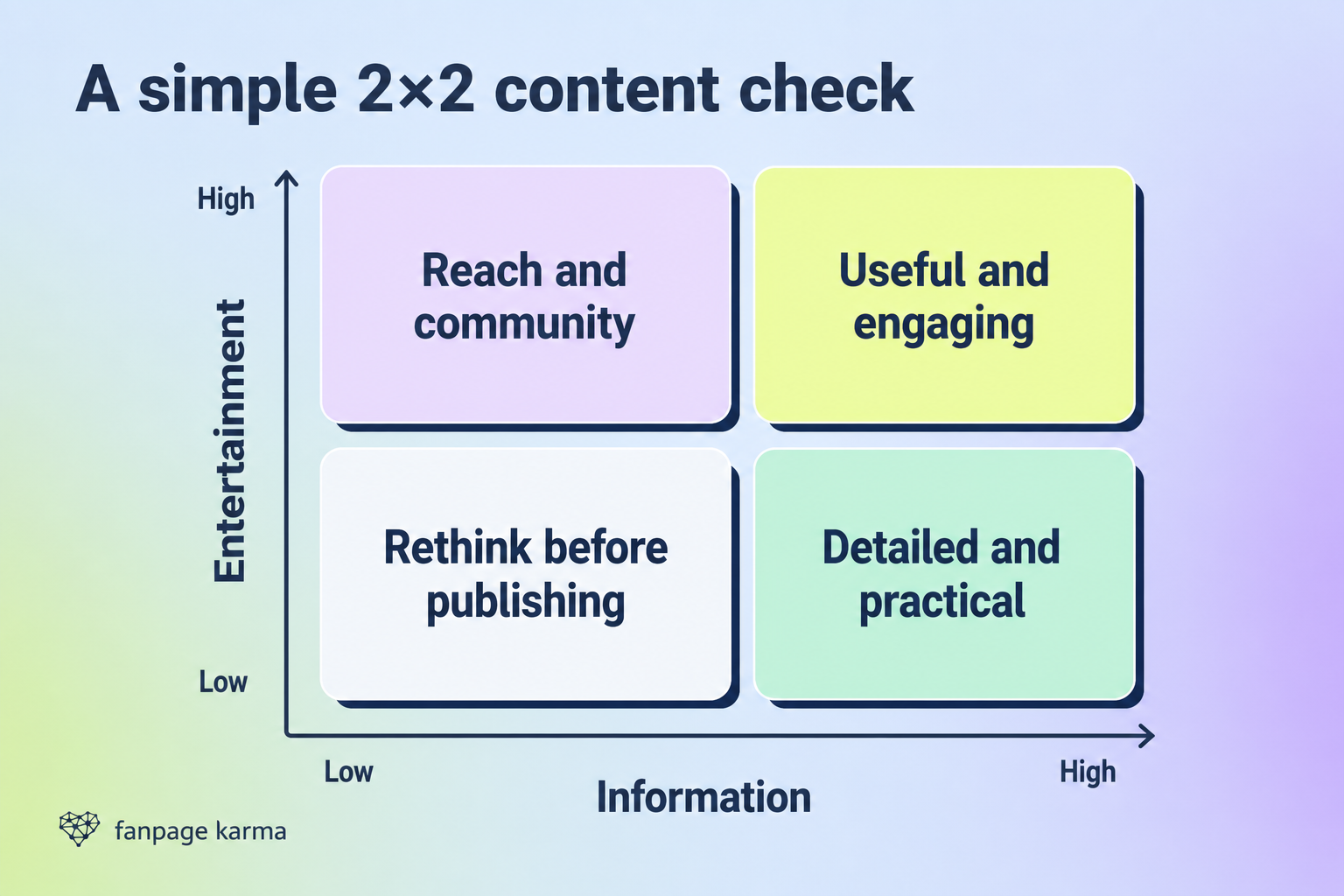
A quick way to assess an idea is to ask two questions. How much useful information does the post offer? And how accessible or engaging is the presentation? The four possible combinations reveal what the idea can realistically achieve within your B2B social media strategy.The matrix is useful because a strong B2B content marketing strategy should not judge every post by the same standard. Some content needs to attract attention, while other posts are meant to explain, build trust, support evaluation, or encourage a more concrete next step. Plotting ideas along these two dimensions helps you see whether the format and presentation actually support the intended objective, rather than simply asking whether a post feels “engaging enough.”It also makes weaknesses easier to diagnose. A valuable idea may only need a more accessible presentation, while an entertaining concept may need a stronger informational payoff before it contributes meaningfully to the wider strategy.
- High information, high entertainment: This combination has strong potential for educational organic content because it pairs a concrete insight with an inviting presentation. A reporting mistake can appear in a familiar workplace scenario, a platform update in a before and after comparison, or a confusing workflow in a visual step by step guide. The information stays central while the audience gets an easier route into it.
- High information, low entertainment: Detailed guides, documentation, implementation advice, and evaluation content belong here. They are not weak simply because they are serious. When people need to compare options or complete a task, clarity and accuracy matter more than amusement. The aim is useful content without forcing humor or trends into a topic that does not need them.
- Low information, high entertainment: This type of post can support reach, community interaction, culture, or simple recognition. It loses value when the entertaining idea has no meaningful connection to the audience’s work or the brand’s expertise. Reactions may show that people noticed it, but not that it reached relevant users or encouraged a useful next step.
- Low information, low entertainment: This combination offers neither a useful takeaway nor a compelling experience, so there is little reason to publish it. Consistency cannot rescue an underdeveloped idea. The post needs a concrete insight, a stronger presentation, or a renewed focus on the original objective before it enters the approval process.
Make difficult B2B topics easier to consume
The good news: Even complex B2B topics do not need to lose substance to become more accessible. The following three approaches can help you improve the delivery of your content while simultaneously preserving the expertise behind the content:
- Turn information into a story: Translate abstract information into a recognizable business situation with events, decisions, and consequences. Show how a problem develops, what someone needs to decide, and why the outcome matters. This structure gives the lesson context and works across industries, products, and professional roles.
- Use humor to sharpen the business point: Start with the professional context of your intended audience. Social media managers creating content for B2B brands need to understand the everyday challenges and pain points of the people they want to reach. Humor rooted in the audience’s industry and role feels more relevant, helping to create an emotional connection and make the brand easier to remember.
- Let visual clarity do real work: Use clear hierarchy, short examples, diagrams, demonstrations, comparisons, and carousels that reveal one idea at a time. These choices should reduce the effort needed to understand the topic rather than merely decorate the post.
Run this B2B social media strategy check before publishing
Before a post goes live, it helps to test whether the idea is doing what it is supposed to do. A strong B2B social media strategy is not only about producing content consistently, but about making sure each post has a clear role within the wider plan. Some posts should explain a complex topic, others should attract attention, build trust, support consideration, or encourage a concrete next step.
Whether the work is handled by an internal team or a B2B social media agency, use the following questions during planning and approval. They turn a vague debate about whether content is engaging enough into a practical review and help identify where an idea still needs work before publication:
- What should the right person do, understand, or remember after seeing the post?
- What specific information will they gain?
- What will earn their attention?
- Does the creative idea clarify the information or merely decorate it?
- Is the entertainment connected to a real audience problem and the brand’s expertise?
- Does the post include enough evidence or context for the topic and journey stage?
- Has the presentation been adapted to the platform?
- Which metric will show whether the intended action happened?
Treat the checklist as an editing tool, not only as an approval gate. If a draft is informative but difficult to consume, improve the opening, example, story, or visual structure. If it is entertaining but empty, add a concrete insight, process, warning sign, or decision criterion. The goal is to strengthen the weaker side without damaging what already works.
Which social media platform is best for B2B marketing?
No single platform stands out as “best” for every B2B marketing goal. Once you have established the key structure and gone through the checklist, you can decide whether and how to adapt the content idea to platform-specific needs. One professional insight can work across Instagram, Facebook, and TikTok, but copying the same execution everywhere could waste the strengths of each platform. Using social media for B2B marketing means keeping the core information consistent while changing the opening, pacing, visual format, caption, and call to action for each environment.
On Instagram, that may mean a strong visual opening, a saveable carousel, or a short Reel with one clear lesson. Facebook can support more context and discussion. TikTok rewards a quick point and a natural, demonstrative delivery, while specific language and TikTok SEO can also improve discoverability as more people use the platform to search for information and reviews. These signals can help relevant B2B content rank for platform searches without changing its professional core.
Use structural tagging to refine your B2B social media strategy
The same principle applies to the balance between information and entertainment. Instead of relying on a fixed rule such as 80% educational content and 20% entertaining content, use your own performance data to find the mix your audience actually responds to. A structural tagging analysis can help here: categorize past posts by content purpose, such as educational, entertaining, inspirational, promotional, or community-focused, and compare how those categories perform on each platform.
Tagging allows you to explore B2B social media data in greater depth within one platform and across platforms and content formats. By applying category tags to your posts and those of your direct market competitors, you can identify patterns in user behavior that help you understand audience preferences.
You may find that educational carousels drive saves on Instagram, while lighter, more entertaining videos generate stronger reach on TikTok and discussion-led posts work better on Facebook. You can then go one step further and analyze combinations such as educational + humorous, product focused + demonstrative, or industry insight + opinion to see where information and entertainment work best together.
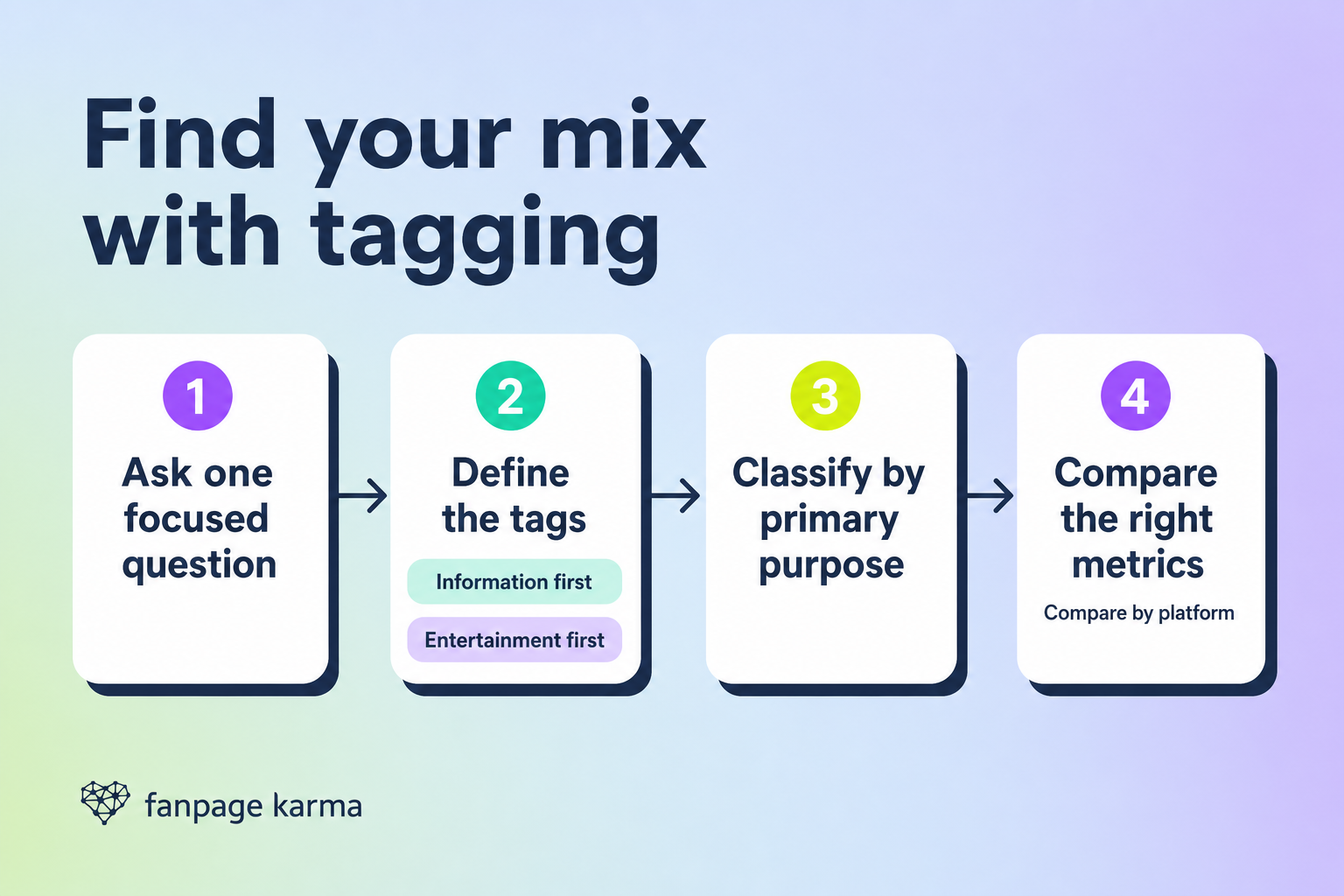
To run a useful tagging analysis, first define exactly what you want to investigate. The following six steps turn that question into a consistent comparison and a more evidence-based B2B content marketing strategy.
1. Start with a specific B2B content question
Before creating any tags, decide what you actually want to learn. Your question should be narrow enough that you can identify the relevant factors consistently, but broad enough to reveal meaningful patterns across your content. A question such as “What content performs best?” is usually too broad because differences could come from the format, topic, tone, or creative execution.
Instead, focus on one B2B content marketing decision at a time. A clear split between information and entertainment may not always be possible, but you can still ask whether an information-first or entertainment-first approach generates stronger engagement with your audience. This gives the analysis a clear direction without tying it to one industry. The goal is not to explain every performance difference, but to test whether business audiences respond better when content primarily informs or entertains. Separate analyses could later examine whether behind-the-scenes content outperforms product-focused content or whether expert-led posts perform better than process-focused posts across different B2B sectors.
2. Define exactly what your content tags mean
Next, translate your question into categories that can be applied consistently. For this B2B content marketing example, the two main tags could be:
- Information-first: The primary purpose of the post is to explain, teach, inform, or provide useful knowledge.
- Entertainment-first: The primary purpose is to entertain, amuse, surprise, or capture attention through an entertaining idea.
Across different B2B sectors, an information-first post might explain a technical process, outline decision criteria, answer a recurring customer question, or provide practical knowledge for evaluating a solution. An entertainment-first post might use a relatable workplace situation, a familiar industry frustration, a surprising scenario, or a trend-led format to earn attention. These categories can support a B2B social media marketing analysis without depending on one product type, profession, or market.
3. Use the post’s objective, not every element it contains
Real B2B social media posts rarely fit perfectly into one category. An educational video can be funny, while an entertaining Reel can still teach viewers something useful about a business topic. That does not mean you need a new tag for every combination. Instead, ask which objective appears to dominate the post.
If a video explains a technical process but uses humor to make the explanation more engaging, its main objective may still be informational. Tag it as information-first. If the same process is mainly used as the setup for a joke or entertaining scenario and the professional information plays a secondary role, entertainment-first is probably the better tag. Consistency matters most. Categorize posts according to their dominant purpose rather than trying to describe every characteristic they contain.
4. Keep your B2B content categories MECE
A useful tagging system should follow the MECE principle: mutually exclusive and collectively exhaustive.
- Mutually exclusive: Each post should belong to only one category within the same tagging dimension. If you are comparing information-first and entertainment-first content, assigning both tags to one post would make the results harder to interpret.
- Collectively exhaustive: The categories should cover all relevant posts. Ideally, every post in the dataset can be classified as either information-first or entertainment-first.
If posts repeatedly fail to fit either category, the tagging system may need adjustment. Highly promotional posts whose main purpose is to announce a service or offer could justify a separate promotion-first category. Do not add a new category because of one unusual post, however. Tags should represent recurring content patterns, not exceptions.
5. Test your definitions and tag the full dataset
Before working through hundreds of posts, apply the tags to a smaller sample. Classify 20 or 30 posts using your definitions and pay particular attention to those that are difficult to categorize. These edge cases reveal where the definitions are still too vague. This is an opportunity for you to rework your tags, narrow the scope, add or remove tags.
You might decide that practical tips, industry facts, process explanations, and company expertise all count as information-first. Humor, trends, challenges, surprising situations, and storytelling designed primarily for enjoyment might count as entertainment-first. Write these rules down before continuing. This improves consistency, especially when several people are involved in the analysis.
Once the categories are clear, apply them to the full set of posts. Do not let performance influence the classification. If a humorous post generated thousands of comments, that should not make you more likely to classify similar posts as entertainment-first. Tag the content itself first and examine performance afterward. Otherwise, you risk building the conclusion you expect into the tagging process.
6. Compare B2B social media performance by platform
After tagging, compare the categories using metrics that match your original question. A B2B marketing team could examine:
- Average post interaction rate
- Reach or views
- Comments
- Shares
- Saves
- Number of posts in each category
Do not rely on only one metric. Entertainment-first content might generate more views, while information-first posts receive fewer views but considerably more saves or shares. That distinction can be more useful than simply declaring one category the winner.
Finally, split the B2B social media analysis by platform. Across different sectors, information-first posts may perform well on Facebook when audiences engage with detailed explanations and decision support, while entertainment-first videos may generate more reach on TikTok. Instagram could sit somewhere in between, with practical information performing best when packaged in a visually engaging Reel or carousel. The purpose is not to assume that every sector will follow the same pattern, but to identify what your own audience responds to on each platform.
This is where tagging analysis becomes especially useful. Instead of applying an arbitrary rule such as “80% educational, 20% entertaining,” you can build a B2B social media content mix based on observed audience behavior that is specific to both your brand and each platform. The result might not be one universal percentage at all. Your ideal balance could be 70/30 on Facebook, 40/60 on TikTok, and close to 50/50 on Instagram. What matters is that the mix comes from patterns in your own content rather than a general rule that may have little to do with your audience.
This gives you a content mix specific to your brand rather than a generic percentage rule. The goal is not to make every platform equally educational or entertaining, but to understand which type of value your audience expects from your brand in each environment and adapt the presentation accordingly.
Measure your B2B social media marketing results after publishing
The most important test of a post’s quality and success is whether it supports its own objective. That is why the post with the highest reach is not automatically the most successful one. Organic reach and qualified traffic describe different outcomes. Likes, views, and impressions show that people encountered or reacted to content, but they do not reveal whether the right people engaged or moved to a useful next step.
This distinction is especially important in B2B social media marketing, where the relevant audience is usually smaller, more specific, and harder to reach than in B2C. Entertaining content may go viral, attract high interaction rates, or generate large numbers of views without producing a single relevant click or lead. That does not make reach or engagement irrelevant, but it means they need to be interpreted in context.
If the goal is to use B2B content marketing to support lead generation, qualified traffic, evaluation, and other signals of buyer intent matter more than reach alone. A detailed post that earns fewer reactions may still perform its job if it attracts relevant clicks, supports consideration, or helps the right audience move closer to a decision. The key is to evaluate each post against the behavior it was designed to generate.
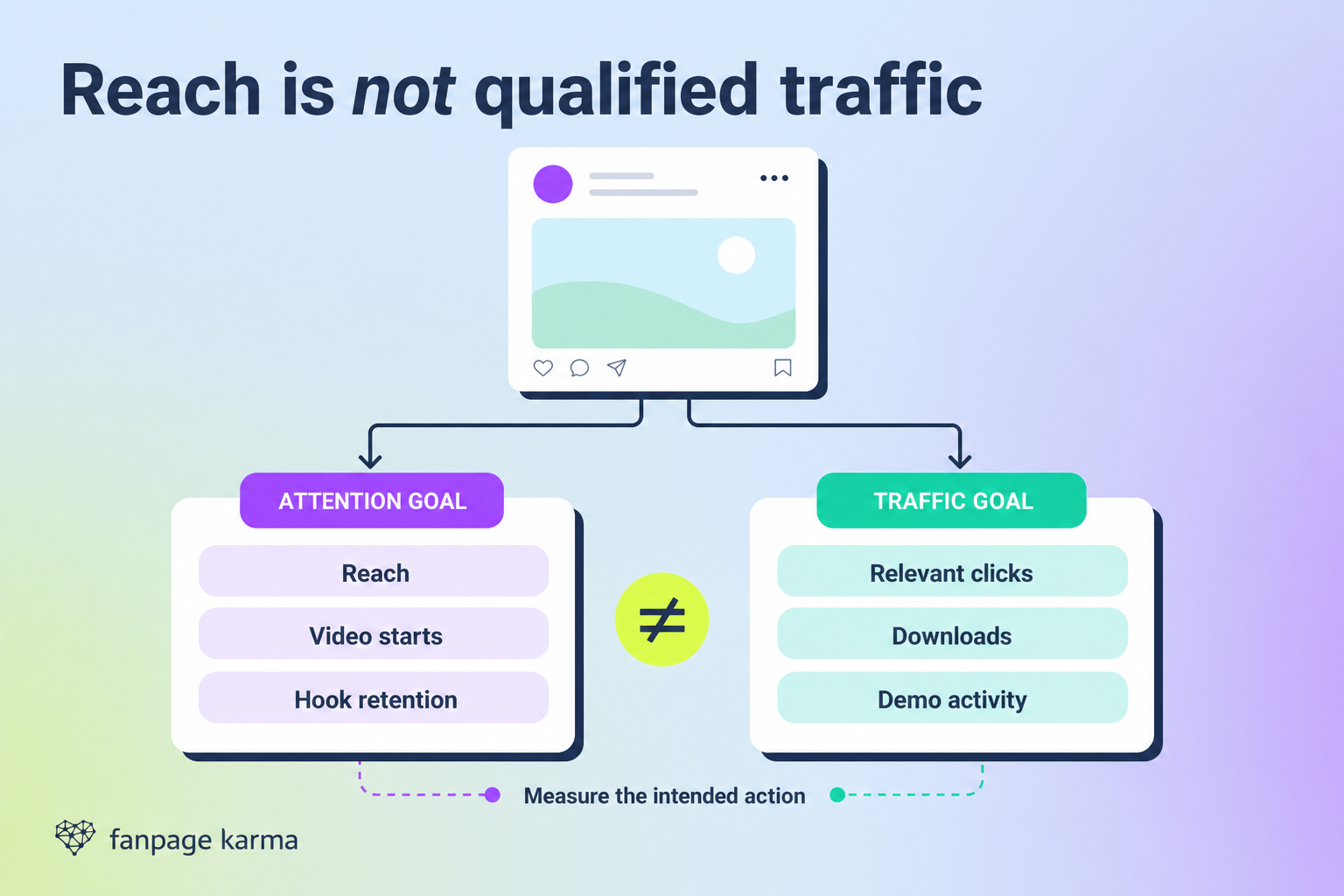
Choose metrics according to the behavior your B2B social media strategy is meant to encourage:
- Attention metrics: reach, video starts, and retention after the opening
- Content use metrics: watch time, completion rate, dwell time, and carousel progression
- Perceived value metrics: saves, relevant clicks, and downloads
- Dialogue metrics: substantial comments, replies, and employee participation
- Distribution metrics: shares, reposts, and mentions
- Business relevance metrics: qualified traffic, demo activity, and supported leads
- Brand effect metrics: recall, sentiment, and perception of expertise
An awareness post and a traffic post should therefore not share the same primary measure of success. Consistent B2B social media analytics and reporting can help teams compare content according to purpose rather than headline numbers. The useful question is not simply which post performed best. It is which post produced the response it was designed for. By paying attention to the relevant metrics, you ensure strategic fit and get closer to reaching your business objective.
Useful B2B content should also feel worth consuming
There is no universal percentage for balancing information and entertainment in organic B2B social media content. A strong B2B content marketing strategy follows the intended action, the audience’s needs, the platform, the sender, and the metric that defines success. Protect the information because it creates professional value. Improve the delivery because valuable expertise can still be ignored when it is hard to access. The objective is not to make every post funny, but to make expertise clear, relevant, memorable, and worth acting on.
Bring your B2B social media workflow together with Fanpage Karma
Fanpage Karma can support social media managers across the B2B social media marketing workflow. Use its analytics and reporting tools to evaluate posts against their objectives, then use Discovery to see which topics and posts are gaining attention, what potential collaborators are talking about, and what may become relevant. Teams can also work together across publishing and community management. If you want a guided introduction, join the free weekly webinar to explore the tool and learn how to get more from your day-to-day social media management.