How to Generate Organic Growth on Facebook
- What is Organic Facebook Growth?
- Facebook Organic Growth Strategies 2026
- 1. Optimize your Profile Page
- 2. Think about what KPIs to Track
- 3. Create Content That Sparks Interaction
- 4. Improve Discoverability with Hashtags
- 5. Boost Engagement Through Active Community Management
- 6. Find Your Best Posting Times & Stick to a Routine
- 7. Use Facebook Groups to Build Authority
- 8. Expand Your Audience with Smart Facebook Partnerships
- 30-Day Action Plan for Facebook Organic Growth
- Conclusion
Many brands sink money into ads on Facebook or even buy likes to force quick wins, only to end up with short-lived, unreliable results. But sustainable growth on Facebook comes from a strong organic strategy. It may seem slower at first, but it’s far more cost-effective, trustworthy, and powerful over time.
With the right mix of strategy, consistency, and clear priorities, organic Facebook growth is within reach. In this article, you’ll learn exactly how to build it. We are going to walk you through proven Facebook organic growth strategies for 2025 that go beyond the basics and show you how to build real visibility, trust, and high-quality organic leads without paying for ads. Along the way, we will offer a number of pro tips to help you get started building your own organic presence on Facebook.
What is Organic Facebook Growth?
The focus of organic Facebook growth is to increase your reach, engagement, and followers without paying for ads or fake engagement. The Facebook algorithm plays a central role here since it prioritizes posts that keep users active on the platform and content that gets comments, shares, reactions, clicks, and meaningful conversations. Any organic Facebook growth strategy will focus on the algorithm because, when you regularly create posts that spark this kind of engagement, the algorithm is more likely to show your content to more people.
Keep in mind that shortcuts such as buying followers or engagement require a constant investment and can even hurt performance if the algorithm detects this type of behavior. Relying only on ads is also risky since you pay every time you want visibility, and once the campaign stops, the visibility disappears. That’s why organic Facebook growth is more sustainable and offers better long-term ROI than tactics that depend purely on ad spend.
Facebook Organic Growth Strategies 2026
When building your organic Facebook marketing presence, getting started may feel a bit overwhelming since there are pages, groups, content formats, and algorithms to think about. To make this easier for you, we’ve put together proven Facebook organic reach strategies for 2026.
When building your Facebook organic marketing strategy, you should consider the following tips:
- Optimize your Profile Page
- Think about what KPIs to Track
- Create Content That Sparks Interaction
- Improve Discoverability with Hashtags
- Boost Engagement Through Active Community Management
- Find Your Best Posting Times & Stick to a Routine
- Use Facebook Groups to Build Authority
- Expand Your Audience with Smart Facebook Partnerships
1. Optimize your Profile Page
Before you think about content, you need a solid foundation for organic Facebook marketing, and that starts with your profile page. Your first objective is simple: someone landing on your Page should understand who you are, what you offer, and why they should care in just a few seconds.
That means:
- Using a clean, professional profile picture (usually your logo or a clear branded icon).
- Designing a cover image that visually reinforces what you do or highlights a key offer.
- Choosing a call-to-action button (e.g. “Sign Up”, “Learn More”, “Contact Us”) that matches your main goal.
- Linking to the most important destination for your business right now (website, product page, contact form, landing page, etc.).
Once your visuals are in place, the next step is to make your Page searchable and conversion-ready. This means that your Page name, About section, and description should include relevant keywords that describe your company and services (for example: “B2B SaaS for small teams”, “local bakery in Berlin”, or “social media analytics tool”). This helps visitors to understand what your business does and makes it easier for the right people to find you via search and “Pages you may like”.
2. Think about what KPIs to Track
Measuring organic growth on Facebook does not rely on a single number, but on a combination of KPIs such as follower growth, engagement rate, reach, and post interactions. That’s why tracking the right KPIs consistently is so important. They reveal what’s working, what isn’t, and where your biggest opportunities for improvement lie, allowing you to make decisions based on evidence rather than guesswork.
It is first necessary to familiarize yourself with important Facebook KPIs to better understand what each one is and which ones you want to track. You should then set up long-term tracking to see how these metrics develop over time. This is important to spot trends and patterns in your performance so you can better understand what is working and what is not.
The next crucial step is to run a benchmarking analysis. Benchmarking matters because your numbers only become meaningful when you compare them to something: your competitors, your industry averages, or other Pages in your niche. It shows you whether your growth is truly strong, average, or falling behind, and helps you set realistic, data-driven goals instead of guessing.
A social media analytics tool can help you track the performance of other similar profiles and competitors and also calculate averages among all the profiles in your data set. This allows you to set more accurate goals since the averages your social media tool calculates come from profiles similar to yours. Once you know the averages, you can determine what your goal should be. For instance, you may set a growth objective of maintaining a 10% increase in followers over the industry average. Here are some metrics for which you might want to set benchmark averages and to track your performance against competitors:
- Follower growth rate
- Engagement rate per post
- Average reach per post
- Click-through rate (CTR) on links
- Posting frequency per week
When you track this data consistently, benchmark against your industry, and adjust based on real performance, measuring your organic Facebook growth becomes easier to assess, so you can adapt your strategy as needed. Keep in mind that having a tool that gives you unlimited profile tracking and analysis allows you to create bigger data sets when calculating averages.
3. Create Content That Sparks Interaction
An essential part of organic growth on Facebook involves creating posts that drive engagement. Engagement such as likes, comments, shares, clicks, and saves sends important signals to the Facebook algorithm that your content is worth seeing. This means that the more people interact with your content, the more Facebook pushes it to others.
There are some practical and relatively straightforward ways to encourage interaction to help get you started:
- Asking direct questions that invite opinions or experiences
- Using polls and prompts to spark quick responses
- Sharing tips or insights that motivate users to comment or save
- Posting relatable or emotional content that encourages sharing
- Encouraging followers to react or vote on something
- Creating content that solves a problem your audience cares about
However, for Facebook experts, there is a data-based technique that goes much deeper than simply comparing emotional vs. neutral posts. A tagging analysis involves labeling each post with characteristics that are specific to your business, such as content type (image, video, link), topic (product, educational, motivational), or format, but also much more detailed attributes.
For example, a food brand could tag posts by cuisine (Italian, Mexican, Thai), by meal type (breakfast, lunch, dessert, dinner), or by dish category (starter, main course, dessert, with meat/vegetarian/vegan). A fashion brand could tag whether a post focuses on jackets, pants, shoes, accessories, or whether the content is outfit inspiration, product close-up, or sale promotion.
Once these tags are in place, you can see very clearly which specific themes actually drive higher interaction rates, maybe “vegan dinner recipes” outperform all other food posts, or “jacket looks” consistently get more saves and clicks than other categories.
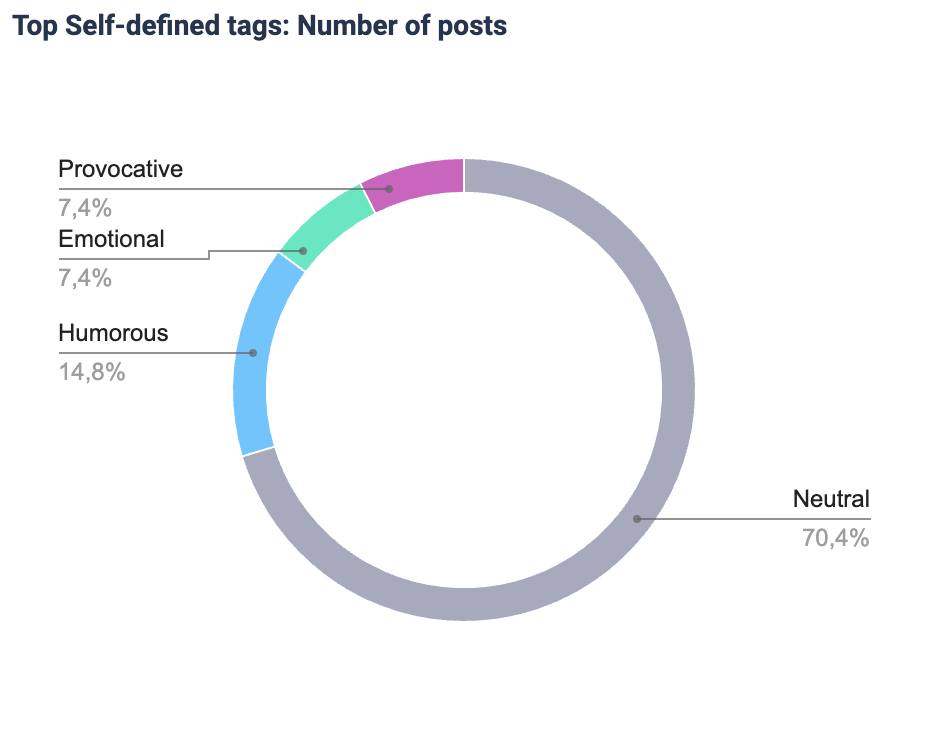
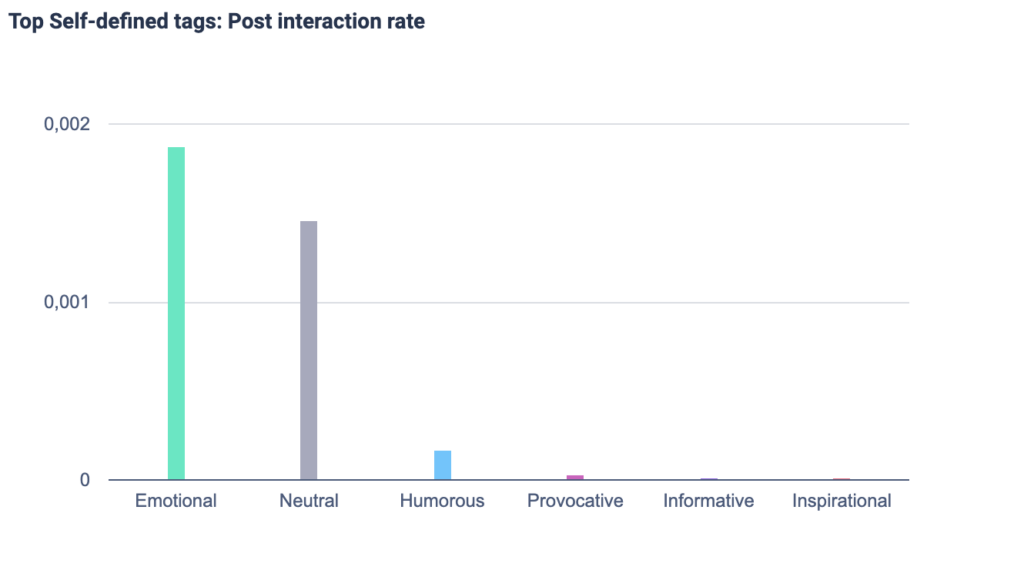
Let’s see how a tagging analysis actually works. The charts below show the results of a tagging analysis on Facebook posts from several major sports brands to understand how different tones influence engagement. Each post was assigned one tone category out of the following: emotional, humorous, informative, inspirational, neutral, or provocative. The goal was to compare how often each tone was used versus how well each tone performed.
The left chart shows the number of posts that used a specific tone. For example:
- Neutral posts made up 70.4% of all content, by far the most common tone.
- Humorous posts made up 14.8%.
- Emotional and provocative posts each made up only 7.4%.
This gives us an idea of which tone brands think works or what they default to posting most often.
The right chart shows the average interaction rate for the posts that use a specific tone. This helps us see what tones correlate to higher average post interaction rates. Here is where the insight becomes interesting:
- Emotional posts, despite being only 7.4% of all posts, generated the highest interaction rate across the entire dataset—more than double that of most other tones.
- Neutral posts, which were used most often, delivered significantly lower engagement.
- Humorous and provocative posts performed modestly, while informative and inspirational posts performed the worst.
The disconnect reveals something important. It appears that these brands believe neutral content was safest or most effective (so they posted it 70% of the time), but the data showed the opposite. Emotional content, which they rarely used, was actually their strongest driver of engagement.
The results above show the power of tagging analysis and how it can help you uncover hidden patterns and opportunities in your content. By identifying what truly engages your audience, you can create more high-performing posts instead of relying on guesswork. Tagging turns your content into a custom dataset for your business, helping you answer the concrete questions that really move the needle and every brand has its own version of these questions. All you need is a social media analytics tool that allows you to use this type of analysis.
4. Improve Discoverability with Hashtags
If you are looking for a data-driven way to spur Facebook organic growth, you first need to make sure people can actually find you. Discoverability is one of the biggest drivers of organic Facebook growth, and it starts with understanding how the algorithm categorizes and surfaces content. Facebook uses several signals to decide when and where to show your posts, which include:
- Relevance (keywords and topics in your post)
- Engagement (likes, comments, shares, clicks)
- Search behavior (what users look for and interact with)
- Content type (video, image, link, text)
- Interaction patterns (who regularly engages with you)
To help Facebook put your content in front of the right people, you need to send clear signals about your niche, and that’s where hashtags come in. We have already mentioned that you should add relevant hashtags and keywords to your Page name, About section, and posts so Facebook can easily categorize your content and match it with users who are searching for those topics. However, it is not just adding hashtags that you think are relevant, but the ones that will help expand your reach and engagement.
That is why using a data-based hashtag research technique is important for those looking to boost their discoverability. Instead of just guesswork, you can start by building a data set from your own posts as well as similar pages/competitors in your niche as long as you have a social media analytics tool that allows for that. This gives you a bigger sample size so you can see which hashtags are correlated with higher average interaction rates (likes, comments, shares, clicks,etc.).
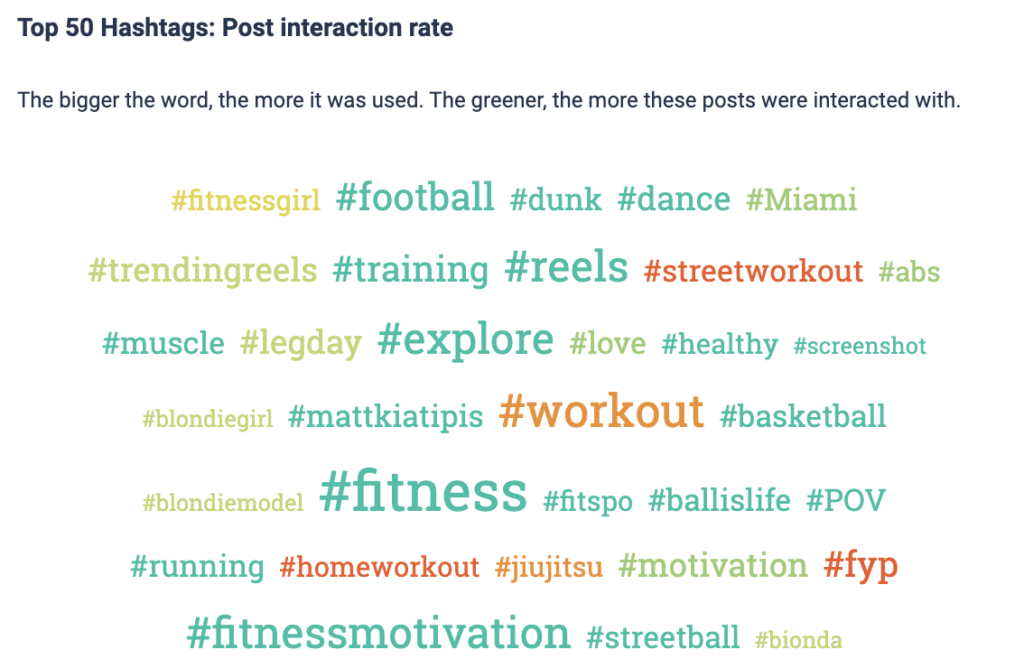
For example, if you’re a fitness coach, your keyword research should start by analyzing the keywords that are correlated with high-performing posts in terms of post interaction rates both from your own past content and other fitness accounts on Facebook. In the graphic below, you see the top 50 hashtags used in your niche. The bigger a word appears, the more often it’s used. The greener a word is, the higher the interaction on posts using that hashtag.
Instead of only using the biggest (most common) hashtags, it can be more effective to focus on medium-sized, greener hashtags since they are still popular and appear to be tied to higher post interaction rates. Examples of high-performing hashtags below would be: #fitness, #fitnessmotivation, #healthy, #training, and #muscle. These are the keywords that you would then strongly consider using in your own posts.
By combining algorithm knowledge, keyword optimization, and real performance data from your profile and others, you can build targeted keyword and hashtag sets that:
- improve your discoverability,
- increase your average interaction rate, and
- bring more of the right people straight to your Page and offers.
This technique turns hashtag selection from guesswork into a repeatable, data-driven process, and that’s a big advantage for sustainable Facebook organic growth.
5. Boost Engagement Through Active Community Management
Growing your audience is important, but continually keeping them engaged is also an important part of long-term success. Community management is one of the most essential activities to boost organic growth on Facebook because it strengthens relationships, boosts engagement, and sends strong signals to the algorithm that your Page creates meaningful interactions. Facebook prioritizes content from Pages that people regularly interact with, so the more conversations you create, the more often your posts will be shown.
Effective community management is more than just replying when someone messages you. It requires a simple and well-planned strategy. Start by deciding how often you’ll check comments and DMs, how many follower posts you’ll engage with, and which topics you regularly want to discuss with your audience. Then take consistent actions such as:
- Responding to comments and messages with thoughtful, helpful answers
- Interacting with follower posts to show you’re part of their world, not just talking at them
- Asking questions in your posts to invite conversation rather than broadcasting
- Using polls, prompts, and feedback posts to spark interaction and gather insights
- Acknowledging your most active followers to strengthen loyalty
- Participating in niche discussions to stay visible in your community
This level of activity helps you build a real community, not just a follower number. A real community is made up of people who regularly interact with your posts, respond to your questions, share feedback, and talk to each other in the comments, not just passively scroll. They recognize your brand, feel seen and understood, and come back because your content is relevant to them. However, you must also put in the time and effort to create meaningful responses to your followers and those interacting with your content. As your community grows, you may want to consider using a social media community management tool to help you organize and respond to your audience.
The stronger this community becomes, the more signals you send to Facebook that your Page creates meaningful interactions. In turn, Facebook rewards you with more reach and visibility, which leads to even more engagement and long-term organic growth.
6. Find Your Best Posting Times & Stick to a Routine
Consistency helps build your organic audience, but when it comes to finding the best time to publish an organic Facebook post, consistency isn’t the main focus. What really matters here is being strategic with your posting times and using data to find out when posts are most likely to get engagement. Early engagement is one of the strongest signals for the algorithm, so you want to post when people are actually active and ready to interact.
Finding the best times to post on Facebook involves analyzing data from the past that helps you determine when to post in the future. Similar to the hashtag research example above, the right social media analytics tool would let you analyze historical data from your own post history as well as that of other similar profiles that are targeting the same audience. This gives you a much larger data set and helps you see which days and times are consistently correlated with higher engagement rates across many posts, not just a handful. With this type of best time to post research, you are looking for patterns that show you times of the day and week when the most interactions with content occur.
A “Best Times to Post” chart like the one below illustrates this clearly. In the chart below, the larger the dot, the more often content was posted at that time. The greener the dot, the higher the average interaction rate was for that time. If you see that mid-morning on weekdays has small but very green dots, that’s a strong hint that fewer people post then, but those posts perform very well in terms of engagement. With insights like these, you can schedule your posts for time slots that give you the best chance of strong early engagement, making your organic reach more predictable and your Facebook growth more sustainable.
By regularly reviewing your results and adjusting your schedule as your audience and their behavior change, your posting becomes more strategic. In this case below, the most ideal posting times would be Thursdays between 8-10 a.m. and Saturdays between 8-10 a.m. and 12-2 p.m.

7. Use Facebook Groups to Build Authority
One of the biggest advantages of Facebook, compared to other social platforms, is its strong focus on Groups, which can make them a powerful driver of Facebook organic growth. Groups bring together highly engaged users around specific topics, industries, or problems. This means that when you show up in the right Groups, you’re placing yourself directly in front of people who are already interested in what you do, without needing ads.
To get the most out of Groups, start by choosing the right ones. Look for Groups that:
- Match your niche or industry
- Have active, recent engagement
- Attract the type of people you want to reach
- Allow value-driven posts (not just self-promotion)
Once you’re in, focus on building authority, not selling. Share helpful insights, answer questions, and provide solutions to common problems. Consistently offering value positions you as a trusted voice in your field. You can:
- Comment on questions with detailed, useful answers
- Share step-by-step tips or insights related to your niche
- Participate in ongoing discussions
- Start valuable conversations (without promoting directly)
Over time, this creates familiarity and trust. People begin to visit your Page, follow your content, and reach out on their own. This is why Groups are one of the most effective ways to grow organically and generate high-quality leads, because they connect you with the right audience in a space designed for meaningful interaction.
8. Expand Your Audience with Smart Facebook Partnerships
Collaborating with other Facebook accounts can be one of the most effective ways to expand your reach and grow your audience organically. When you partner with creators, brands, or community pages that share a similar audience, you get instant access to new people who are already interested in your niche. These organic collaborations can lead to higher visibility, more engagement, and ultimately, more followers.
A social media research tool can help you identify potential collaboration partners more quickly and effectively by showing you accounts in your niche, analyzing their engagement rates, and highlighting Pages that share similar audiences. This makes the search for meaningful partnerships much easier and far more strategic.
What to look for in a strong collaboration:
- Audience overlap: Choose accounts whose followers match your target group.
- Consistent engagement: Look for Pages with authentic, active communities, not just high follower numbers.
- Relevant content: Their topics should complement yours so the collaboration feels natural and valuable.
- Brand alignment: Make sure your values, tone, and messaging align to build trust with both audiences.
- Mutual benefit: Each partner should gain something (reach, visibility, content, or credibility).
30-Day Action Plan for Facebook Organic Growth
To make organic Facebook growth manageable and effective, you need a simple structure you can follow week by week. Instead of trying everything at once, this 30-day plan breaks the process into clear steps. Follow these weekly actions to build momentum, increase your reach, and generate consistent organic leads without relying on ads:
Week 1: Build Your Foundation
- Optimize your Facebook Page (profile picture, cover image, About section) and add relevant keywords so your niche is clear.
- Define your target audience (needs, pain points, goals).
- Identify 3–5 core content topics you want to be known for.
- Create 20–30 content ideas based on audience questions and problems, and do a quick competitor check to see what works in your niche.
Week 2: Create Content That Drives Engagement
- Set a realistic posting schedule you can stick to (e.g. 3–4 posts per week).
- Run a “best times to post” study and align your posts with your niche and content pillars.
- Focus every post on clear visuals, simple value, and a call to action (comment, share, click, save).
- Use an analytics tool to track which posts get the most reach, clicks, and engagement.
Week 3: Expand Reach Through Community & Groups
- Reply to all comments and messages in a timely, genuine way.
- Set a daily engagement routine (e.g. 10–15 minutes engaging with follower posts and relevant Pages).
- Join or stay active in relevant Facebook Groups and share helpful insights (not just promos).
- Use questions, polls, and prompts on your Page and in Groups to spark interaction and learn more about your audience.
Week 4: Optimize with Data & Plan Ahead
- Review your top-performing posts and Group activities from the month in your analytics tool.
- Identify patterns in timing, topics, formats, and style (what consistently works, what doesn’t).
- Test small changes (hook, visual, CTA, posting time) and note the impact.
- Plan your next 30 days using these insights.

Conclusion
You don’t need a big budget or paid ads to grow on Facebook. With a strong organic Facebook marketing strategy, you can build a loyal and sustainable audience through valuable content, smart posting routines, and real engagement. Facebook organic growth is all about focusing on the basics which includes knowing your audience, showing up consistently, creating content that invites interaction, and using data to refine your approach. When you follow these Facebook organic marketing strategies, you set yourself up for long-term success and steady, authentic growth, all without paid ads or buying followers and engagement.
To support your organic Facebook marketing strategy, a good social media tool can make everything easier. Fanpage Karma is a powerful all-in-one social media tool that allows for unlimited profile tracking, which can help you take your Facebook organic growth to the next level. With advanced features for analytics, community management, content planning and publishing, and research, it helps you stay consistent, make data-driven decisions, and optimize your Facebook presence step by step. You can also join one of Fanpage Karma’s free weekly webinars to learn how the tool supports your Facebook strategy, helps you understand your performance, and simplifies your daily social media workflows.