More Depth, More Impact: The Most Important Trends in Social Media Storytelling

Between fast-paced memes and algorithm-driven trends, a clear pattern is emerging on social media. Feeds are overflowing with short-form content, but very little of it is truly memorable. A quick laugh, maybe. But the fifth variation of the same trend rarely sticks with your target audience.
What lasts is content that delivers meaning, emotion, and context. That’s where strategic social media marketing makes the difference. For brands, relevance isn’t created by posting more often or cutting videos shorter. It’s built through social media storytelling that gives audiences something worth remembering.
In this article, we break down the key developments shaping storytelling on social media and show you what makes stories truly work. We will first provide an overview of the two primary methods of storytelling: micro-storytelling and long-form storytelling. Then, we will discuss the key differences between them and the core factors that go into using storytelling effectively. Finally, we will highlight some of the ways you can optimize your storytelling processes by using data analytics.
What is social media storytelling?
When we talk about social media storytelling, we’re not reinventing the wheel. Stories have always helped humans pass down knowledge, values, and emotions. What changes on social media is the format, not the principle. The reason it works is simple: your brain remembers emotions better than neutral facts because emotional context strengthens memory and recall. For marketers, that means one thing: content that doesn’t spark emotions is forgettable.
It is easy to see why knowing emotional storytelling techniques for social media is important. In fact, there are two main methods to crafting a story that sticks with your audience:
- micro-storytelling
- long-form storytelling

Micro-Storytelling Versus Long-Form: The Key Differences
To understand the difference, we’ll briefly define what characterizes each format and then explore how they serve different goals within your social media marketing strategy. Social media platforms are increasingly prioritizing longer formats. While long-form social media storytelling requires more time and resources, it allows you to demonstrate expertise and professionalism. Fast-paced content is often perceived as fleeting, whereas long-form formats signal intentional curation, creative vision, quality, and substance.
That said, short-form content remains indispensable. Micro-stories perform best when the dramaturgy is tight: a strong hook, a clear arc of suspense, and a memorable moment. Ultimately, the strongest strategy is a balanced mix:
- Use micro-storytelling to attract new audiences and increase reach
- Use long-form storytelling to strengthen brand loyalty and long-term engagement
However, before deciding which format to use, it’s important to understand that micro- and long-form storytelling differ in more than just duration. The real distinction lies in how the story is constructed, how much depth it allows, and what strategic goal it serves.
While micro-storytelling compresses content into short video sequences of 6–60 seconds, long-form content gives you room to expand context, explore emotional arcs, and deepen meaning. Platforms like TikTok show why this matters: recent data on how long TikTok videos should be illustrates that optimal length depends on your objective. Multiple studies indicate that the average length of both TikToks and Reels is increasing, and we can see average watch times rising alongside them. Shorter videos, on the other hand, continue to lead when it comes to retention and completion rates.
Here are some of the most important differences marketers need to know when trying to master social media storytelling techniques:
- Narrative Logic: How the Story is Structured
- Narrative Focus: Moment vs. Journey
- Marketing Intent: Action vs. Relationship
- Algorithm Signals: What Performance Looks Like
1. Narrative Logic: How the Story is Structured
The key differences in the logic of the narrative between micro- and long-form storytelling on social media come down to very specific aspects of how you structure your content:
- Micro-storytelling: Hook with the outcome, only give the absolute minimum amount of context required, trigger emotions immediately, and do not incorporate more than one key plot point or moment in your narrative.
- Long-form storytelling: Hook with the context or issue (build tension), slowly build up emotion, explore the full process by taking the audience on a problem-to-solution journey.
2. Narrative Focus: Moment vs. Journey
The key differences in the logic of the narrative between micro- and long-form storytelling on social media come down to very specific aspects of how you structure your content:
- Micro-storytelling: Captures a single moment. One insight, one transformation, one clear takeaway. The pacing is rapid and focused strictly on the core plot. Cuts are fast, silence is rare, and every visual reinforces that one decisive moment.
- Long-form storytelling: Takes the audience on a journey. It builds context, shows development, and creates multiple emotional touchpoints along the way. Instead of isolating one highlight, it maps the process. The editing is slower and intentional, with longer scenes, deliberate transitions, and space to build atmosphere and progression.
3. Marketing Intent: Action vs. Relationship
Knowing where your content is meant to take you should determine what format you choose:
- Micro-storytelling: Use CTAs that target transactional CTAs (e.g., “Try it yourself!”).
- Long-form storytelling: Use relationship-driven CTAs (e.g., “This is what helped me achieve my goal”).
The right CTA clarifies your communicative intent, helping your audience build an understanding of what to expect from your content.
4. Algorithm Signals: What Performance Looks Like
Each format performs differently within platform logic. Hence, defining what KPIs you want to enhance is a smart move when thinking about how to use storytelling in social media marketing:
- Micro-storytelling: achieve higher completion and replay rates
- Long-form storytelling: attain deeper engagement in the form of comments, saves, or shares.
8 Characteristics of Strong Social Media Storytelling
The great thing about using storytelling on your social media channels is that it opens up many different angles you can take to tell a story. For brands, long-form storytelling opens up clear content angles that revolve around:
- Founder journeys or the origin story
- The process behind the product
- Real problems your product or service solves
- Transformation Journeys / Customer Success Stories
- Behind the scenes
- Educational Deep Dives
- Inspiring narratives of overcoming challenges
- Value-Driven Narratives
However, a story can only unfold its full potential when the dramaturgy is right. This framework ensures that storytelling on social media is more than just content. It makes content understandable, emotionally tangible, and memorable. On this basis, we can clearly define 8 success factors of good storytelling:
- A strong hook
The first moment determines whether users stay or continue scrolling. A strong hook creates immediate interest and sets the tone for everything that follows. - A clear protagonist
A central character to follow, whether a person, brand, or community. Without someone to experience something, there is no story. Don’t cling to abstract notions; instead, give your protagonist a name and face. - A conflict or problem
Tension only arises when something is at stake. This can be a misunderstanding, an obstacle, or a realization. - Emotional anchor points
Stories work through emotions. They don’t have to be overwhelming, but they do have to be credible. - Consistency across formats
Good stories stay on track. Tone, visual language, and values must be recognizable. - A dramatic arc
Every story needs direction. A beginning that arouses curiosity, a middle that carries the story, and an ending that makes a clear point. No matter if your story spans multiple parts or needs to be told in 60 seconds, following the dramatic arc is important. - Authenticity
Over-staged content quickly loses credibility. Authenticity is more powerful than perfection. - A clear takeaway
Why are you telling this story? What should stick in the mind? A strong story ends with a statement, not just a fade-out.

How to Optimize Your Storytelling with Data-Driven Insights
You might still be wondering how to use storytelling in social media marketing in a way that feels strategic, not just creative. When you invest in long-form content that is time-intensive and costly, you need confidence in your decisions. That confidence is not only good for your peace of mind, it also strengthens your position in conversations with upper management.
So how do you justify your storytelling choices with data?
We’ll walk you through two practical social media storytelling examples that generate real insights and translate directly into strategy:
- Use tagging analysis to identify which content themes and formats actually drive engagement.
- Use discovery tools to uncover trending topics, relevant conversations, and potential influencers or collaborators in your industry.
Both approaches help you align how to use storytelling in social media with the help of audience behavior data instead of mere assumptions.
1. How to Use Tagging to Optimize Your Storytelling for Content
A tagging analysis focuses on understanding how to use storytelling in social media posts for maximum impact. This type of analysis helps you detect patterns in audience engagement across different content categories, allowing you to see how users respond to specific themes or narrative angles.
For this example, we analyzed eight Instagram accounts in the haircare industry: Garnier, Head & Shoulders, Monday Haircare, Kérastase, L’Oréal Paris, Moroccan Oil, Olaplex, and Pantene Pro-V. We tagged Reels published within the last 28 days (February 2026 data) based on what hair types were shown or talked about to assess which of these tags sparked the most attention:
- Straight hair
- Wavy hair
- Curly hair
We then ran a focused analysis to generate actionable insights for improving visual storytelling on social media. Specifically, we examined:
- The number of Reels published per tag
- The interaction rate per tagged category
The charts below show a clear pattern: straight-hair content had the highest posting frequency but generated the lowest average post interaction rates.
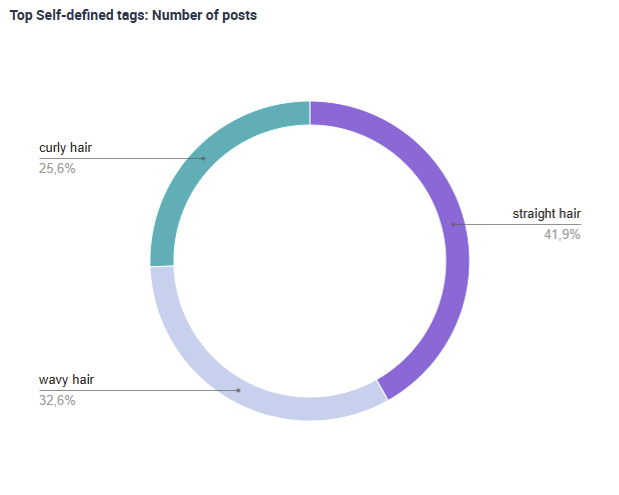
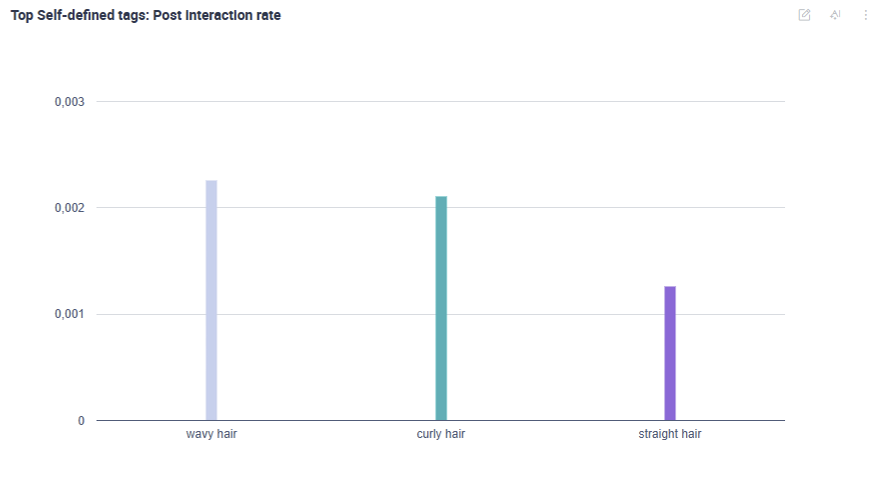
Insights like these allow you to adjust how to use storytelling in social media contexts based on actual engagement patterns. Instead of producing more of what feels safe or conventional, you can shift focus toward narratives and themes your audience truly responds to.
2. Use Discovery Tools to Find Industry Trends, Topics, and Creators
As you work toward becoming a storytelling social media expert, you should go beyond analyzing your own content and actively monitor industry trends and creators. One effective approach is industry-based trend research.
For example, you can analyze competitor data from both well-known and emerging brands within your industry or related fields. By examining what other creators and brands are posting about, and which storytelling styles they use to maximize performance, you can uncover concrete opportunities to refine your own brand storytelling on social media.
Social media discovery tools allow you to search posts or creator databases by keyword. Sticking with our earlier haircare example, you could analyze which products, themes, or conversations are currently trending.
You can refine your search by:
- Platform (e.g. Instagram, TikTok, Facebook)
- Region or country
- Language
- Account type (personal profiles vs. brand accounts)
- Follower range to match your campaign size and collaboration goals
For the example below, we used a social media research tool to show posts about the topic “curly hair.” We limited the results to content published within the last 28 days and filtered for English-language posts from the US.
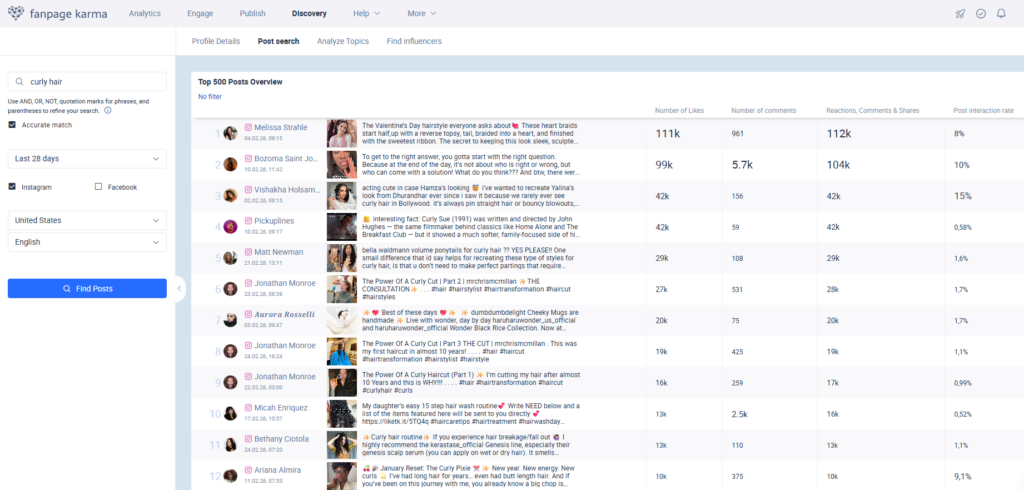
The use of discovery tools for brand storytelling on social media expands your scope beyond competitor benchmarking for content optimization purposes. It helps you understand what your target audience is actually engaging with in creator content and identify the relevant or influential voices within your niche. This also opens the door to strategic collaborations with brands or creators who align with your vision, allowing you to co-create stories with credible voices.
How to Use Social Media for Brand Storytelling
The use of storytelling is only gaining prominence in this social media climate where authentic communication is taking on increasing importance. With the need to connect to an audience and keep them engaged, many brands are increasingly turning to storytelling to help them get their message across.
If you are looking for a social media tool to improve your social media performance, then try Fanpage Karma’s free 14-day trial. Fanpage Karma offers features that help you research trends, find the best times to post, and optimize your content. As an all-in-one social media tool, Fanpage Karma offers analytic, publishing, community management, and research features.
Also remember that Fanpage Karma offers a free weekly webinar that shows you all the features of the tool and how to use it.